
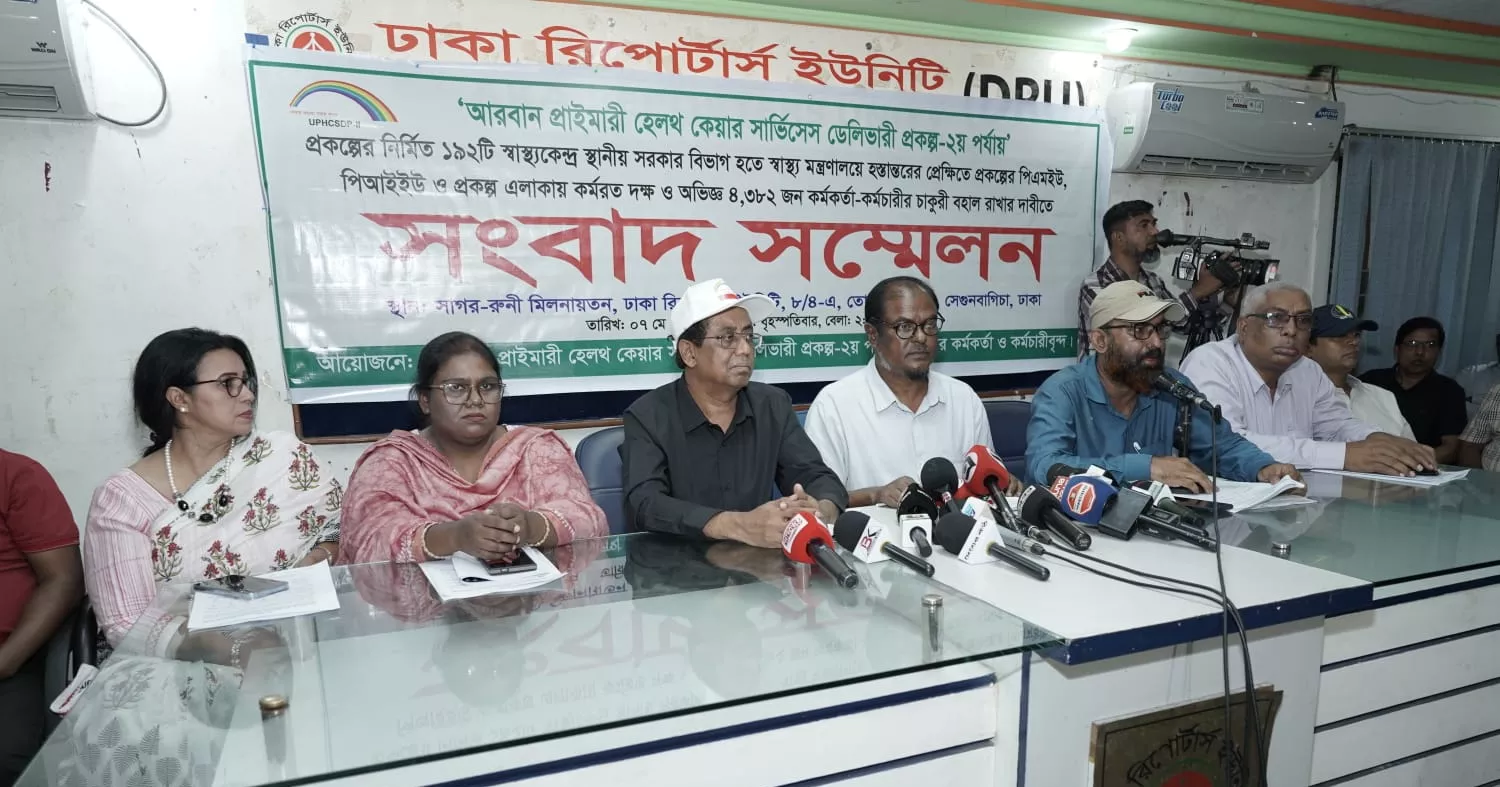
Officials and employees working under the ‘Urban Primary Health Care Services Delivery Project (2nd Phase)’ on Thursday demanded retention of jobs for 4,382 skilled workers and uninterrupted operation of 192 health centres during the ongoing transfer process from the Local Government Division of the Ministry of Health.
The demand was raised at a press conference held at the Sagar-Runi Auditorium of the Dhaka Reporters Unity (DRU) in the capital.
Speakers at the event said the project, implemented under the Local Government Division with financial support from the government and development partners including the Asian Development Bank (ADB), provided primary healthcare services in selected urban areas until June 30, 2025.
Under the project, a total of 192 facilities — including 45 urban maternity centres and 147 urban health centres — were established across 11 city corporations and 18 municipalities.
Since July 1, 2025, the centres have been directly operated by city corporations and municipalities.
At present, healthcare services are being managed through 18 non-governmental organisations (NGOs), three municipalities and one city corporation’s own health department.
According to the organisers, the project has been delivering 16 types of essential healthcare services in 45 partnership areas, primarily targeting low-income urban populations.
The services include antenatal, delivery and postnatal care, newborn and child healthcare, EPI services, family planning, control of communicable and non-communicable diseases, and support services for women facing violence.
Under existing policy guidelines, at least 30 percent of services at these centres are provided either free of cost or at subsidised rates for poor patients.
The speakers said the project has provided healthcare services to around 17 million people since March 1, 2018, including 3.46 million antenatal care services and ensuring the safe delivery of nearly 190,000 children.
They expressed concern that the ongoing transfer of the programme to the Health Ministry has created uncertainty over the future of the 4,382 experienced workforce engaged in the project.
The employees urged the authorities concerned to retain all existing staff and ensure uninterrupted primary healthcare services for urban residents during the transition period.
They also sought the Prime Minister’s intervention in this regard.