Foreign-Affairs
Bangladesh explores tech cooperation with Silicon Valley giants
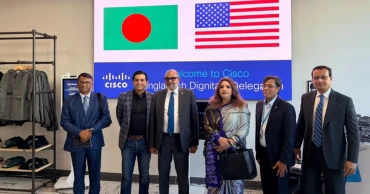
Bangladesh has held talks with leading Silicon Valley technology companies Cisco, Apple, Meta, NVIDIA and Plug and Play on artificial intelligence, digital infrastructure, cybersecurity, education, skills development, investment and startups.
A high-level Bangladesh delegation, led by Prime Minister’s Adviser on Finance and Planning Rashed Al Mahmud Titumir, held the meetings on Monday.
The delegation included State Minister for Foreign Affairs Shama Obaed Islam, State Minister for Primary and Mass Education Boby Hajjaj, Prime Minister’s Adviser on Posts, Telecommunications and Information Technology and Science and Technology Rehan Asif Asad and other senior officials.
The engagements were facilitated by the Consulate General of Bangladesh in Los Angeles as part of its efforts to connect Bangladesh’s development priorities with leading technology companies, investors and innovation networks in Silicon Valley, according to a press release.
At Cisco, talks focused on secure digital infrastructure, cybersecurity, connectivity, AI and workforce skills, while discussions at Apple covered education, software development, digital entrepreneurship and the developer ecosystem.
During the Apple Park visit, the delegation discussed Bangladesh’s growing digital economy and opportunities to engage in education, skills development, application and software development, digital entrepreneurship, and the developer ecosystem.
Meta discussions centred on AI, digital infrastructure, online safety and locally relevant content.
At NVIDIA’s headquarters in Santa Clara, discussions focused on AI for nation-scale development, workforce upskilling, research, computing infrastructure and development of an AI ecosystem in Bangladesh.
The two sides explored potential applications of AI in education, healthcare, agriculture, public services and industry, alongside opportunities to strengthen local AI skills, research capacity and talent.
3 hours ago
Outgoing Chinese envoy meets opposition leader
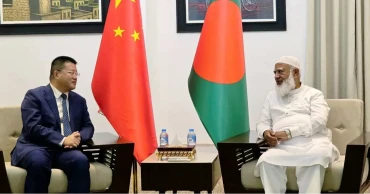
Outgoing Chinese Ambassador to Bangladesh Yao Wen paid a farewell call on Leader of the Opposition and Bangladesh Jamaat-e-Islami Ameer Dr Shafiqur Rahman at his official residence on Tuesday.
During the meeting, they discussed issues of mutual interest and bilateral relations, according to a press release.
Both sides expressed hope that the economic, political, trade, diplomatic and friendly ties between Bangladesh and China will be further strengthened in the days ahead.
They also expressed optimism that Bangladesh and China will work together to accelerate bilateral cooperation, development and progress.
At the meeting, Jamaat leaders thanked Yao Wen for what they described as his positive role in Bangladesh’s political affairs.
They particularly expressed gratitude to the outgoing Chinese envoy for his role in improving relations among different political parties, including Jamaat, and creating an environment for dialogue following the political changes after the July 2024 mass uprising.
Yao Wen’s meeting with Shafiqur came a day after he paid a farewell call on Prime Minister Tarique Rahman, during which the two sides discussed expanding trade, investment and development cooperation between Bangladesh and China, as well as issues of mutual interest and the Rohingya crisis.
Chinese Deputy Chief of Mission Dr Liu Yuyin, Cultural Counsellor Li Shaopeng, Attaché Liang Shuying and Political Affairs Attaché Wang Daowei were present at the meeting.
Jamaat Nayeb-e-Ameer ATM Azharul Islam, Secretary General Mia Golam Porwar and Assistant Secretary General Rafiqul Islam Khan, among others, were present.
6 hours ago
French envoy meets NDC's senior directing staff
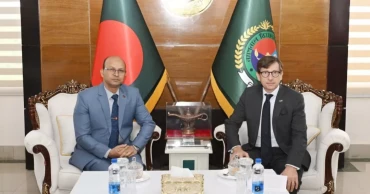
France Ambassador to Bangladesh Jean-Marc Séré-Charlet on Tuesday met the Senior Directing Staff (Army-2) of the National Defence College (NDC) and exchanged views on matters of mutual interest and issues related to the broader scope of Bangladesh-France bilateral relations.
The meeting took place during the ambassador’s visit to the NDC, where he also delivered a lecture titled “Contemporary France: Its Foreign Policy, Security and Development Strategy, and Bangladesh-France Relations” to the course members of the National Defence Course 2026.
During the lecture, the Ambassador shared insights into France’s foreign-policy priorities, security and development strategies, as well as the various dimensions of Bangladesh-France relations.
He also highlighted areas of mutual interest and opportunities for further strengthening bilateral cooperation.
The lecture was followed by an interactive session during which the course members exchanged views with the Ambassador on contemporary global and regional security issues.
7 hours ago

Maitree Express journey time may fall to 6 hours via Padma Bridge: Officials
The journey time of Maitree Express between Dhaka and Kolkata could be reduced by around three hours to six hours if the cross-border passenger train is operated through the Padma Bridge-Benapole route instead of the existing Jamuna Bridge-Darsana route, officials said.
The proposed route could also reduce the passenger fare by around Tk 1,000, making the train a more convenient alternative to air travel between the two cities, according to sources familiar with the matter.
The Maitree Express, which connects Bangladesh and India, was suspended on July 19, 2024, amid security concerns.
Despite recent political tensions between the two neighbouring countries, the number of Bangladeshi tourists entering India jumped by nearly 80 per cent compared with the corresponding period of the previous year.
According to preliminary data by the Ministry of Tourism, India, over 74,000 people from Bangladesh travelled to India in August.
On September 9, Railways Minister Shaikh Rabiul Alam informed Parliament that freight train services are currently operating between Bangladesh and India, while initiatives are being taken to resume passenger train services with the neighbouring country.
Railway Ministry Additional Secretary Ziaul Haque, after the three-day recent inter-governmental railway meeting told the reporters that no decision has been taken yet on resuming the suspended cross-border train services between Bangladesh and India.
Officials said the two sides are reviewing the possibility of restarting the train services.
The train - Maitree Express - was introduced jointly by Bangladesh and India in April 2008, on the occasion of the Bengali New Year, with the aim of restoring passenger rail connectivity between the two countries that had been disrupted in 1965.
The cross-border service has since served as an important mode of transport for passengers travelling between Bangladesh and India, particularly those travelling for tourism, trade, commerce and medical treatment.
According to Bangladesh Railway sources, a total of 288,360 passengers travelled on Maitree Express from 2022-23 until July 19, 2024. Available records show that around 95 percent of the passengers were from Bangladesh.
The train maintained an average occupancy rate of 80 to 85 percent, while the occupancy exceeded 95 percent during major holidays such as Eid and Durga Puja, reflecting strong demand for the service among Bangladeshi passengers.
Under the existing arrangement for cross-border passenger train operations, Bangladesh Railway receives 75 percent of the apportioned earnings from passenger bookings on Maitree Express, while the remaining 25 percent goes to Indian Railways.
Before its suspension, Maitree Express operated through the Tangail-Jamuna Bridge-Ishwardi-Darsana route, covering around 392 kilometres between Dhaka and Kolkata.
According to the approved timetable, the train departed Dhaka Station at 8:15am and was scheduled to reach Kolkata at 4pm, taking seven hours and 45 minutes. On the return journey, it departed Kolkata's Chitpur Terminal Station at 7:10am and was scheduled to arrive in Dhaka at 3:35pm, taking eight hours and 25 minutes.
In practice, however, the journey could take more than nine to 10 hours due to congestion on the railway network, particularly along the Dhaka-Ishwardi-Darsana section.
The opening of the Padma Bridge railway route in December 2024 has created an alternative corridor for trains travelling towards the country's southwestern region and the Benapole border.
The distance and travel time between Kamlapur and Benapole have been significantly reduced through the new route.
While trains previously required more than eight hours for the journey, Ruposhi Bangla Express now covers the route in around three hours and four minutes, according to railway sources.
Railway officials believe Maitree Express could similarly benefit if it is rerouted through Padma Bridge and Benapole instead of the Jamuna Bridge-Darsana corridor.
8 hours ago
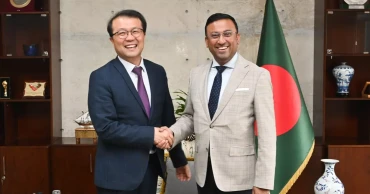
Bangladesh eyes South Korean President’s visit
Bangladesh is expecting an official visit by South Korean President Lee Jae Myung to further strengthen the growing cooperation between the two countries.
State Minister for Foreign Affairs Humaiun Kobir is scheduled to leave here for Seoul early Wednesday and will convey an invitation from Prime Minister Tarique Rahman to the South Korean President to visit Bangladesh, a senior official told UNB.
Meanwhile, Korean Ambassador to Bangladesh Kim Ji-joon called on State Minister Kobir at the Ministry of Foreign Affairs on Tuesday.
The State Minister noted that his visit would pave the way for many more engagements between Bangladesh and Korea in the days ahead.
Ambassador Kim welcomed the initiative to convey the invitation personally and described it as a very positive step towards further strengthening the bilateral relationship.
Kobir welcomed the conclusion of negotiations on the Comprehensive Economic Partnership Agreement (CEPA) and expressed the hope that the agreement would further expand bilateral trade and investment.
The State Minister said that Bangladesh attaches great importance to its longstanding and close relations with the Republic of Korea.
10 hours ago

Bangladesh engages Silicon Valley CEOs, executives on technology investment
Bangladesh has engaged leading Silicon Valley CEOs, senior executives, entrepreneurs and investors in discussions on technology investment and strategic partnerships to support the country’s economic growth.
The Consulate General of Bangladesh in Los Angeles hosted a high-level CEO/Senior Executive Roundtable titled “Technology Investment and Strategic Partnerships for Bangladesh’s Growth” at the Four Seasons Hotel Silicon Valley on Sept 27.
A senior Bangladesh delegation, along with technology CEOs, senior executives, entrepreneurs and investors, attended the roundtable.
The delegation was led by Adviser to the Prime Minister for Finance and Planning Rashed Al Mahmud Titumir and included State Minister for Foreign Affairs Shama Obaed Islam, State Minister for Primary and Mass Education Boby Hajjaj, and Adviser to the Prime Minister for Posts, Telecommunications and Information Technology and Science and Technology Rehan Asif Asad.
Kazi Muhammad Jabed Iqbal, Consul General of Bangladesh in Los Angeles, and officials from the Prime Minister’s Office also participated.
The roundtable was moderated by Shamim Mohammad, executive vice president and chief information and technology officer of CarMax.
Among the prominent participants were Amjad Masad, founder and CEO of Replit; Jay Chaudhry, founder, chairman and CEO of Zscaler; and Dr Omar Ishrak, former chairman of Intel and former chairman and CEO of Medtronic.
Senior executives, entrepreneurs and investors from the semiconductor, artificial intelligence, cybersecurity, space technology, venture capital, digital infrastructure and advanced technology sectors also took part.
The interactive discussion explored practical opportunities for investment and collaboration in artificial intelligence, cybersecurity, semiconductor design and manufacturing, digital infrastructure, education and skills development, venture capital, healthcare technology, earth observation and advanced manufacturing.
14 hours ago
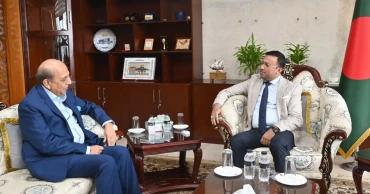
Dhaka, Delhi sound positive over PM’s visit to India; hopeful of overcoming challenges
State Minister for Foreign Affairs Humaiun Kobir on Tuesday said Bangladesh and India will overcome their existing challenges through dialogue and discussion, expressing optimism about positive outcomes in the near future and a visit by Prime Minister Tarique Rahman to India.
“Of course, there are some challenges. We are hopeful that we can overcome these challenges through dialogue and discussion. And of course, you know, at some point, with a conducive environment in place, a visit by the Prime Minister also… We had a very good discussion,” he told reporters at the Ministry of Foreign Affairs in the afternoon.
Kobir said there were some discussions on the visit during the courtesy meeting with Indian High Commissioner to Bangladesh Dinesh Trivedi in the morning. “We have a positive outlook on the future possibility.”
Asked about the timing of the visit, he said it would be decided later through mutual discussion. “So, we will do a visit when the environment is conducive, based on mutual respect,” said the State Minister, noting that they had a “very good, cordial and productive” conversation.
On speculation that November could be a possible timeframe, Kobir declined to comment. “There are many rumours, but I do not talk about rumours. I talk about reality, and the reality is that we had a very good meeting today,” he added.
Relations “Absolutely Positive”
Indian High Commissioner Dinesh Trivedi described the overall state of Bangladesh-India relations as “absolutely positive”, saying Prime Minister Tarique Rahman’s visit to India will take place at a mutually convenient time.
16 hours ago
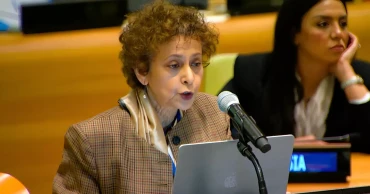
World far from fulfilling promise of ending racial discrimination: Irene Khan
Bangladesh’s Permanent Representative to the United Nations Ambassador Irene Khan has said 25 years after the adoption of the Durban Declaration and Programme of Action (DDPA), the world remains far from fulfilling its promise that no one should face discrimination based on race, colour, descent or national or ethnic origin.
Speaking at the UN high-level event on September 28 marking the 25th anniversary of the DDPA, Ambassador Khan reaffirmed Bangladesh’s commitment to its full and effective implementation.
Ambassador Khan called for stronger action to address historical and structural inequalities linked to slavery, colonialism, and other injustices through justice, education, development and international cooperation.
She also urged stronger protection for migrants, refugees, forcibly displaced persons, minorities, women, children, and people in vulnerable situations.
Highlighting emerging challenges, Ambassador Khan said new technologies must counter rather than spread hatred and incitement to violence.
She called for safe, secure, and human rights-respecting artificial intelligence with safeguards for equality and non-discrimination.
“Bangladesh remains committed to a world where the diversity and dignity of all people are upheld, offline and online,” she said.
18 hours ago
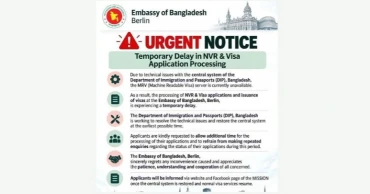
Bangladesh Missions abroad go offline due to technical issues with DIP server
The government is working to address the technical issues as soon as possible and help the Bangladesh Missions abroad deal with visa processing issues as the server is currently unavailable.
“Efforts are underway to address the technical issues as soon as possible,” a senior official told UNB on Monday night, noting that due to technical issues with the central system of the Department of Immigration and Passports (DIP), Bangladesh, the MRV (Machine Readable Visa) server is currently unavailable.
He said all the Missions abroad are facing the same problem. A visa applicant who applied from a European country told UNB that he submitted his visa application online but has been unable to proceed with the process due to the technical issue.
“Although the system indicated that I would receive an email within 24 hours of submitting the application, I have not received any email so far, while repeated calls have gone unanswered,” said the applicant.
Due to the technical issues, the processing of NVR (No Visa Required (NVR)) and visa applications and the issuance of visas at the Bangladesh Missions abroad are experiencing a temporary delay.
The Department of Immigration and Passports (DIP), Bangladesh, is working to resolve the technical issues and restore the central system at the earliest possible time.
The government has requested the applicants to allow additional time for the processing of their applications and to refrain from making repeated enquiries regarding the status of their applications during this period.
Meanwhile, the Embassy of Bangladesh, Berlin, in an urgent notice, regretted any inconvenience caused and appreciated the patience, understanding and cooperation of all concerned.
Applicants will be informed via the websites and Facebook pages of the Missions abroad once the central system is restored and normal visa services resume.
Another official said the Department of Immigration and Passports (DIP) conveyed to the Missions abroad the information regarding the technical issues last week, as it is applicable to all.
The Embassy of Bangladesh in Bangkok, in a public message on Tuesday said, informed all visa service seekers that, due to a temporary technical issue with the visa server, applicants may experience difficulties in submitting visa applications and/or receiving visa-related services.
The concerned technical team is working to resolve the issue as soon as possible, said the Embassy.
Applicants have been requested to bear with the temporary inconvenience and, where possible, avoid making urgent travel arrangements dependent on immediate visa processing until the system is fully restored.
The Embassy regretted the inconvenience caused and appreciated the patience and understanding of all concerned.
1 day ago
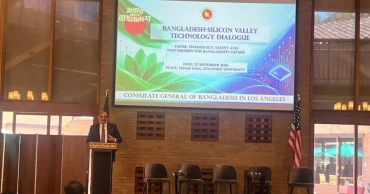
Govt to take steps to support technology-led industry, skilled employment: Dr Titumir
Prime Minister’s Finance and Planning Adviser Dr Rashed Al Mahmud Titumir has said Bangladesh would assess how fiscal policy, investment planning and public institutions can support technology-led industry and skilled employment.
Speaking at a dialogue, he urged participants to identify feasible projects, responsible counterparts and clear next steps and emphasized that cooperation should ultimately improve public services and create opportunities for the people of Bangladesh.
The Consulate General of Bangladesh in Los Angeles organized the Bangladesh-Silicon Valley Technology Dialogue on September 27 at Cedar Hall, Stanford University, under the theme “Technology, Talent and Partnerships for Bangladesh’s Future.”
A special delegation sent by Prime Minister Tarique Rahman met technology professionals, researchers, entrepreneurs and investors, including members of the Bangladeshi diaspora, said the Ministry of Foreign Affairs.
1 day ago