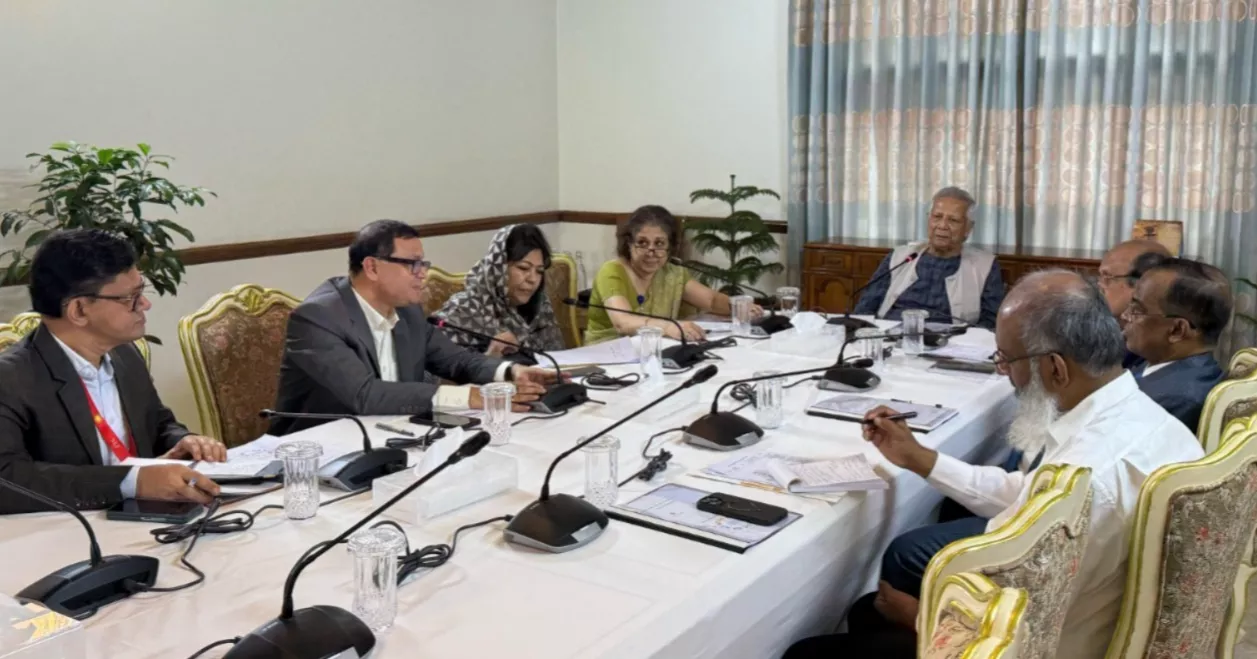
Chief Adviser Prof Muhammad Yunus on Sunday expressed displeasure over the very slow progress of the ‘Sayedabad Water Treatment Plant Construction Project Phase-3’ and the ‘Master Plan to Protect the Meghna River’ projects as the work on the two important schemes has been stalled for 10 years.
“Such an important project has been stalled for almost 10 years! It is very important for the people of Dhaka city. Day by day, we are putting the environment at great risk by extracting groundwater. Despite the fact that there is a way-out of the crisis, the work has not been done for so many years,” he said.
Dr Yunus made the remarks when he held a meeting with the officials concerned to enquire about the progress of the two projects.
Senior officials of the Local Government Division, Dhaka WASA, Physical Infrastructure Division of the Planning Commission, Economic Relations Division (ERD), Ministry of Environment, Forests and Climate Change and the Department of Environment were present in the meeting held at the State Guest House Jamuna.
The meeting was also attended by Principal Coordinator for SDGs Affairs Lamiya Morshed and Principal Secretary to the Chief Adviser M Siraz Uddin Miah.
The Chief Adviser asked the concerned departments and ministries to find out where there are obstacles in starting these two projects and discussed the issue of reducing costs.
The officials concerned said that about 70 percent of the total water supply in Dhaka city is being supplied from underground sources.
Due to the use of underground water for a long time, the water level is going down by about 2-3 meters every year; which goes against the sustainable development and poses a threat of major disasters in the future.
Dr Yunus likely to visit China, Thailand and Japan soon to deepen ties
To address this crisis, the Meghna River Protection Master Plan was initiated to purify the water supplied from the Meghna River in the 'Sayedabad Water Treatment Plant Project (Phase-3)' and build a sustainable and environmentally friendly water supply system for the residents of Dhaka city.
Germany, France, Denmark and the European Union are supporting this project. The European Union and other foreign organizations will continue their cooperation in the implementation of the project in the future, and have promised to increase assistance, if necessary, according to the CA’s press wing.
Preparations for the implementation of the master plan to protect the Meghna River began 10 years ago. Although the planning work has been completed, the implementation work has not begun yet.
The Buriganga and Shitalakshya rivers near Dhaka have become unusable due to pollution, and other rivers in Bangladesh are also in various crises.
In this situation, the Chief Adviser said protecting the Meghna River is the government's priority.
There is a lot of concern about the Meghna River, he said, adding that they have to start working quickly to save it.
Keeping the rivers of Bangladesh free from pollution should be one of the government's priorities, Dr Yunus said, adding that otherwise, the lives of the people in this area cannot be saved.
He directed the relevant ministries and departments to complete their official work very quickly and implement the projects within the current fiscal year.
Dr Yunus also discussed how the River Protection Commission can be made more active and how to increase coordination between the Department of Environment and the River Protection Commission.