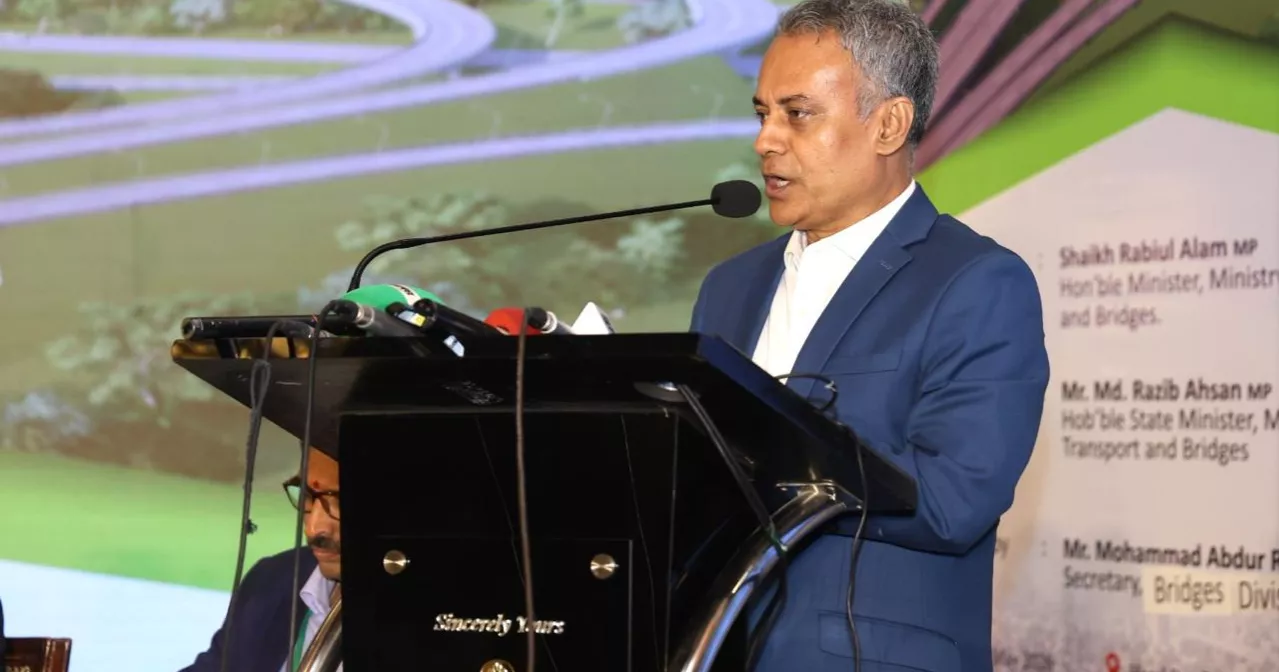
The proposed Dhaka East-West Elevated Expressway will fundamentally transform the transportation network across the capital and its surrounding districts, Road Transport and Bridges Minister Shaikh Rabiul Alam said on Tuesday.
“This 39-kilometre expressway will bypass Dhaka city and connect Hemayetpur with Narayanganj, establishing a direct corridor between the country's eastern and south-western regions. It will significantly improve traffic flow and reduce congestion in Dhaka by nearly half,” Rabiul said at a high-level stakeholder consultation workshop, held at a city hotel to advance the Dhaka East-West PPP project.
He noted that an updated feasibility study for the project has already been completed, adding that delayed implementation carries serious economic consequences.
Citing the Dhaka-Sylhet highway as a cautionary example, he pointed to significant financial losses caused by belated land acquisition. “If a project is not implemented on time, it becomes an economic burden. What we need is commitment and sound planning.”
The minister stressed the current government's intent to break from five decades of flawed infrastructure policy, saying it would not pursue large-scale mega projects indiscriminately as previous administrations had done. “We want to spend public money in a way that eliminates waste and delivers real benefits to people.”
Road Transport and Bridges State Minister Md Razib Ahsan said modern expressway infrastructure is now a pressing necessity, as traffic gridlock continues to erode fuel efficiency and economic productivity.
He said the project would be especially vital for goods transport and inter-city passenger movement. “If a realistic toll structure can be established, this project will be a landmark achievement. We want to implement it through public-private partnership in a way that becomes a true milestone.”
Razib also directed project officials to complete land acquisition within the shortest feasible timeframe and emphasised the need to move away from the perception that large projects inevitably breed large-scale corruption. “Previous projects were mired in controversy from inception. We must change public perception. We want to move this sector forward, inclusively and without dispute.”
Project Details
The expressway: stretching 38.98 kilometres from N5 to N1, will run from Hemayetpur on the Dhaka-Aricha Highway through Atibazar, Abdullahpur, Jolpori Bazar and Narayanganj, ending at Langalbandh on the Chittagong Highway.
It will feature five major interchanges at N5, Atibazar Road, N8, R111 and N10, and will cross two major rivers, the Buriganga and Shitalakshya. The corridor will also connect with the Padma Bridge Rail Link and the Dhaka-Narayanganj railway line, spanning five upazilas across two districts.
Once operational, the expressway will allow vehicles from Chittagong, Sylhet and other eastern districts, as well as from Khulna and Barishal in the south-west, to bypass Dhaka entirely and travel directly to 20 north-western districts. It will also link into the Asian Highway network.
The total project cost has been estimated at Tk 36,000 crore (approximately USD 2.88 billion), comprising Tk 22,000 crore for construction and Tk 14,000 crore for land acquisition and resettlement, excluding contingency and ancillary costs.
Traffic and Financial Projections
According to a 2025 traffic survey, daily vehicle volume is projected at 21,000–25,000 upon the expressway's expected opening in 2030, rising to over 50,000 by 2050. Average vehicle speed is forecast to jump from the current 20–30 km/h to approximately 90 km/h.
A Social Cost-Benefit Analysis (SCBA) put the project's Economic Internal Rate of Return (EIRR) at 16.42 percent. Under the base-case financial model, factoring in a base toll of BDT 9.20 per kilometre and a 30 percent Viability Gap Funding (VGF) support — the Financial Internal Rate of Return (FIRR) stands at 7.66 percent.
Analysts noted that with appropriate VGF support and a realistic toll framework, the project can be made financially sustainable and investment-worthy.
The Cabinet Committee on Economic Affairs (CCEA) approved the project's implementation on a PPP basis on December 8, 2021. Infrastructure Investment Facilitation Company (IIFC) was appointed as transaction adviser on December 24, 2024, to update the feasibility study and cost estimates at current market rates.
Tuesday's workshop primarily reviewed the updated feasibility report prepared by IIFC and gathered feedback from relevant government agencies, development partners and sector experts. Senior officials of the Bridges Division, Bangladesh Bridge Authority and a panel of independent experts were also present.