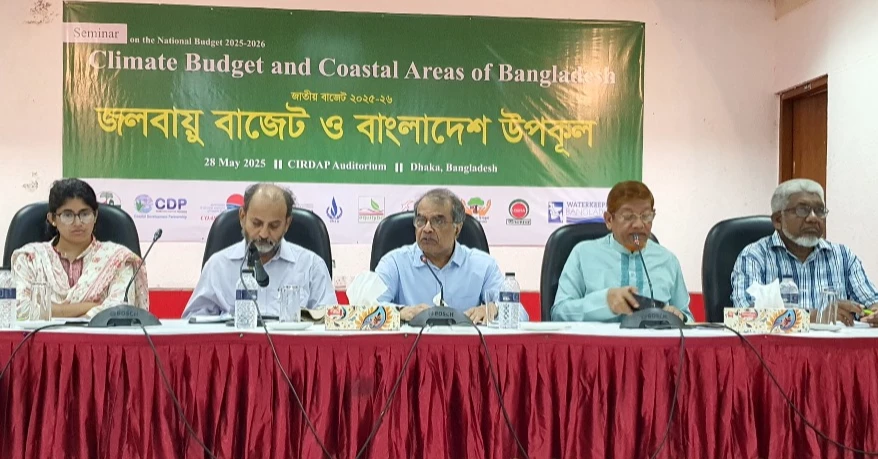
Speakers at a seminar on Wednesday opined that Climate budget allocations in Bangladesh remain neither adequate nor well-planned, and the coastal regions continue to face growing risks due to the lack of protection infrastructure.
They also said that despite an increase in climate-induced losses and damages, budgetary allocations have not risen, and the demands of coastal communities have long been neglected.
The seminar titled “National Budget 2025-26: Climate Budget and Coastal Bangladesh”, held at the CIRDAP Auditorium in the city on Wednesday.
Glaciers to Ocean: New project links Himalayas to Bay of Bengal in climate fight
The event was organised by EquityBD, a network of civil society organizations, in association with COAST Foundation, CPRD, CDP, Waterkeepers Bangladesh, Sundarban Protection Movement, BCJF, Udayan, DUS and SDI.
Chaired by disaster management expert Gawher Nayeem Wahra,the seminar was moderated by Executive Director of COAST Foundation Rezaul Karim Chowdhury. The keynote was presented by M. A. Hasan of COAST Foundation.
Among others, Assistant Secretary General of Bangladesh Jamaat-e-Islami A.H.M. Hamidur Rahman Azad, spokesperson of Anti-Discrimination Movement Umama Fatema, Joint Convener of National Citizen Party (NCP) Javed Rasin and Executive Director of Unnayan Dhara Trust Aminur Rasul Babul were also took part in the discussion.
In his speech, Gawher Nayeem stated that the Bangladesh Delta Plan cannot be implemented without resolving transboundary river issues.
He asked for greater involvement of local communities in embankment management and also highlighted that 45% of the population of Bangladesh is children, yet they remain unaware of national budget processes.
He urged a search for effective alternatives to protect the Sundarbans and emphasised the importance of transparent water governance, safe migration policies, and institutional accountability.
In his remarks, Rezaul Karim emphasised that climate budget allocation should be at least 3% of the national GDP.
He mentioned that we should focus on constructing concrete or stone embankments and advocate for the establishment of climate-resilient water purification plants.
He also stressed the need for integrated research to guide climate adaptation.
Hamidur Rahman pointed out that despite the implementation of several mega projects over the years, coastal communities have been largely sidelined.
He called for stronger connectivity between hard-to-reach areas and the mainland, as well as skill development programs for displaced coastal populations. He also urged for budget formulation based on local available resources and highlighted the importance of institutional capacity building for organizations/departments involved in natural resource management.
Umama Fatema, spokesperson, Anti-Discrimination Student Movement criticised the previous government's several destructive projects, such as the Rampal and Matarbari coal power plants.
She noted that coastal forest areas have been devastated by the rise of shipbreaking industries near protected zones.
Highlighting the gap between budget formulation and actual expenditure, she emphasised effective implementation and monitoring. She added the importance of river dredging to ensure safe water supply.
Climate disasters erode up to 2% of Bangladesh’s GDP
Javed Rasin, joint convenor, NCP, advocated both embankment protection and afforestation initiatives. He noted that women in coastal areas are affected by climate change and demanded budget allocations to address their health needs.