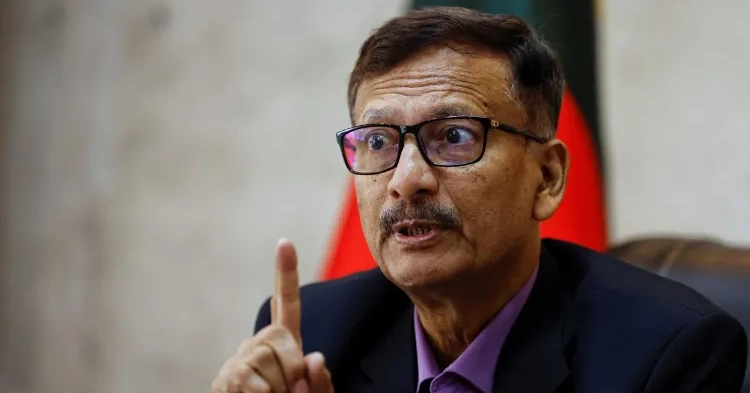
Foreign Affairs Adviser Md Touhid Hossain on Wednesday said there is no situation in the country that would compel foreign diplomats to send their family members back home, stressing that he sees no justification for the reported non-family posting of Indian diplomats.
“I don’t find any correct message (no valid reason). If they want to take back their families, they are free to do so. We have nothing to do with that,” he told reporters at the Ministry of Foreign Affairs when asked about India’s recent decision.
Adviser Hossain said the government has not been informed of any security concerns regarding the family members of Indian diplomats in Bangladesh.
He said it is also unclear whether any message is being conveyed by the withdrawal of the family members of Indian diplomats from the country.
Asked about the withdrawal, Hossain said there is no security concern, but he does not understand what signal is being sent. “There is no situation in Bangladesh where officials or their family members are in danger.”
“Nothing of this sort has happened so far. They may feel apprehensive, or they may want to send a message, but I do not really see any reason for it. If they want to take their families back, it is not our concern,” said the Adviser.
Referring to security conditions surrounding the 13th National Parliament elections, Hossain said there has been no overall disruption. “I do not think there have been more clashes than during previous election periods. I do not believe there has been a security situation that would warrant such a step.”
When asked whether the Indian High Commission in Dhaka had raised security concerns in advance, the Foreign Affairs Adviser said no such concerns had been communicated.
Earlier, the Indian government advised the dependents of officials posted at its High Commission in Dhaka and other missions outside Dhaka to return home as a precautionary measure, citing the security situation.
However, the High Commission in Dhaka and other Indian missions in Bangladesh continue to remain open and fully operational.
“Given the security situation, as a precautionary measure, we have advised the dependents of officials in the Mission and Posts to return to India,” a source at the Indian Ministry of External Affairs told UNB, responding to recent media reports.
The source added that the Mission and all Posts in Bangladesh remain open and operational at full strength.
Asked about concerns over election-related violence mentioned in a recent statement by the Ministry of Foreign Affairs, Adviser Hossain said those who are not participating in the elections, or are unable to do so, may be involved if any violence occurs.
He said there is normally no reason to anticipate conflict during the elections, as all contesting parties are showing restraint.
On January 25, the Ministry said unabashed incitements by the Awami League leadership once again demonstrated why the interim government had to ban its activities.
The Ministry said Bangladesh would hold the outfit responsible for incidents of violence and terror in the run-up to the elections and on polling day, and would take appropriate measures to foil what it described as ‘evil conspiracies’.
Bangladesh and India have experienced occasional tensions in their relations since the regime change in Bangladesh on August 5, 2024.
In an unprecedented development, cricket, traditionally a symbol of friendly ties, has emerged as a flashpoint after Bangladeshi star Mustafizur Rahman was dropped from the Indian Premier League (IPL).
Bangladesh responded by banning IPL broadcasts, citing player safety concerns, and sought to shift its ICC T20 World Cup 2026 matches from India to Sri Lanka.
Doesn’t matter who thinks what about Bangladesh decision on drone making: Foreign Adviser
The Ministry of Foreign Affairs said the government and people of Bangladesh were ‘surprised and shocked’ that fugitive Sheikh Hasina, who has been convicted by the International Crimes Tribunal for crimes against humanity, was allowed to make a public statement in New Delhi on January 23.
In that statement, she allegedly called for the removal of the Government of Bangladesh and openly incited her party loyalists and the public to carry out acts of terror to derail the upcoming general elections.
Bangladesh is deeply aggrieved that India has yet to act on its obligation to hand Sheikh Hasina over under the bilateral extradition agreement, despite repeated requests from the Bangladesh government.
Instead, she was allowed to make what the Ministry termed inciteful pronouncements from Indian soil. “This clearly endangers Bangladesh’s democratic transition, peace, and security,” the ministry said.
Allowing the event to take place in the Indian capital and permitting Hasina to deliver what it described as hate speech runs contrary to the norms of inter-state relations, including respect for sovereignty, non-interference, and good neighbourliness, the interim government said.
“It sets a dangerous precedent for the future of Bangladesh-India relations and may seriously impair the ability of a future elected government in Bangladesh to engage, shape, and nurture mutually beneficial bilateral relations,” the Ministry said in its statement.