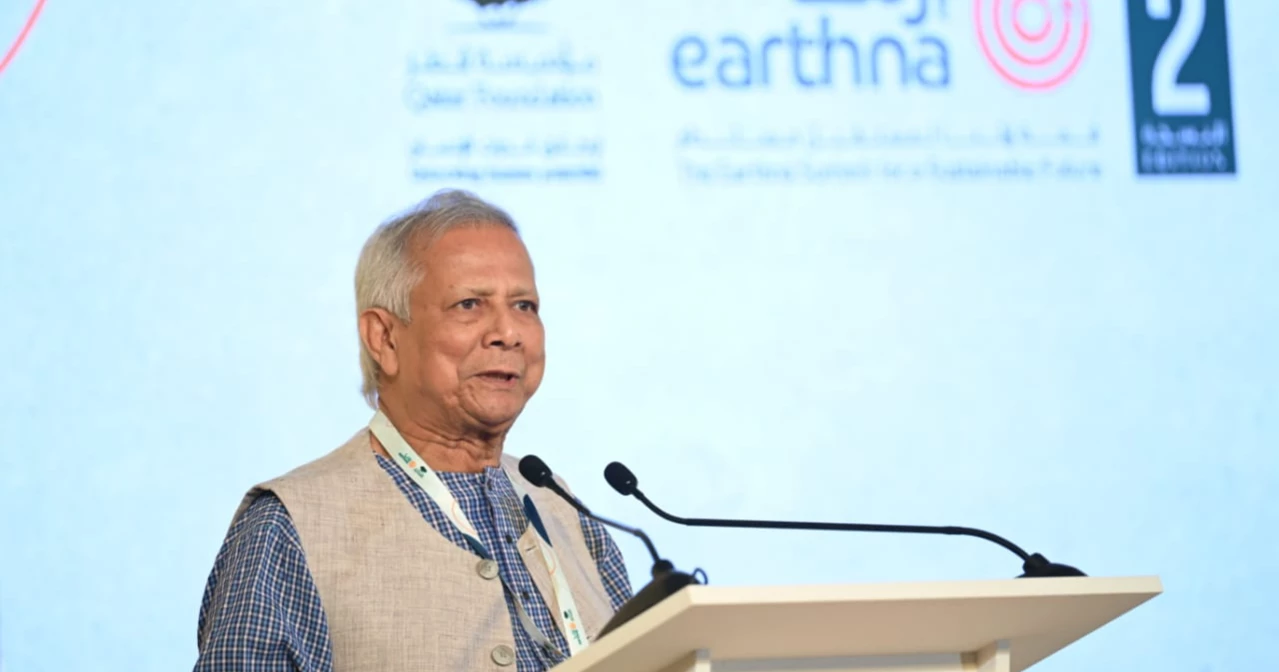
Sharing five specific initiatives with global stakeholders, Chief Adviser Prof Muhammad Yunus on Tuesday said the path to a sustainable and equitable future lies in their collective action.
Delivering his keynote speech at the Earthna Summit-2025, Prof Yunus said the safety of the environment demands a new way of living which is based on the principles of zero net carbon emissions, zero wealth concentration through the creation of social businesses and zero unemployment by becoming entrepreneurs.
"This is how we will create a new civilization that fosters sustainable development for everyone, everywhere," he said.
Bangladesh wants to be beacon of hope for the world, says Prof Yunus at Earthna Summit
The Chief Adviser said the climate crisis is also intensifying and the fact that funding for the global effort in this regard may dwindle in future is increasing.
"It is an existential threat for all of us. However, we are still continuing to uphold self-destructive values," Prof Yunus said, adding that they have chosen a lifestyle that works against nature; one that thrives on limitless consumption.
Profit maximisation is treated like the force of gravity, propelling every element of the system toward unsustainable outcomes, he said.
Five Initiatives Shared by Prof Yunus
"First, we must expand financial inclusion to reach all marginalised communities empowering individuals with the financial tools they need to build livelihoods and participate fully in the economy.
Earthna Summit: Qatari ministers, global dignitaries extend warm welcome to Prof Yunus
Second, we must champion social business as a powerful tool for addressing social and environmental challenges, fostering enterprises that prioritise purpose over profit.
Third, we must recognise the crucial role of the youth as agents of change and creating platforms for their voices to be heard and investing in their skills and potential.
Fourth, we must work towards peace and justice globally, recognising that these are fundamental prerequisites for sustainable development and the well-being of all humanity.
Fifth, we must not forget the moral obligation of the global community for providing necessary financing for undertaking the aforementioned activities. Developed countries must meet their ODA commitments, particularly the 0.2% GNI target for the LDCs, which remains at 0.09%. Enhanced concessional financing, with disaster clauses, is critical for sustaining development momentum including in the graduating countries."
Finally, Prof Yunus said, they must create another culture; a counter-culture based on a different lifestyle.
"This lifestyle will be rooted in zero waste, zero carbon and an economy based primarily on zero personal profit, i.e., on social business," he said.
This kind of business is a non-dividend enterprise designed specifically to solve social and environmental problems, Prof Yunus said.