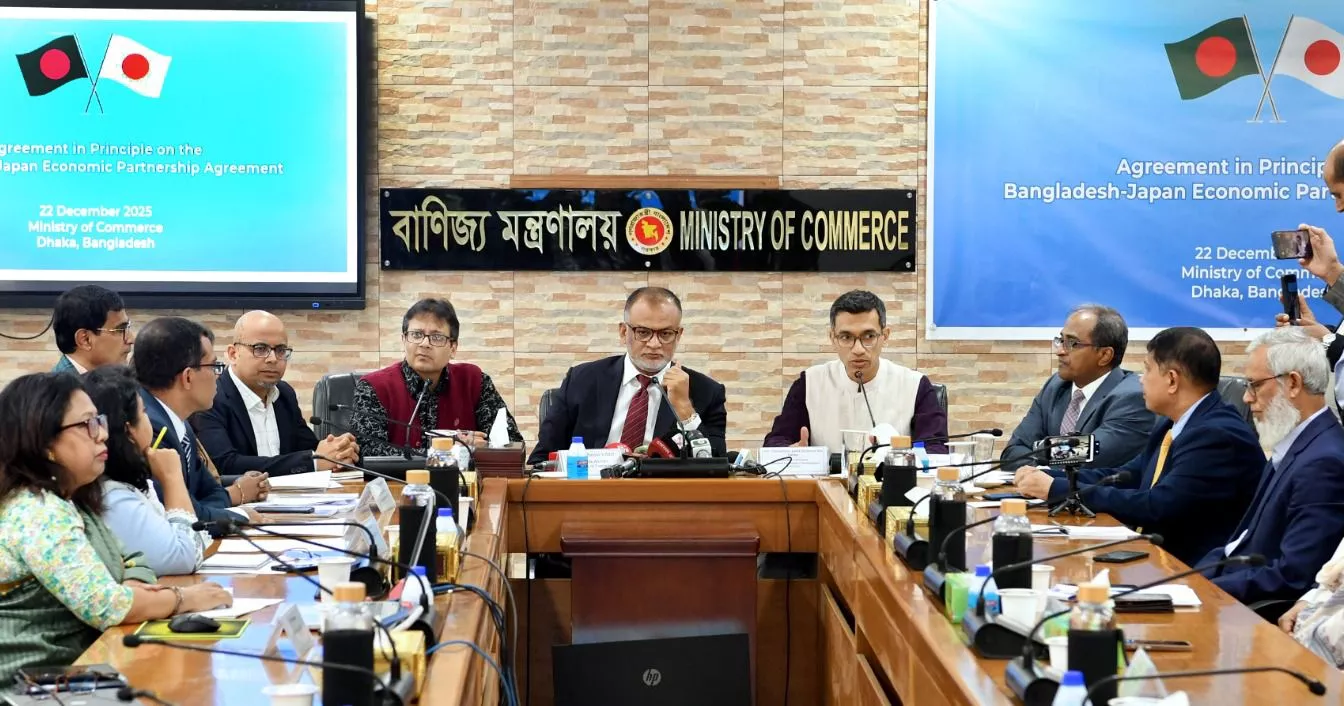
Bangladesh and Japan have finalised the draft of an Economic Partnership Agreement (EPA), with the deal set to be signed next month, Commerce Adviser Sk Bashir Uddin said on Monday.
“I talked to the Japanese Foreign Minister over the phone today. The EPA will be signed next month,” he said at a press conference on Bangladesh-Japan EPA negotiations at the Secretariat.
.He said Bangladesh has agreed to open 97 sub-sectors to Japan under the agreement while Japan has decided to open 120 sub-sectors to Bangladesh in four modes of services.
Bashir Uddin said the EPA draft was finalised through intensive negotiations with Japan.
He said this would be Bangladesh’s first-ever economic partnership agreement with any country which is expected to boost investment and bilateral trade between the two nations.
Chief Adviser’s Special Envoy on International Affairs Lutfey Siddiqi, Bangladesh Investment Development Authority (BIDA) Executive Chairman Chowdhury Ashik Mahmud Bin Harun and Commerce Secretary Mahbubur Rahman were present at the briefing.
Commerce Secretary Mahbubur Rahman said the process of the agreement began at the end of 2024 and was finalised after eight rounds of meetings.
Lutfey Siddiqi said Bangladesh had never entered into such an economic agreement before and initially there was limited experience on how to proceed.
“With sincere efforts from everyone in the government we have managed to complete it. Undoubtedly, this is a good agreement for Bangladesh,” he said.
BIDA Executive Chairman Ashik Mahmud said Bangladesh has long enjoyed friendly relations with Japan but Japanese investment in Bangladesh stands at only about $500 million which is relatively low compared to Japan’s investments in other countries.
He said in the past the absence of a structured economic agreement often discouraged larger Japanese investments in Bangladesh.
“We are often compared with Vietnam which has agreements with around 30 countries. We are just starting but this journey will allow us to sign many more economic agreements in the future and help address challenges related to LDC graduation,” he said.
He added that Japanese investment previously concentrated in only a few sectors would now expand into areas such as logistics, electronics, IT and automobiles, accelerating both investment inflows and technology transfer.
At the press conference, it was said the EPA is expected to bring wide-ranging trade and economic benefits for Bangladesh including trade expansion, increased investment and new employment opportunities.
Once the agreement comes into effect, Bangladesh will receive immediate duty-free access to the Japanese market for 7,379 products from the first day of signing.
In return, Japan will receive immediate duty-free access to Bangladesh’s market for 1,039 products.