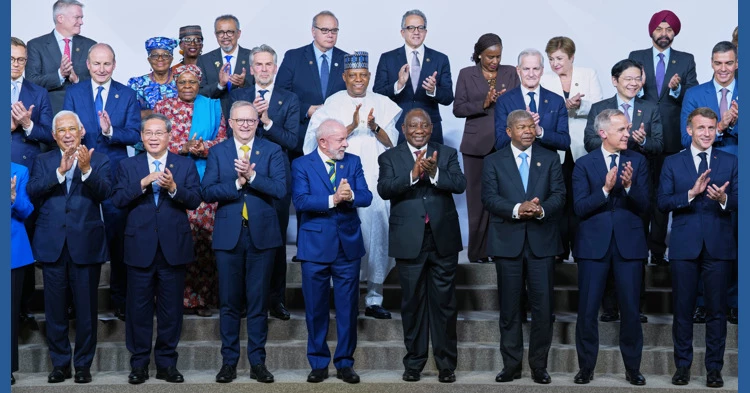
The G20 summit in South Africa began with an unexpected development on Saturday as world leaders endorsed a joint declaration at the outset of the meeting, even as the United States boycotted the two-day event in protest against the host nation.
South African President Cyril Ramaphosa’s spokesperson, Vincent Magwenya, confirmed that all participating members backed the 122-point document when the summit opened in Johannesburg. Typically, G20 declarations are signed at the close of proceedings. The agreement, heavily shaped by South Africa, calls for greater international support for vulnerable nations facing climate-driven disasters and mounting debt—areas the hosts had championed as priorities for the first G20 summit held on African soil.
The U.S., absent on the orders of President Donald Trump, had reportedly urged South Africa not to move forward with a leaders’ declaration in its absence. The summit has been clouded by the U.S. boycott, part of a broader diplomatic dispute with Pretoria.
As Ramaphosa began what was supposed to be a closed-door session, his remarks about adopting the declaration were inadvertently broadcast, prompting South Africa’s foreign minister to intervene and remind him that cameras were still live.
While the South African government insisted the declaration was unanimously approved, Argentina distanced itself from the document. President Javier Milei also skipped the summit in solidarity with Trump, sending his foreign minister as a representative instead.
Talks on Ukraine on the sidelines
Officials from France, Germany, the U.K., Canada and Japan held discussions on the margins of the summit regarding a U.S.-brokered peace plan for the Russia-Ukraine conflict. German Chancellor Friedrich Merz said representatives from several European countries, the EU, the U.S., and Ukraine would meet in Switzerland on Sunday to continue talks. The proposal, shaped by Washington and Moscow, includes concessions that Ukrainian President Volodymyr Zelenskyy has rejected, such as ceding territory.
Deals and diplomacy mark Trump–Saudi Crown Prince meeting
A joint statement from multiple Western nations said the plan required further work and reaffirmed that national borders “must not be changed by force.”
South Africa pushes for support for poorer nations
Holding the rotating G20 presidency, South Africa used the summit to call for stronger global commitments to help developing countries rebuild after climate-linked disasters, reduce debt burdens, move toward renewable energy, and benefit from their own natural resources.
But Washington's absence loomed large. Trump accused South Africa of violently targeting its Afrikaner white minority and has opposed the summit's agenda, particularly its emphasis on climate change and inequality.
Despite the tension, several leaders urged cooperation. “I regret it,” French President Emmanuel Macron said of Trump’s boycott, “but it should not stop our work.”
The G20—comprising 19 nations, the European Union and the African Union—represents the bulk of the world’s economy and population, yet relies on consensus, which is often difficult to achieve among powers with competing interests.
Strains over the declaration and U.S. handover
G7 ministers reaffirm support for Ukraine, sidestep trade and military strike debates
South Africa said the U.S. had pressured it to water down the summit declaration into a non-binding host’s statement. Ramaphosa responded firmly, saying the country “will not be bullied.”
The U.S. is set to assume the G20 presidency after the summit, but only a U.S. embassy official will attend the handover ceremony, which South African officials described as disrespectful and said may not be conducted formally.
Source: AP