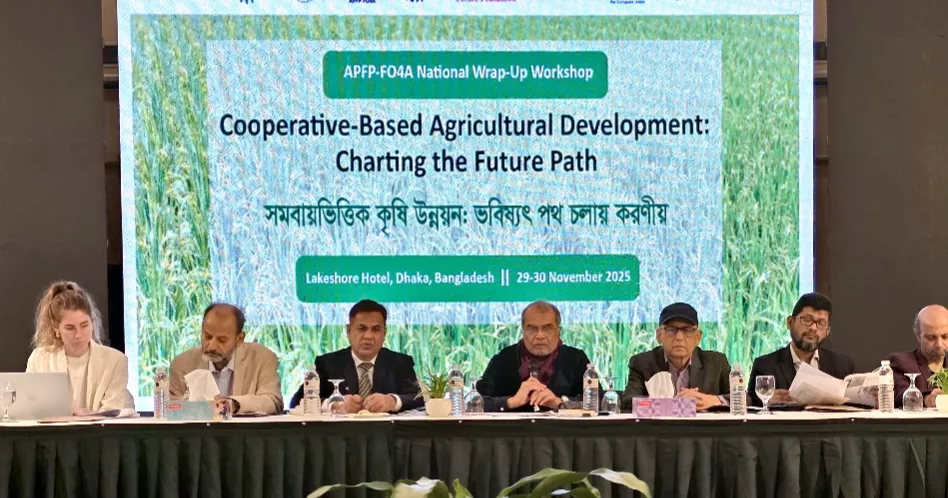
COAST Foundation, a national NGO based in Bangladesh, on Saturday wrapped up a five-year cooperative-based agricultural development initiative with a national-level workshop held at a city hotel in the capital, bringing together government officials, academics, development partners and farmers’ organizations.
The event reviewed project achievements, discussed future strategies and renewed commitments to strengthening small-scale farmers across Bangladesh.
Speakers stressed that farmers’ cooperatives are crucial for promoting ecological agriculture, boosting rural economies and ensuring food security. Despite producing 60–70% of the country’s food, small-scale farmers still face malnutrition and insecurity, they noted.
S M Sohrab Uddin, Director General of the Department of Agricultural Extension, underscored the need for careful crop planning and product selection before cultivation.
Mariel Zimmermann, Programme Officer of IFAD’s Asia and Pacific Division, highlighted the importance of documenting best practices to support replication.
Md Mohsin Ali, Executive Director of WAVE Foundation, called for wider adoption of agroecology, organic fertilizers and safe food production methods.
Moderating the session, COAST Foundation Executive Director M Rezaul Karim Chowdhury said the country must return to ecological agriculture to avoid the long-term harms of chemical-dependent farming.
Presenting the keynote, Sanat Kumar Bhowmik, Deputy Executive Director of COAST Foundation, said Tk 2.08 crore in revolving financing has been provided to six farmers’ organizations. He added that youth engagement in farming increased by more than 25% during the project period.
Gawher Nayeem Warha, Member Secretary of Disaster Forum and Acting Chairperson of COAST Foundation, urged wider dissemination of impact stories to draw more young people into agriculture.
Hunger Free World Country Director Ataur Rahman Miton said cooperatives empower farmers to secure fair prices, access markets collectively and build resilience.
Ahmed Borhan, Director of the Center for Social Research, pointed to the growing elderly population in rural areas and called for research and campaigns on fair pricing for agricultural products.
Alauddin Sikder, President of Goiata Cooperative (GKUSSL), highlighted the cooperative’s role in indigenous seed production and monitoring input prices.
Mahfuza Akter, President of GKUSSL’s Youth Committee, stressed the need to expand saline-tolerant seed varieties, especially in coastal regions.
Young participants also shared impact stories demonstrating the transformative potential of cooperative farming.
The workshop concluded with a shared commitment to strengthen farmers’ cooperatives, bring them under the Ministry of Agriculture, and ensure greater participation of women and youth.