Bangladesh is facing a severe ecological crisis as forest land shrinks and urban green cover dwindles, with officials revealing that 2.5 lakh acres of forest have been illegally encroached upon nationwide.
Furthermore, in the densely populated capital of Dhaka, the environmental balance has reached a critical low, where oxygen of a single tree is shared among nearly 28 people on average.
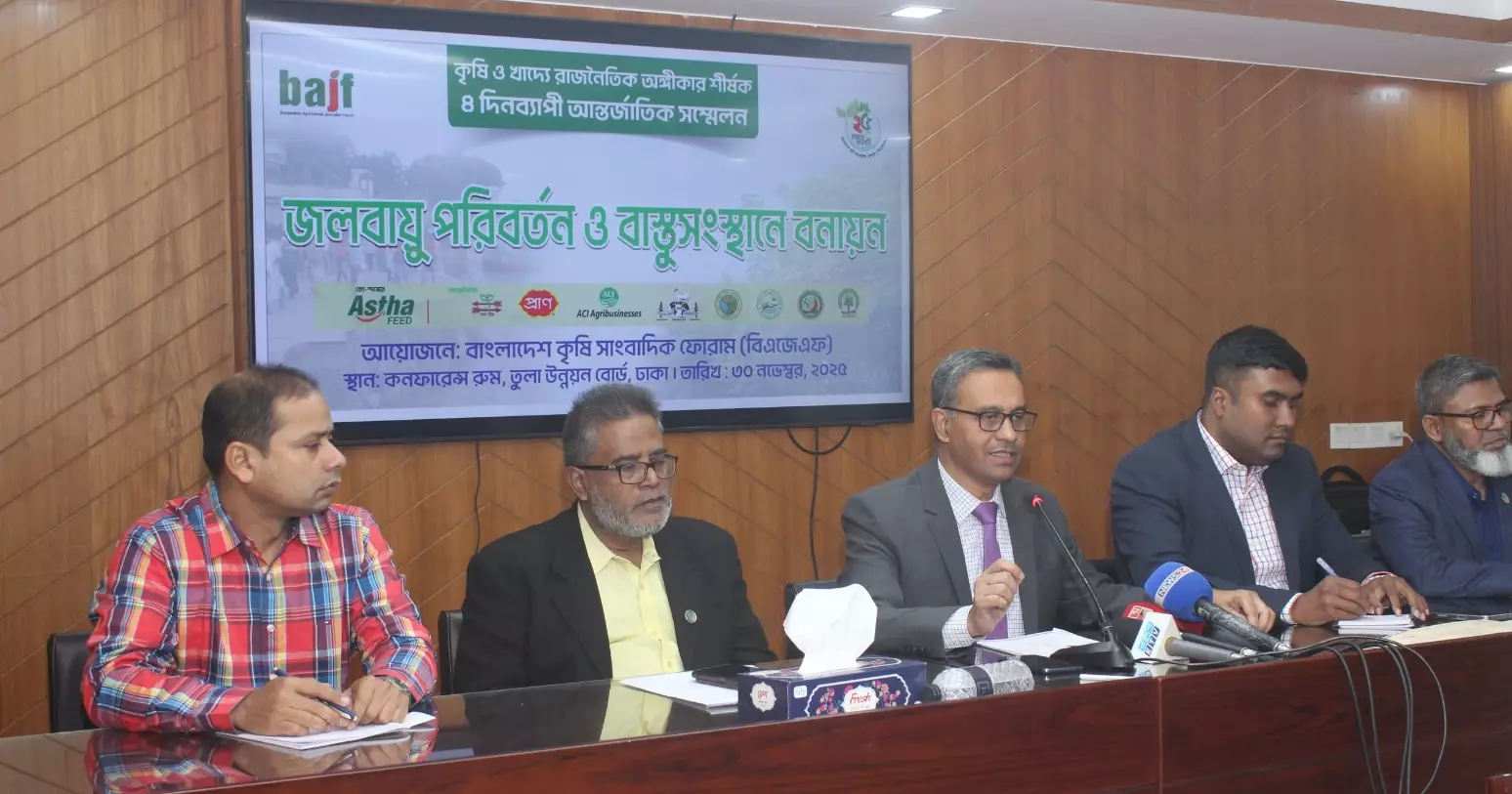
This alarming data was presented on Sunday by Md. Zahidul Kabir, Deputy Chief Conservator of Forests at the Forest Department, during his keynote speech at the closing ceremony of a four-day international conference and workshop titled ‘Political Commitment in Agriculture and Food.’ The event, organized by the Bangladesh Agricultural Journalists Forum (BAJF), was held at the Cotton Development Board auditorium in Dhaka.
He emphasized the dire situation in Dhaka, stating that a person requires at least 550 liters of oxygen daily, which necessitates a minimum of three fully grown trees for a sustainable supply.
"We are living in a grave crisis. In Dhaka, the reality is that there is only one tree for every 28 people," said Kabir.
He further noted that compared to 2015, the country's afforestation has decreased by one lakh acres, with the hilly regions alone accounting for a reduction of 83,000 acres.
Human activities are significantly damaging the country's biodiversity and ecosystems, according to the Deputy Chief of Forest Conservator. Major threats include-poaching and illegal construction, forest encroachment, fire incidents, and mangrove destruction and unregulated vessel movement.
These factors, compounded by the pressures of climate change, are making the forests increasingly vulnerable.
Kabir also provided figures on the country's carbon stock, stating that the total tree cover (inside and outside forest areas) holds 973 million tons of carbon, with forest areas alone storing 251 million tons.
He mentioned the distribution of 4.19 lakh free saplings to individuals as part of a forest expansion program, an initiative expected to encourage tree planting and enhance the country's long-term carbon sequestration capacity.
Md. Amir Hosain Chowdhury, Chief Conservator of Forests, who attended as the chief guest, underscored the importance of forests in combating climate change.
"Afforestation is the most effective and low-cost natural solution to tackle climate change,” Chowdhury stated.
He pointed out that while global consumption and resulting carbon emissions are rising, Bangladesh is especially vulnerable due to its extremely high population density, about 1,200 people per square kilometer.
He contrasted this with countries like Russia, which has 20 percent of the world's total forest area but a population density of only 9 people per square kilometer, highlighting the immense pressure on Bangladesh's limited forest resources.
Chowdhury also noted that while the recommended minimum green space for a city like Dhaka is 20 percent, the two city corporations currently possess just over 10% green cover.
Abul Kalam Azad, Chief Executive of Planter Skill Development and a researcher at Dhaka University, attended as a special guest and emphasized the need for political will to realize the nation's potential in agriculture and environment.
He identified several challenges hampering progress, including-political non-cooperation and a crisis of values, lack of proper distribution policies and leadership, syndicate formation, political vendettas, and weak implementation on the ground.
He concluded that ensuring good governance and cultivating value-driven individuals is crucial to achieving desired changes in food security and environmental protection.
The conference, which saw participation from 180 journalists and communication specialists. BAJF President Shahanuware Shaid Shahin and General Secretary Abu Khali also spoke at the event.