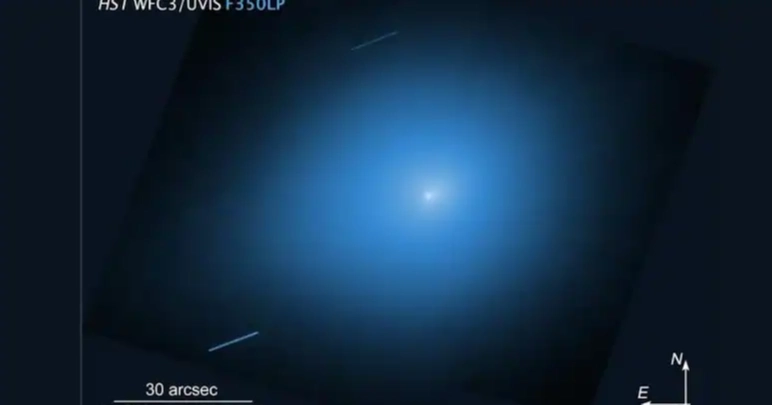
NASA has provided answers to common questions about the interstellar comet 3I/ATLAS, which is set to make its closest approach to Earth on December 19, 2025.
3I/ATLAS, the third confirmed interstellar object to enter the Solar System after ‘Oumuamua in 2017 and 2I/Borisov in 2019, was discovered on July 1, 2025, by the ATLAS telescope in Chile. NASA confirmed that the comet approached from the direction of the Sagittarius constellation, moving at around 137,000 miles per hour (221,000 km/h) and accelerating to 153,000 miles per hour (246,000 km/h) near the Sun.
The comet is believed to have originated from the thick disk of the Milky Way, with an estimated age of 7.6 to 14 billion years. It follows a hyperbolic trajectory, meaning it is passing through the Solar System only once and will continue into interstellar space. Scientists say 3I/ATLAS poses no threat to Earth, maintaining a distance of at least 170 million miles (270 million km) at closest approach.
Observations show the comet is active, with a nucleus diameter estimated between 1,400 feet and 3.5 miles (440 meters to 5.6 km), composed of water ice, carbon dioxide, and other gases. Its reddish hue is similar to D-type asteroids and previous interstellar object 2I/Borisov.
Though not visible to the naked eye, 3I/ATLAS can be observed using telescopes. Its passage offers scientists a rare chance to study material from another star system, revealing insights into the composition and history of interstellar objects. ESA’s XMM-Newton telescope has also captured the comet in X-ray light, showing a massive debris cloud and typical cometary activity.
With inputs from NDTV