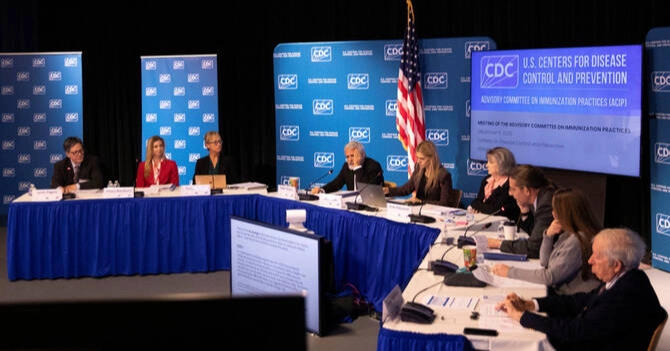
A federal advisory committee voted Friday to end the longstanding recommendation that all U.S. newborns receive the hepatitis B vaccine on their first day of life.
The move sparked strong criticism from public health and medical experts. All current members of the committee were appointed by U.S. Health Secretary Robert F. Kennedy Jr., who was previously a prominent anti-vaccine activist. Dr. William Schaffner, a Vanderbilt University vaccine expert, called the panel “a group that can’t shoot straight.”
Despite the committee’s vote, several medical societies and state health departments said they would continue recommending the birth dose. Health insurers represented by AHIP also stated they will continue covering it.
For decades, newborn vaccination against hepatitis B — a liver infection that can become chronic and lead to liver failure or cancer — has been a cornerstone of U.S. public health efforts. The virus can be transmitted from infected mothers to babies, as well as through sex or shared needles in adults.
Japan turns to new technology as dementia cases surge
The newly appointed committee recommended the birth dose only for babies whose mothers test positive for hepatitis B, or in cases where the mother’s status is unknown. For other infants, the decision would be left to parents and their doctors, with the series starting at two months if vaccination is delayed. The vote on this recommendation was 8-3.
President Donald Trump called the decision “very good,” while the acting CDC director, Jim O’Neill, will decide whether to adopt it. Critics say this represents a return to a strategy abandoned more than 30 years ago. Committee member Vicky Pebsworth cited “pressure from stakeholder groups” for the review.
Some committee members questioned past safety studies on newborns and expressed concerns about insufficient discussions with parents regarding the pros and cons of early vaccination. Others, including Drs. Joseph Hibbeln and Cody Meissner, argued there is no scientific basis for delaying the first dose to two months or for checking antibody levels to determine if fewer shots suffice.
Health experts warned the approach could weaken herd immunity and increase disease risk. Dr. Robert Malone said the panel is focusing on individual risk rather than protecting public health. Critics also noted that CDC scientists no longer present safety and effectiveness data, with slots instead going to voices from anti-vaccine circles.
Republican Senator Bill Cassidy called the recommendation “a mistake” that “makes America sicker.” Advocacy groups described the panel as no longer a legitimate scientific body, and some prominent vaccine researchers declined to participate, citing the committee’s shift away from evidence-based medicine.
Source: AP