Middle Eastern allies of the United States are once again urging both Washington and Tehran to avoid escalation, as President Donald Trump warns of possible military action and increases U.S. force deployments in the region, according to an Arab diplomat familiar with the discussions.
Saudi Arabia, Turkey, Oman, and Qatar have contacted officials in both the U.S. and Iran, warning that any confrontation could severely destabilize the region and disrupt global energy markets, said the diplomat, who spoke anonymously due to the sensitive nature of the talks.
Regional Arab and Muslim governments fear that a U.S. strike on Iran would likely provoke retaliation from Tehran, potentially targeting neighboring countries or U.S. interests on their soil and causing widespread collateral damage.
Saudi Defense Minister Khalid bin Salman said Friday on social media that he met in Washington with Secretary of State Marco Rubio, Defense Secretary Pete Hegseth, Trump’s regional envoy Steve Witkoff, and Joint Chiefs Chairman Gen. Dan Caine to discuss efforts aimed at promoting regional and global stability.
The appeals for restraint come as Trump has shifted his public justification for potential military action—from condemning Iran’s violent suppression of nationwide protests to focusing on preventing Tehran from advancing its nuclear program. This is despite Trump’s repeated claims that U.S. strikes in June had already destroyed Iran’s nuclear facilities.
Trump signals interest in a deal
Trump said Friday that he hopes to reach an agreement with Iran, but warned reporters that consequences would follow if negotiations fail. Asked whether he had imposed a deadline, Trump replied ambiguously that only Iran would know, confirming that his warnings had been directly conveyed to Iranian officials.
According to two senior administration officials, Trump’s renewed emphasis on Iran’s nuclear ambitions reflects a broader strategy rather than a change in course. One official said Trump initially highlighted the protests to encourage demonstrators and to caution Tehran against further repression.
Trump said Iran appeared to heed earlier warnings about executions but acknowledged that many people were still being killed.
Despite this, the administration views Iran’s nuclear program as the central threat—particularly from the perspective of Israel. Officials said Trump wants to remind Iran that eliminating that risk remains the ultimate objective.
Trump wrote on social media that he hopes Iran will quickly return to negotiations for a “fair and equitable deal” that ensures it never develops nuclear weapons, warning that time is running short.
Another senior official emphasized that Trump retains all military options, though the White House has not confirmed whether it believes Iran is attempting to rebuild its nuclear capabilities.
Iran says it is open to talks—but prepared for conflict
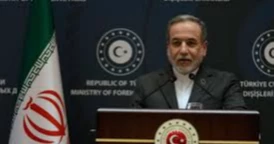
Iranian Foreign Minister Abbas Araghchi said Friday during talks in Istanbul with Turkish officials that Iran is open to dialogue but that no formal negotiations with the U.S. are currently planned. He added that while Iran is prepared to negotiate, it is also ready for war.
Turkey has sought to ease tensions, with President Recep Tayyip Erdogan offering to act as a mediator between Tehran and Washington during a phone call with Iranian President Masoud Pezeshkian earlier Friday.
Earlier this month, Trump halted plans for military strikes after urging Iranians to continue protesting and saying support was forthcoming. He later said Iran assured him it would not carry out mass executions of demonstrators.
Protests that began in late December over economic conditions have since evolved into a broader challenge to Iran’s leadership. Activist groups claim at least 6,540 people have been killed in the government crackdown.
Trump has repeatedly highlighted the buildup of U.S. military forces in the region, including the deployment of the aircraft carrier USS Abraham Lincoln and several guided-missile destroyers, bringing thousands of additional U.S. personnel to the Middle East.
U.S. Central Command warned Iran against endangering freedom of navigation during an upcoming live-fire drill in the Strait of Hormuz, a critical route for roughly 20% of the world’s oil supply. The command said it would not tolerate unsafe behavior such as close flyovers, aggressive boat maneuvers, or weapons pointed at U.S. forces.
The Arab diplomat said regional governments are urging the U.S. to act with extreme caution, given the potential for widespread fallout. Iran, meanwhile, is being advised that if a strike does occur, its response should be carefully measured to avoid harming neighboring countries.
Iran previously retaliated against U.S. actions by targeting American assets in Qatar after last year’s strikes on Iranian nuclear sites.
Ideally, the diplomat said, the crisis would result in nothing more than heightened tension—but warned that the situation remains volatile and unpredictable, with only Trump knowing whether military action is imminent.