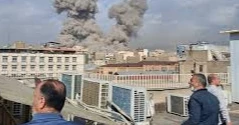
Powerful explosions were reported in the Iranian capital, Tehran, early Saturday, sending thick smoke into the sky. In response, Iran launched missiles toward Israel, while the United States warned that an even larger bombing campaign could soon take place as the weeklong conflict escalates.
There were no clear signs that the fighting would end soon. The administration of U.S. President Donald Trump approved a new $151 million weapons sale to Israel after Trump reiterated that negotiations with Iran would only happen if Tehran agreed to an “unconditional surrender.” Iran’s ambassador to the United Nations said the country would take all necessary actions to defend itself.
Video obtained by the Associated Press showed flashes from explosions and rising smoke across western parts of Tehran as Israel confirmed it had launched a broad round of strikes. At the same time, Israel’s military said it was working to intercept a fresh wave of Iranian missiles.
The conflict appeared to be expanding across the region. Early Saturday, warning sirens sounded in Bahrain after an Iranian attack targeted the island nation. Saudi Arabia reported destroying drones headed toward its Shaybah oil field and intercepting a ballistic missile aimed at Prince Sultan Air Base, where U.S. forces are stationed.
Over the past week, the United States and Israel have carried out repeated strikes on Iran, targeting its military infrastructure, leadership and nuclear facilities. However, the war’s objectives have shifted over time, with some U.S. officials suggesting the possibility of overthrowing Iran’s government or encouraging new leadership within the country.
Meanwhile, two U.S. officials familiar with intelligence assessments said Russia had provided Iran with information that could help it target American military assets in the region. Russian President Vladimir Putin spoke with Iranian President Masoud Pezeshkian on Friday to offer condolences following the death of Iran’s Supreme Leader, Ali Khamenei, according to the Kremlin.
Concerns over deadly school explosion
New evidence has also suggested that a deadly explosion at a school in the city of Minab may have been caused by U.S. airstrikes that struck a nearby facility connected to the Islamic Revolutionary Guard Corps. Iranian state media reported that more than 165 people, most of them children, were killed in the blast.
Iran has blamed both Israel and the United States for the incident, although neither country has confirmed responsibility. U.S. Defense Secretary Pete Hegseth said the matter was under investigation.
Global economic concerns grow
Saad al-Kaabi warned that the war could have severe economic consequences worldwide. In an interview with the Financial Times, he said the conflict could disrupt Gulf energy exports and push oil prices to as high as $150 per barrel. Benchmark U.S. crude already climbed above $90 on Friday, the highest level in more than two years.
Possible Russian involvement
Officials also said Russia had supplied Iran with intelligence that might help it target American ships, aircraft and other assets in the region. Although there is no indication Moscow is directing how the information should be used, it may represent the first sign of Russia becoming involved in the conflict.
Trump outlines conditions for Iran’s future
In a social media message, Trump stated that the only possible agreement with Iran would require unconditional surrender. He added that once Iran chooses “acceptable” leadership, the United States and its allies could help rebuild the country and strengthen its economy.
The comments have raised questions about the ultimate goal of the war. According to officials, the conflict has already killed at least 1,230 people in Iran, more than 200 in Lebanon and about a dozen in Israel. Six U.S. troops have also died.
President Pezeshkian said on social media that several countries had begun mediation efforts, though he did not provide details.
Trump has also suggested he should play a role in choosing a successor to Khamenei. He dismissed Khamenei’s son, Mojtaba Khamenei, who is considered a leading candidate to replace his father, calling him politically weak.
Iran’s ambassador to the United Nations, Amir Saeid Iravani, condemned Trump’s remarks and insisted that Iran would never allow foreign powers to interfere in its internal affairs.
Iranian state television reported that officials had begun discussions about convening the Assembly of Experts, the body responsible for selecting the country’s next supreme leader.
Warning of more intense bombing
U.S. Treasury Secretary Scott Bessent said in a television interview that the most extensive bombing campaign of the war may still lie ahead.
Israel also said it had heavily targeted an underground bunker believed to have been prepared for Iranian leadership during the conflict.
Fighting spreads into Lebanon
In eastern Lebanon, the state news agency reported that local fighters clashed with Israeli troops who landed near the town of Nabi Chit, an area known as a stronghold of Hezbollah. There were no immediate reports of casualties.
Israel has also conducted multiple airstrikes on the southern suburbs of Beirut, where Hezbollah has a significant presence but which is also home to large civilian populations.
Lebanon’s Health Ministry reported that Israeli strikes since Monday have killed 217 people and injured 798 others.
Heavy traffic clogged the streets of Beirut as residents tried to flee, while smoke rose from the southern districts of the city. Two hospitals evacuated their patients and staff amid the attacks.
One displaced resident, Jihan Shehadeh, said many families were forced to sleep in their cars because they had nowhere else to go.