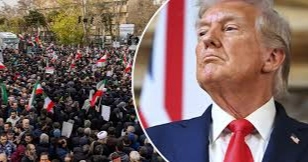
Iran’s chief prosecutor on Friday dismissed US President Donald Trump’s repeated assertion that he prevented the execution of 800 people arrested during recent protests, calling the claim “entirely untrue.” At the same time, activists reported that the death toll from Iran’s violent crackdown on nationwide demonstrations has climbed to at least 5,032.
Rights groups believe the actual number of deaths may be significantly higher, but verification has been difficult due to Iran’s ongoing internet shutdown, now the longest in the country’s history.
Relations between Washington and Tehran remain tense as a U.S. aircraft carrier group moves closer to the Middle East. Trump referred to the deployment as an “armada” and analysts say the military buildup gives him the option of launching strikes, even though he has so far stopped short of doing so. Trump has previously said mass executions or the killing of peaceful protesters would trigger military action.
According to an analysis by the Soufan Center, Trump appears to have stepped back from immediate military action, possibly due to regional pressure and doubts that airstrikes alone could destabilize Iran’s leadership. However, continued military movements suggest force remains a possibility.
Iran’s top prosecutor, Mohammad Movahedi, denied Trump’s claim in remarks carried by the judiciary’s Mizan news agency, saying no such executions were planned and no such number existed. He emphasized that Iran’s judiciary does not take orders from foreign governments.
Movahedi’s comments hinted that the disputed figure may have come from Iran’s Foreign Ministry, which has been in contact with U.S. envoy Steve Witkoff during nuclear negotiations. He stressed that Iran’s institutions operate independently.
A White House official later disputed the prosecutor’s denial, reiterating that executions were halted because of Trump’s warnings. Speaking anonymously, the official said the administration was closely monitoring the situation and warned that all options remain open if executions take place, though no evidence was provided to support the claim.
Iranian authorities have labeled some detainees as “mohareb,” or “enemies of God,” a charge punishable by death and previously used during the mass executions of 1988.
At a special session of the U.N. Human Rights Council in Geneva, U.N. human rights chief Volker Türk voiced concern over mixed signals from Iranian officials about whether protesters could face execution. He noted that Iran remains among the world’s leading executioners, with at least 1,500 executions reported last year, a sharp increase from the year before.
Meanwhile, Tehran’s Friday prayer leader Mohammad Javad Haji Ali Akbari mocked Trump in a speech aired on state radio and warned that any harm to Iran’s leadership would prompt retaliation against U.S. interests and military bases in the region.
Iran’s Foreign Ministry also condemned a European Parliament resolution criticizing Tehran for repression and mass killings of protesters and calling for the designation of Iran’s Revolutionary Guard as a terrorist organization. The ministry warned that any such actions would be met with a response from Iran.
The U.S.-based Human Rights Activists News Agency reported that more than 4,700 of those killed were protesters and said over 27,600 people have been detained. The group’s figures, based on activist networks inside Iran, exceed any protest-related death toll in the country in decades. Iran’s government, however, has reported a lower death toll of 3,117, including civilians, security forces, and what it described as “terrorists.”
The Associated Press has not been able to independently verify casualty figures due to restrictions on communications within Iran.
The U.S. military has continued moving forces into the region, including the aircraft carrier USS Abraham Lincoln, now operating in the Indian Ocean. Trump said the deployment was precautionary, adding that he hoped it would not be necessary to use the force.
He also referenced previous nuclear talks with Iran and warned that future U.S. military action could be far more severe than earlier strikes. Separately, the U.K. Defense Ministry announced that its joint fighter jet squadron with Qatar has been deployed to the Persian Gulf for defensive purposes amid rising regional tensions.