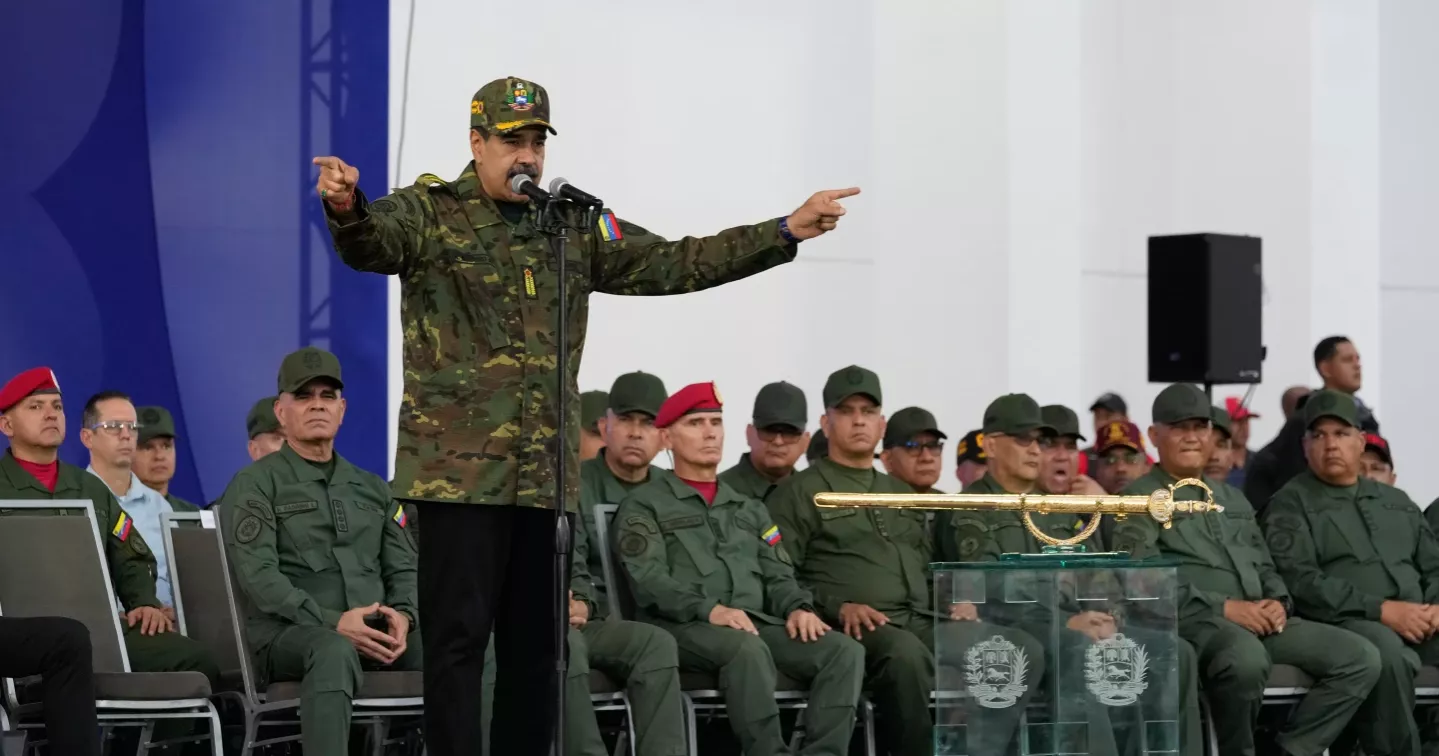
Venezuelan President Nicolás Maduro is projecting a softer image as U.S. military action looms, singing John Lennon’s Imagine and repeating a new English slogan, “No War, Yes Peace.” But behind the shift lies a hardened system of control built on rewarding loyalty and harshly punishing dissent, a structure that has kept his circle intact despite years of international pressure.
Maduro’s sudden embrace of English is a stark contrast to past speeches where he urged Venezuelans to avoid foreign words like skatepark and fashion. Opposition supporters say the new tone shows desperation and insist that the threat of U.S. force should fracture the ruling elite. Months of pressure, however, have yet to trigger defections or force a transition.
Analysts say the resilience comes from a loyalty-or-punishment strategy rooted in Chavismo, the political movement founded by Hugo Chávez. Officials who stay loyal, including ministers, judges and military commanders, benefit from corruption networks built during Chávez’s rule and strengthened under Maduro. Those who break ranks face prison, torture or worse, especially if they are part of the military.
Ronal Rodríguez of Colombia’s Universidad del Rosario said Chavismo thrives under outside pressure, uniting its members to protect their power. He said the movement has used corruption and fear to keep rivals down and remove threats inside government.
The Venezuelan opposition, led by Nobel Peace Prize winner María Corina Machado, expected the military to help oust Maduro after credible evidence showed he lost the 2024 presidential election. But military leaders stood by him, just as they did in 2019 when soldiers pledged loyalty to Juan Guaidó during a failed revolt.
Since returning to office, U.S. President Donald Trump has tightened pressure, doubling the reward for Maduro’s arrest to 50 million dollars on narcoterrorism charges. The U.S. recently designated the Cartel de los Soles, which Maduro is accused of leading, as a foreign terrorist organization. Maduro rejects the allegations.
Trump on Saturday declared Venezuelan airspace “closed in its entirety,” prompting Maduro’s government to accuse Washington of making a colonial threat. The move energized ruling party supporters, who rallied against what they called an attack on national sovereignty.
U.S. forces have already bombed boats accused of transporting drugs in the Caribbean and eastern Pacific, killing more than 80 people. The strikes increased fears of an operation aimed at removing Maduro.
Two weeks after the first boat attack, U.S. officials tried to recruit Maduro’s pilot in a plot to capture the president. The pilot refused, calling Venezuelans loyal and unwilling to betray their leader.
On Tuesday, supporters marched in Caracas to demonstrate Chavismo’s “anti-imperialist spirit.” At the end of the rally, Maduro lifted a jeweled sword once owned by independence hero Simón Bolívar and led his Cabinet in a public oath to defend peace and freedom.
Susan Shirk, a professor at the University of California, San Diego, said authoritarian leaders depend on shows of unity to prevent divisions that could encourage protests. She said any sign of fragmentation could embolden the public to rise up.
U.S. Defense Secretary Pete Hegseth said the new terrorist designation gives Trump more options against Maduro, though he did not specify them. Analysts say Washington doubts any acceptable outcome includes Maduro staying in power.
David Smilde, a Venezuela expert at Tulane University, said people misunderstand how Chavismo works if they believe military pressure will topple Maduro. He said force only strengthens the ruling movement and that no officer would trust the U.S. after being labeled part of a drug cartel.
Maduro’s rule has coincided with deep political and economic crises that pushed millions into poverty and forced more than 7.7 million people to leave the country. Support for the ruling party has dropped sharply, but Maduro maintains a core base using long-standing tactics, including orchestrated marches.
Zenaida Quintero, a 60-year-old school porter, said she remembers the food shortages of the late 2010s but remains loyal because Chávez handpicked Maduro to lead the revolution. She believes he will stand by his supporters.
“I trust him,” Quintero said. “We have to remain united. We have to defend ourselves.”