Malta and Canada announced Wednesday that they will officially recognize the state of Palestine in September, joining France and potentially the United Kingdom in a growing international effort to push for an end to the decades-long Israeli-Palestinian conflict.
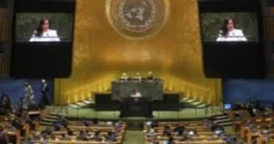
Canadian Prime Minister Mark Carney shared the decision following a Cabinet meeting, while Malta’s announcement came from Christopher Cutajar, the top official at the Maltese Foreign Ministry, during a U.N. General Assembly session on the two-state solution. The session was extended to a third day due to high participation.
Cutajar emphasized Malta’s longstanding support for Palestinian self-determination and stated that the country has a responsibility to help make the two-state solution a reality. He said Malta would formally recognize Palestine at the U.N. General Assembly in September.
Carney said Canada will also make its declaration during the annual U.N. gathering starting Sept. 23, with conditions. He said Canada's recognition hinges on the Palestinian Authority holding general elections in 2026 that exclude Hamas, and on the future Palestinian state being demilitarized. Palestinian President Mahmoud Abbas promised these measures in a June 10 letter, though it remains uncertain if further commitments are required.
Malta Seeks Peace in the Region
Malta’s Prime Minister Robert Abela confirmed the decision on Facebook, calling it part of the country’s broader aim to help achieve lasting peace in the Middle East. Malta, an EU member and former British colony, will join over 145 countries that already recognize Palestine, including more than a dozen European nations.
French President Emmanuel Macron had already announced France’s intention to recognize Palestine at the upcoming U.N. summit, while UK Prime Minister Keir Starmer said Britain would do so unless Israel agrees to a ceasefire and peace framework within the next eight weeks.
With Canada joining in, three G7 countries now back Palestinian statehood recognition. Israel strongly opposes such moves and is boycotting the U.N. meeting along with the United States, its closest ally.
Israel Pushes Back
Israeli Ambassador to the U.N., Danny Danon, criticized the participation of over 120 countries in the conference, calling their recognition of Palestine an endorsement of terrorism. He accused them of prioritizing symbolic gestures over the effort to free hostages held by Hamas and said such acts only encourage extremism.
Malta’s representative, Cutajar, responded that recognizing Palestine is not just symbolic but a vital step toward achieving a fair and lasting resolution.
Call for Swift Action
At the U.N. conference, many leaders reiterated their commitment to a two-state solution and urged all remaining countries to recognize Palestine promptly. A seven-page document known as the "New York Declaration" outlines a step-by-step plan to resolve the conflict, envisioning a demilitarized Palestinian state coexisting peacefully with Israel and becoming part of the broader Middle East community.
Additionally, a one-page statement titled the "New York Call" was endorsed by 15 Western nations. It encourages global recognition of Palestine as key to peace. The document includes six nations that already recognize Palestine and nine, including Malta and Canada, that have expressed strong support but haven’t done so yet. The seven countries that still haven’t endorsed recognition are Andorra, Australia, Finland, Luxembourg, New Zealand, Portugal, and San Marino.
The meeting concluded after the 128th speaker, with Saudi Arabia’s U.N. ambassador Abdulaziz Alwasil suspending the session and stating that a final document has been circulated to all U.N. members for endorsement by early September.