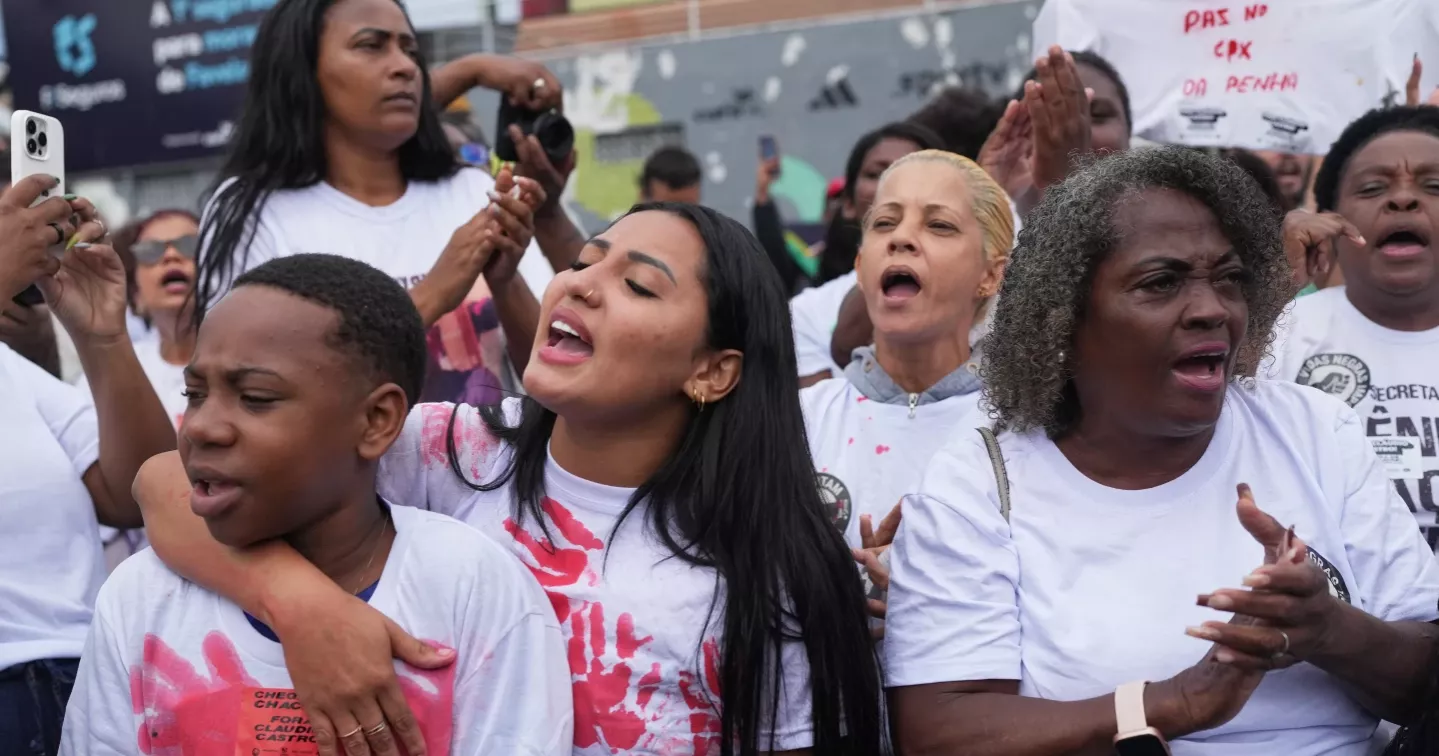
Hundreds of protesters took to the streets of Vila Cruzeiro, a favela in Rio de Janeiro’s Penha complex, on Friday, demanding the resignation of Rio state Governor Cláudio Castro following the city’s deadliest police raid that left over 100 people dead.
The demonstration brought together local residents, activists, politicians, grieving mothers, and people from other parts of Rio to voice outrage over the raid. Days earlier, residents had collected and laid out scores of bodies from a nearby green area after the operation.
At least 121 people were killed in Tuesday’s raid, including four police officers, according to official figures. The Rio public defender’s office reported 132 deaths.
“Coward, terrorist, assassin! His hands are stained with blood,” said 30-year-old Anne Caroline Dos Santos, referring to Castro, an ally of former President Jair Bolsonaro and a critic of leftist President Luiz Inácio Lula da Silva. Castro has defended the operation, accusing the federal government of abandoning Rio in its fight against organized crime, a claim denied by Lula’s administration.
Many protesters, including Dos Santos who travelled from Rio’s Rocinha favela, accused law enforcement of torture and extrajudicial killings. “Mothers are now struggling to retrieve their sons’ bodies and bury them,” she said, adding that she had lost a friend in the raid.
Though many shops have reopened since the unrest earlier this week, signs of the violence remain, including burned cars used as barricades. Protesters wore white to symbolize peace, some with T-shirts marked by red handprints, and carried signs reading “stop killing us” or “enough massacres.”
“This is a disgrace to Brazil,” said 44-year-old Leandro Santiago, a Vila Cruzeiro resident who earns a living with his motorbike. “Nothing justifies this.”
The raid involved approximately 2,500 police and soldiers targeting the notorious Red Command gang in the Complexo de Alemao and Complexo da Penha favelas. The operation aimed to capture gang leaders and limit the group’s territorial expansion, which has grown in Rio and other parts of Brazil, including the Amazon.
Gunfire and retaliation by gang members during the raid caused widespread chaos across the city. Castro described the operation as a success and declared Rio to be at war against “narco-terrorism.” The state government maintains that those killed were criminals who resisted police.
However, the unprecedented death toll drew international condemnation from human rights groups and the United Nations, and sparked scrutiny from Brazil’s Supreme Court, prosecutors, and lawmakers. Supreme Court Justice Alexandre de Moraes has scheduled a hearing with the state governor and police leaders on Nov. 3.
Many protesters in Vila Cruzeiro held Castro personally responsible, calling him an “assassin” and demanding his resignation or imprisonment. Local councilwoman Mônica Benício, widow of slain councillor Marielle Franco, said, “Assassinating young people in favelas isn’t public policy; it’s a massacre. We need policies that target those financing crime, not the victims.”
While some right-wing voters and politicians praised the operation against the heavily armed gang, critics questioned its long-term impact, noting that many of those killed were low-ranking and easily replaceable. The state government reported that of 99 suspects identified so far, 42 had outstanding arrest warrants and at least 78 had criminal records. However, O Globo reported that none had been formally indicted by the Rio public prosecutor.
Protesters also condemned the brutal condition of the bodies, some decapitated or found with puncture wounds or tied up. Lawyer Adriana Miranda, 48, emphasized that even suspected gang members have rights under Brazilian law. “Suspicions must be investigated through due process. The constitution guarantees everyone’s rights,” she said.
Source: AP