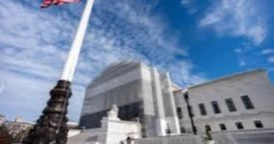
The U.S. Supreme Court on Friday agreed to examine the constitutionality of President Donald Trump’s order denying birthright citizenship to children born in the United States to parents who are in the country illegally or on temporary status.
The justices will hear Trump’s appeal of a lower-court decision that struck down the policy. The order has not taken effect anywhere in the nation.
The case is scheduled for arguments in the spring, with a ruling expected by early summer.
Trump signed the birthright citizenship directive on Jan. 20, the start of his second term, as part of a broader Republican-led push to tighten immigration enforcement. Other measures include ramped-up enforcement operations in several major cities and the first use of the 18th-century Alien Enemies Act during peacetime.
The administration faces numerous legal challenges, and the Supreme Court has delivered mixed rulings on related issues. The justices temporarily blocked use of the Alien Enemies Act for fast-tracking the deportation of alleged Venezuelan gang members, yet allowed immigration sweeps to resume in the Los Angeles area after a lower court halted them over profiling concerns.
The Court is also reviewing the administration’s emergency request to deploy National Guard units in the Chicago area for immigration operations — a move currently frozen by a lower court.
This is the first of Trump’s immigration policies to reach the Supreme Court for a final decision. The directive challenges more than a century of interpretation of the 14th Amendment, which has long been understood to guarantee citizenship to nearly all individuals born on U.S. soil, except for children of foreign diplomats or occupying forces.
Several lower courts have struck down the order as unconstitutional — or likely unconstitutional — even after the Supreme Court limited the use of nationwide injunctions earlier this year. However, the Court left open the possibility of nationwide relief through class actions or state-led suits.
Each lower court considering the issue has ruled that Trump’s directive violates the 14th Amendment, which was enacted to guarantee U.S. citizenship to Black Americans, including formerly enslaved people. Under long-standing practice, anyone born in the United States — including children of undocumented mothers — is automatically a U.S. citizen.
The case now before the Court originated in New Hampshire, where a federal judge in July blocked the order in a class-action suit covering all affected children. The American Civil Liberties Union is representing the children and families challenging the policy.
“No president can rewrite the 14th Amendment’s core guarantee of citizenship,” said Cecillia Wang, national legal director of the ACLU. “We look forward to resolving this issue definitively at the Supreme Court.”
The administration also asked the justices to review a July ruling from the 9th U.S. Circuit Court of Appeals, which held that Democratic-led states challenging the policy needed a nationwide injunction to avoid a patchwork of citizenship rules. The Supreme Court did not act on the 9th Circuit case.
The administration argues that children of noncitizens are not “subject to the jurisdiction” of the United States and therefore do not qualify for citizenship.
“The Citizenship Clause was intended to secure citizenship for newly freed slaves — not for children of individuals in the U.S. illegally or temporarily,” Trump’s solicitor general, D. John Sauer, wrote in urging Supreme Court review.
Twenty-four Republican-led states and 27 GOP lawmakers, including Senators Ted Cruz and Lindsey Graham, are supporting the administration’s position.