Israel’s defence minister issued an warning to Iran on Saturday saying “Tehran will burn” if the Islamic Republic persists in its missile attacks against Israel.
Following a meeting with Israel’s military chief, Defence Minister Israel Katz stated that Iran would face grave consequences for endangering Israeli citizens.
His remarks came after Iran fired a volley of missiles in retaliation for Israeli airstrikes that targeted Iran’s nuclear facilities a day earlier.
Iran's Retaliation After Israeli Strikes
In the early hours of Saturday, Iran launched drones and missiles at Israel in response to Israeli attacks that struck deep within Iran’s nuclear infrastructure and military leadership. At least three Israelis were killed and dozens injured in the Iranian strikes, according to Israeli officials.
The Israeli offensive, carried out using both aircraft and drones reportedly pre-positioned inside Iran, targeted sensitive military and nuclear sites, killing high-ranking generals and scientists. Iran’s ambassador to the U.N. reported 78 fatalities and over 320 injuries from the attacks.
In response, Iran sent waves of ballistic missiles and drones toward Israeli cities, lighting up the skies over Jerusalem and Tel Aviv. The Israeli military, already strained after nearly two years of war following Hamas’ October 7, 2023 attack, urged civilians to take shelter.
Both nations signaled their readiness to continue hostilities, raising concerns of a prolonged regional conflict. Prime Minister Benjamin Netanyahu stated his aim is to eliminate any threat from Iran, and called on the Iranian people to resist their rulers. He added that while Israel was not directly working toward regime change, it would welcome such an outcome.
Nuclear Talks in Jeopardy
The escalation cast a shadow over U.S.-Iran nuclear talks scheduled for Sunday in Oman. Iran’s Foreign Ministry spokesperson said Israel’s strikes made further negotiations “meaningless,” blaming Washington for enabling the attack.
“The U.S. did a job that made the talks become meaningless,” said Esmail Baghaei, as quoted by state TV. He condemned Israel’s actions as a “criminal act” that crossed all red lines, though he stopped short of declaring the talks canceled. Iran’s judiciary-run Mizan news agency reported that a final decision had not yet been made regarding Sunday’s meeting.
Iranian Missiles Hit Israeli Cities
Ayatollah Ali Khamenei, Iran’s Supreme Leader, vowed consequences for Israel’s actions, saying: “We will not allow them to escape safely from this great crime they committed.”
Missiles launched from Iran struck several targets across Israel late Friday and into Saturday morning. In Tel Aviv, seven people were treated for injuries, and a woman died after a projectile hit a building. Later, two more people were killed and 19 injured in Rishon Lezion when another missile landed near homes.
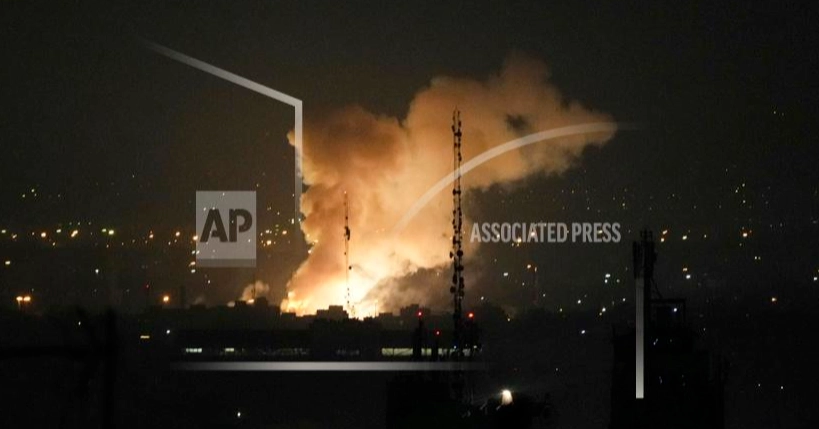
In Iran, residents heard explosions and saw Tehran’s air defenses activated shortly after midnight. A fire was reported at Mehrabad International Airport, with video footage showing smoke and flames. The Israeli military confirmed it had struck air defense targets near Tehran.
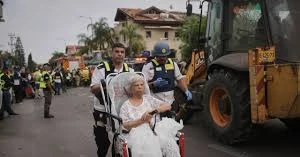
In the Tel Aviv area, 34 people were reportedly injured in the attacks. A critically wounded woman was pulled from rubble. AP journalists observed significant damage in Ramat Gan, including destroyed cars and houses with extensive structural damage.
“We thought, that’s it, the house is gone, and in fact half of the house was gone, it fell apart,” said Moshe Shani, a resident of a city hit Friday night.
U.S. officials confirmed American ground-based air defenses assisted in intercepting Iranian missiles.
Fears of Regional War Mount
The latest strikes raised fears of a full-scale war between Israel and Iran. The broader region, already tense due to Israel’s ongoing campaign in Gaza, now faces even greater instability. In Gaza, 27 people were reportedly killed by Israeli airstrikes overnight.
While regional governments condemned Israel’s initial attack, global leaders urged both countries to deescalate immediately.
Despite longstanding American concerns that such a move could trigger a broader Middle East war, a mix of developments — including Hamas’ 2023 attack and the reelection of President Donald Trump — gave Israel the conditions it needed to proceed. Netanyahu stated the U.S. was informed in advance of the offensive.
Israel’s strikes came just a day after the U.N.’s nuclear watchdog censured Iran for non-compliance with safeguards meant to prevent nuclear weapons development.
Airspace across the Middle East was temporarily disrupted, but by Saturday morning, both Jordan and Lebanon announced they had reopened their skies to civilian flights.
Key Iranian Nuclear Sites Hit
Among Israel’s key targets was Iran’s main uranium enrichment facility in Natanz, where black smoke was seen rising. Israel also appeared to hit the Fordo enrichment site and a nuclear research facility in Isfahan.
According to the U.N.’s nuclear chief, Rafael Grossi, the above-ground portion of the Natanz facility was destroyed, though the underground centrifuge hall remained intact. Still, the damage to infrastructure may be significant due to power loss.
Netanyahu revealed that the operation had been planned months ago and was initially scheduled for April but was postponed.
Two Israeli security officials said Mossad had planted drones and weapons inside Iran in advance, which were used to take out air defense systems and missile launchers near Tehran. These claims could not be independently verified.
Over the past year, Israel has targeted Iran’s air defenses several times, including striking a radar system in April 2024 and missile production sites last October.
An Israeli military official said that the first wave of strikes gave Israel “significant freedom of movement” in Iranian airspace and suggested further attacks were planned. The official noted that Israel was prepared for an operation lasting up to two weeks.
Senior Iranian Military Leaders Killed
Among those killed in the strikes were some of Iran’s top military commanders: Gen. Mohammad Bagheri, chief of Iran’s armed forces; Gen. Hossein Salami, leader of the Revolutionary Guard; and Gen. Amir Ali Hajizadeh, head of its missile program. Iran later confirmed the deaths of two additional senior officers: Gen. Gholamreza Mehrabi and Gen. Mehdi Rabbani.
Former U.S. President Donald Trump, addressing the conflict on his Truth Social platform, warned Iran to strike a deal with the U.S., stating, “Iran must make a deal, before there is nothing left.”