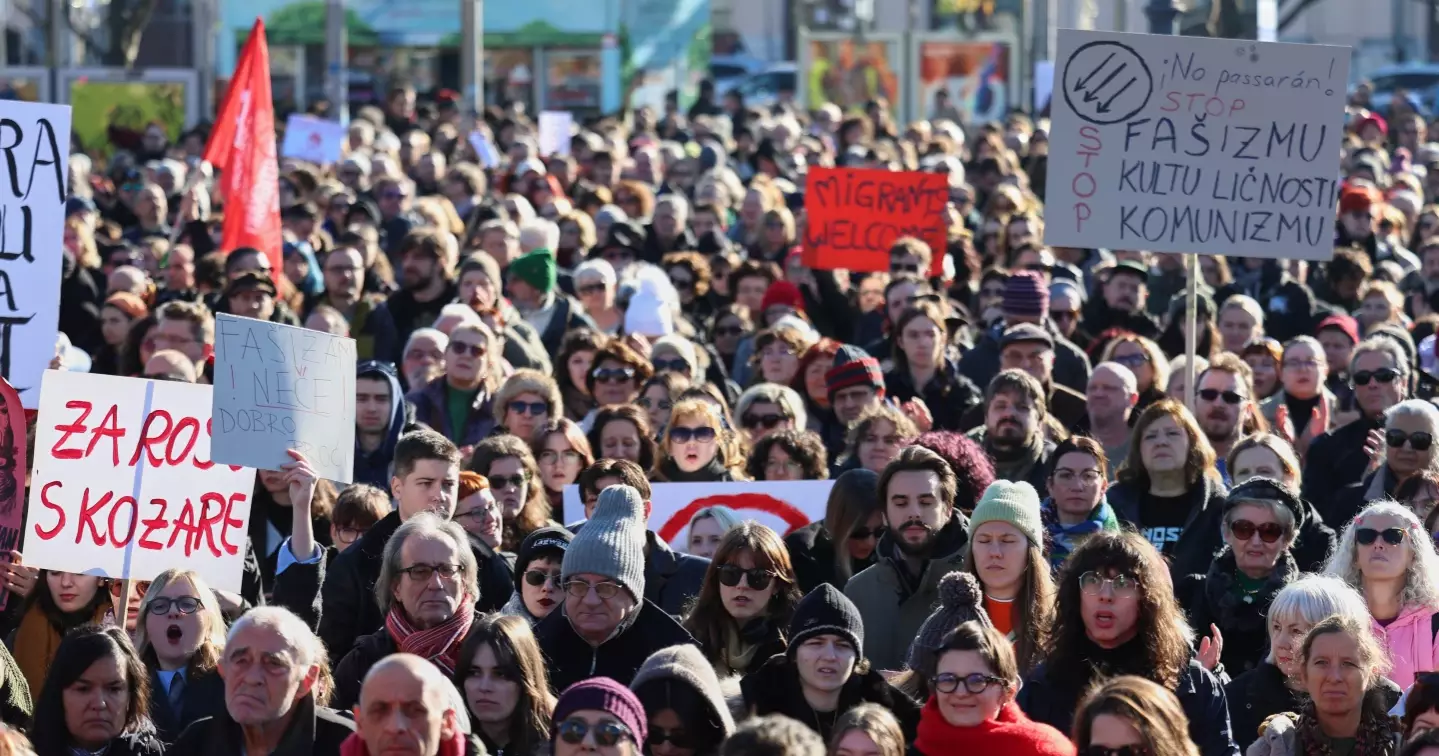
Thousands of people protested across Croatia on Sunday against a rising far-right movement following a series of incidents that heightened ethnic and political tensions.
Demonstrations under the banner “United against fascism” took place in four major cities, including the capital Zagreb. Protesters chanted “we are all antifascists” and called on authorities to curb far-right groups and their frequent use of pro-fascist symbols linked to Croatia’s World War II pro-Nazi puppet state, which ran concentration camps where tens of thousands of Serbs, Jews, Roma, and antifascist Croats were killed.
A protest declaration said, “We will not agree to treating national minorities as a provocation or to a form of patriotism that draws from the darkest chapter of our history.”
Journalist Maja Sever addressed the crowd in Zagreb, saying, “All that has been happening around us is very dangerous. You have shown you will not be quiet but that we will fight for a democratic society.”
Counter-gatherings by young men in black occurred in Rijeka and Zadar, where they shouted insults and threw firecrackers and red paint at protesters, according to the HRT public broadcaster.
Incidents in November targeted ethnic Serb cultural events in Zagreb and Split, raising fears of ethnic violence decades after the 1991-95 Serb-Croat war. Extremists also directed attacks at liberal groups, politicians, and foreign workers, often using the Nazi-era Ustasha salute “For the homeland — Ready!”
Iva Davorija, organizer of the Zadar march, said, “They are throwing smoke bombs, firecrackers, and threatening violence, raising their right hand in the air and shouting the slogan. They are doing this freely.”
Croatia’s political shift to the right began after Prime Minister Andrej Plenkovic’s conservative party formed a coalition with a far-right party following last year’s parliamentary election, excluding an ethnic Serb party from government for the first time in years.
The trend intensified after a July concert by right-wing singer Marko Perkovic, known as Thompson, who frequently uses the World War II-era slogan in his songs. Despite bans in some European cities, he remains highly popular in Croatia.
Prime Minister Plenkovic denied ignoring far-right extremism and neo-fascist hate speech, accusing leftist opponents of exaggerating the problem and deepening divisions.
Croatia, formerly part of Communist Yugoslavia, joined NATO in 2009 and the European Union in 2013, following a series of nationalist wars in the 1990s that left over 10,000 people dead.