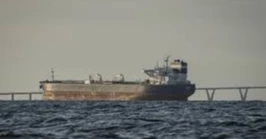
US military forces intercepted and boarded another oil tanker in the Caribbean on Friday, marking the fifth such seizure under the Trump administration’s campaign to target sanctioned vessels operating to and from Venezuela as Washington seeks greater control over the country’s oil sector.
According to U.S. Southern Command, Marines and Navy personnel carried out the early-morning operation from the aircraft carrier USS Gerald R. Ford, part of a sizable U.S. military presence that has expanded in the Caribbean in recent months. The tanker, identified as the Olina, was secured and later handed over to the U.S. Coast Guard. Southern Command declared during the announcement that “criminals will find no refuge.”
Unclassified videos released by Southern Command and Homeland Security Secretary Kristi Noem showed a U.S. helicopter landing on the ship, service members searching the deck, and what appeared to be an explosive charge placed near a doorway to access the vessel’s interior.
Noem described the Olina as part of a so-called “ghost fleet” suspected of transporting oil in violation of U.S. sanctions. She said the tanker had departed Venezuela while attempting to avoid detection by American forces.
The seizure represents the fifth tanker taken under President Donald Trump’s push to oversee Venezuela’s oil production, refining, and worldwide distribution following the U.S.-led removal of President Nicolás Maduro in a surprise nighttime operation.
Trump later said on social media that the action was carried out “in coordination with the Interim Authorities of Venezuela,” though he did not provide further details. The White House declined to immediately comment.
Venezuela’s government confirmed it was cooperating with U.S. officials to return the tanker, stating that the vessel had departed Venezuelan waters without proper authorization or payment. Officials said the ship was now being escorted back to Venezuelan waters for protection and further legal steps, calling the operation a successful joint effort.
Shipping analyst Samir Madani, co-founder of TankerTrackers.com, said satellite data and photographs indicate that at least 16 tankers recently left Venezuela in violation of a U.S.-enforced maritime quarantine aimed at stopping sanctioned trade. The Olina was among those vessels.
U.S. records show the tanker had previously been sanctioned for transporting Russian oil under its former name, Minerva M, and was once registered in Panama. Although the Olina now claims registration under Timor-Leste, international shipping databases list its flag as invalid. The ship’s ownership and management were transferred in July to a Hong Kong–based company.
Tracking data shows the Olina last broadcast its location in November while in the Caribbean north of Venezuela. Since then, the vessel had disabled its tracking signal, a practice commonly referred to as “going dark.”
While U.S. officials have portrayed the seizure as routine law enforcement, other members of the Trump administration have openly framed the effort as a revenue-generating strategy intended to revive Venezuela’s struggling oil industry and economy.
In a social media post Friday morning, Trump said the U.S. and Venezuela were cooperating closely to rebuild and modernize the country’s oil and gas infrastructure. The administration estimates it could sell between 30 million and 50 million barrels of sanctioned Venezuelan oil, with proceeds benefiting both countries, and expects the arrangement to continue long term.
Trump also met Friday with oil industry executives to discuss plans to invest $100 billion in restoring and upgrading Venezuela’s oil production and distribution networks.
Vice President JD Vance said this week that Washington can effectively control Venezuela’s finances by determining where its oil is allowed to be sold.
Madani estimated that the Olina was carrying roughly 707,000 barrels of crude, worth more than $42 million at current market prices of around $60 per barrel.