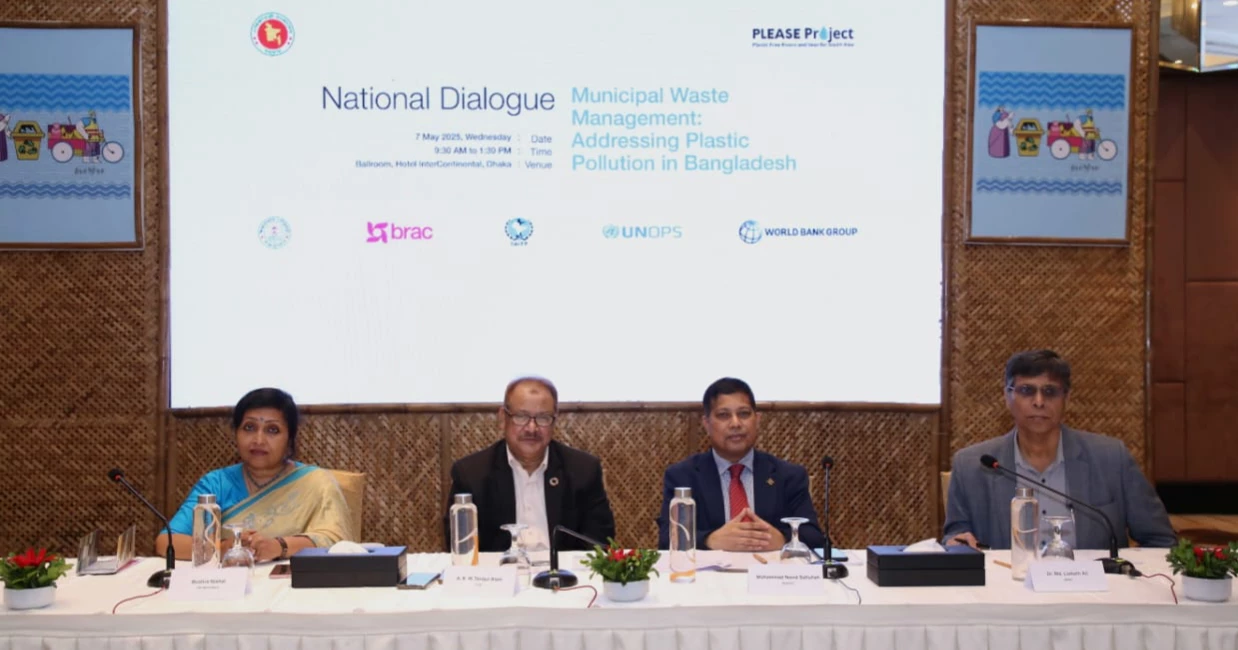
Speakers on Wednesday said that plastic waste management in city and rural areas remains a serious challenge in Bangladesh.
According to BRAC’s 2024 Baseline Study conducted in Cox’s Bazar, an estimated 34.5 tonnes of plastic waste are mismanaged daily in the municipality -- much of it flowing into canals, drains, and eventually the sea.
The study also found that only 18 per cent of the population practices waste segregation at source, with many lacking access to formal waste collection services.
In response to the growing plastic pollution crisis, a high-level national dialogue titled “Municipal Waste Management: Addressing Plastic Pollution in Bangladesh” was held at InterContinental Dhaka.
Organised by BRAC under its flagship Plastic Free Rivers and Seas for South Asia (PLEASE) project -- funded by the World Bank with support from South Asia Co-operative Environment Programme (SACEP) and United Nations Office for Project Services (UNOPS) -- the event brought together senior government officials, municipal leaders, private sector representatives, researchers, and development practitioners.
Additional secretary of Local Government Division (LGD) AKM Tariqul Alam
and additional secretary at Ministry of Environment, Forest and Climate Change (MoEFCC) Mohammad Navid Safiullah graced the event as guests of honour while Environmental Specialist atbThe World Bank Bushra Nishat attended as the special guest.
The welcome address was delivered by Imamul Azam Shahi, Programme Head, Urban Development Programme (UDP), while Ekhtekharul Islam, a faculty member at the Independent University, presented the keynote, says a press release.
Sankalita Shome, chief coordinator at the Bangladesh Sustainability Alliance (BSA), moderated the panel discussion while Insights were shared by Municipal Administrator of Cox’s Bazar Municipality
Prof Yunus welcomes investment proposals from UAE in various sectors
Rubaiya Afroz, senior chemist (Waste and Chemicals Management) of Department of Environment (DoE) Kazi Suman, deputy secretary at MoEFCC Rubina Ferdousi, Country Head of Corporate Affairs and Brand and Marketing of Standard Chartered Bangladesh Bitopi Das Chowdhury, Country Director at Practical Action Ishrat Shabnam, and Joint secretary (Climate Change) of MoEFCC Dharitri Kumar Sarkar
Speaking at the event, AKM Tariqul Alam emphasised the importance of preventing plastic waste from flowing downstream into the sea by strengthening systems that intercept waste along rivers and streams.
He added that Bangladesh can benefit from both studying international best practices and scaling up homegrown, locally-led innovations in waste management.
Mohammad Navid Safiullah stated that the ministry has reinforced regulatory measures and scaled up enforcement to address the growing plastic pollution crisis. In parallel, it is actively promoting sustainable alternatives, such as jute- and potato starch-based products.
Bushra Nishat highlighted that although Bangladesh’s per capita plastic use -- around 9 kg annually -- is significantly lower than that of countries like the USA or UK, the consequences of mismanaged plastic waste are much more severe. She identified inadequate source segregation as a major challenge and underscored the need for household-level awareness to drive meaningful community participation in waste management.
In his closing remarks and vote of thanks, Director of Climate Change, Urban Development and Disaster Risk Management Programme at BRAC Dr. Md. Liakath Ali stressed the importance of multi-level stakeholder coordination and the adoption of circular economy principles to address plastic waste effectively. With increasing momentum in plastic waste management efforts, he expressed hope that Bangladesh is moving steadily towards its long-term vision of zero waste.
The dialogue underscored the need for stronger municipal leadership and coordination. Participants emphasised that city governments must be equipped with the authority, resources, and capacity to implement effective, locally-led waste management solutions.
Speakers highlighted persistent gaps in collection, segregation, and enforcement -- particularly in urban coastal areas such as Cox’s Bazar, where tourism and the influx of Rohingya populations have intensified the challenge. While national policies are in place, translating them into actionable interventions at the municipal level remains a critical hurdle.
An exhibition was also organised as part of the event, showcasing innovative solutions piloted under the PLEASE project in Cox’s Bazar. Green entrepreneurs -- including ProPad, DenimRevive, Repro, Wonder Garden, EcoCare, EcoSundar Khulna, and Art for Arter -- displayed recycled and upcycled products, such as shoes made from discarded denim and eco-friendly sanitary items.
Guests were introduced to the project’s aesthetically designed communal bins and a proposed plastic recycling facility -- both aimed at encouraging municipalities to adopt inclusive and sustainable waste management practices.
Data from the PLEASE project indicate that approximately 12.5 per cent of household waste in Cox’s Bazar is plastic. This level of pollution poses a serious threat to coastal ecosystems and to the lives and livelihoods of communities that depend on the sea.