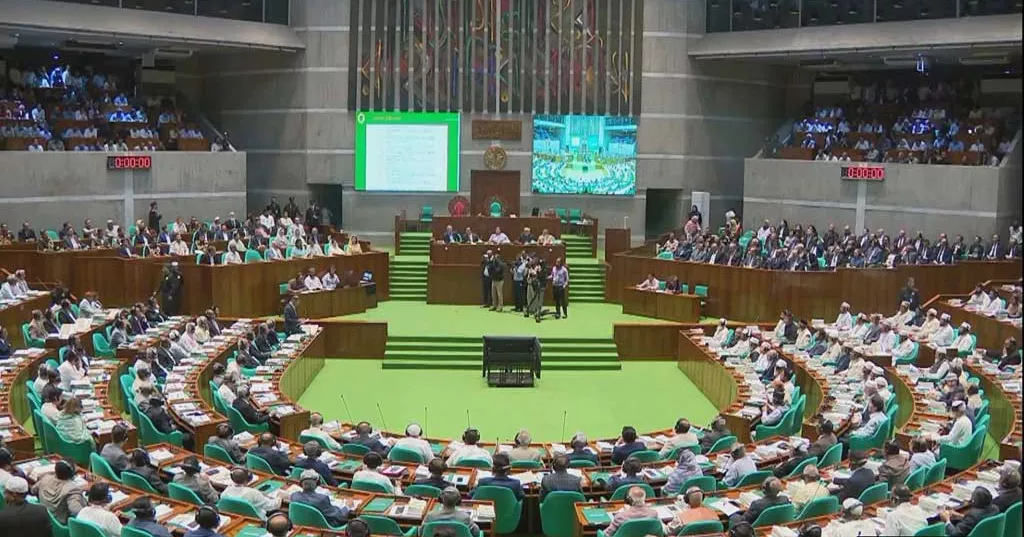
Lawmakers from both treasury and opposition benches engaged in a heated debate in Parliament on Wednesday over proposed constitutional reforms and the implementation of the “July National Charter,” during discussions on the President’s address.
The session saw MPs from BNP and Bangladesh Jamaat-e-Islami debate the legitimacy of the current parliamentary structure and the future of the nation’s democratic framework.
Mohammad Kamal Hossain, Jamaat MP from Dhaka-5, sparked intense debate by questioning the government's delay in convening the Constitution Reform Council.
Citing a statement made by Home Minister Salahuddin Ahmed regarding the validity of referendum, he insisted that the government must immediately call for a session of the reform council.
"If a referendum is valid, then you must call for a session of the Constitution Reform Council. Otherwise, this Parliament will become illegitimate after 180 days," Kamal Hossain warned.
He emphasised that the core spirit of the July uprising was to "repair the state" and establish a state free of discrimination, arguing that mere amendments to the existing Constitution will not suffice to fulfil the martyrs' aspirations; rather, a total transformation is required.
The Jamaat MP also took a swipe at the government's energy management, noting that fuel is scarce for the public.
Mentioning that he had to stand on the road until 2:00am on Tuesday but failed to get fuel, he joked, “Fuel is only available in this House – so much fuel is being wasted here. Outside, it is hard to find fuel.”
Representing the ruling BNP, Mohammad Abu Sufian (Chattogram-9) highlighted that while people send representatives to Parliament, their fortunes often remain unchanged. However, he expressed confidence in the leadership of Prime Minister Tarique Rahman.
"The people have placed their trust in the 'I Have a Plan' initiative and the 31-point programme presented by the Prime Minister. Under his leadership, we hope to establish a safe and rights-based Bangladesh," Sufian said. He also called for strict legislation to combat "false propaganda and photo cards" on social media, urging a clear distinction between freedom of speech and criminal offence.
AKM Fazlul Haque Milan, another ruling party MP, described the July Charter as a realistic roadmap written with the blood of martyrs rather than just political rhetoric.
He criticised the opposition members for engaging in "hearsay politics" and urged a focus on systematic solutions.
Addressing those who joined the uprising in its final stages, Milan said: "We know who joined the movement when and from where. The 16-17 years of continuous struggle that led to this point should not be undermined by those who only appeared at the very end."
Abdus Salam Azad (BNP) drew Parliament’s attention to the environmental risks facing Bangladesh, particularly the threat of desertification due to the Farakka Barrage.
He noted that Prime Minister Tarique Rahman has revived the "canal-digging revolution" originally initiated by Shaheed President Ziaur Rahman to mitigate these risks, calling for national unity on the issue.
Finally, Fakhruddin Ahmed (Mymensingh-11) touched upon the President's address, noting that the head of state had acknowledged the dark history of forced disappearances, murders, and the 2024 genocide.
"The President has admitted that this current Parliament is the result of a neutral election. We can consider him a witness who has testified against the misdeeds of the previous regime through his speech," Fakhruddin said.