After two years of rapid, war-fueled growth, Russia’s economy is losing momentum. Oil revenues have dropped, the budget deficit has widened and defense spending — the engine of recent expansion — has plateaued.
Facing growing financial pressures, the Kremlin is turning to ordinary consumers and small businesses for additional revenue, signaling where President Vladimir Putin plans to find the money to stabilize state finances.
A proposed increase in value-added tax (VAT) from 20% to 22% could add up to 1 trillion rubles ($12.3 billion) to government coffers. The measure is already advancing through the Russian parliament and is slated to take effect on Jan. 1.
More tax hikes and higher fees expected
The legislation also lowers the sales-revenue threshold for businesses required to collect VAT, dropping gradually to 10 million rubles ($123,000) by 2028 from the current 60 million rubles ($739,000). The move aims partly to prevent firms from splitting operations to dodge the tax — but it will also pull in many small enterprises such as neighborhood shops and beauty salons.
Other proposed measures include higher excise taxes on spirits, wine, beer, cigarettes and vapes. The tax on strong liquor like vodka would rise by 84 rubles per liter of pure alcohol — roughly 17 rubles (20 cents) for a half-liter bottle, or about 5% of the minimum retail price.
Fees for driver’s license renewals and international licenses are also set to increase, while a major tax break on imported cars will be scrapped. Russian media report that officials are considering a new technology tax of up to 5,000 rubles ($61.50) on high-end devices such as smartphones and laptops.
G7 ministers reaffirm support for Ukraine, sidestep trade and military strike debates
The unfolding tax measures underscore the trade-offs Putin faces as the war in Ukraine enters its fourth year: the tension between sustaining military spending and protecting household purchasing power.
Public reaction: frustration mixed with resignation
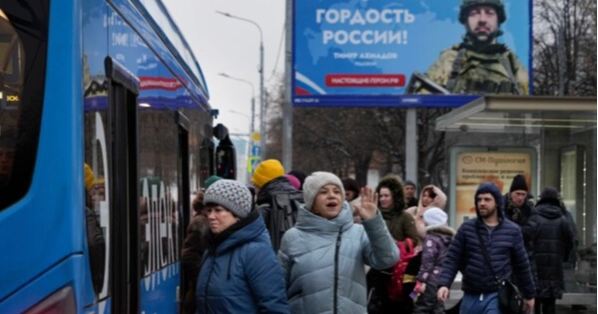
On a Moscow street, residents told The Associated Press the changes will strain household budgets, particularly in poorer regions.
Pensioner Svetlana Martynova warned that forcing smaller firms to collect VAT could backfire.
“I think small and medium businesses will fold,” she said. “The budget will get less, not more.”
Higher car registration costs add to the burden
The VAT hike arrives alongside changes to the recycling fee for registering cars — a cost increase that will hit owners of higher-powered imported vehicles. Starting Dec. 1, individuals will lose access to a concessionary rate of 3,400 rubles ($42) on cars above 160 horsepower and must pay the commercial rate, potentially hundreds of thousands of rubles.
But this will do little to spur domestic auto manufacturing, said Andrei Olkhovsky, head of the Avtodom auto group, citing high interest rates and the relatively small Russian market compared to China, now the main supplier of imported vehicles.
He expects sales to dip in the short term and then return to current levels.
“Taxes and fees will influence prices,” Olkhovsky said. “Consumers will adapt — and demand higher wages. That will raise the cost of everything around us.”
Slower growth widens deficit
Russia’s economy contracted early this year and is projected to grow only about 1% in 2025 — a sharp slowdown from the more than 4% logged in both 2023 and 2024. High central bank interest rates, now 16.5%, are dampening activity as policymakers try to curb inflation running at 8% after years of heavy wartime spending.
Oil revenues have fallen roughly 20% due to lower global prices, according to the Kyiv School of Economics Institute. Western sanctions continue to drag on investment and raise production costs.
As a result, the budget deficit has been revised upward to 2.6% of GDP, compared with 1.7% last year. Unlike many countries, Russia cannot borrow on global bond markets and must rely on domestic banks.
Finance Minister Anton Siluanov has argued that raising revenue is preferable to borrowing, saying excessive debt would fuel inflation and force even higher interest rates — further weakening growth.
SoftBank sells Nvidia stake for $5.8 billion to boost investments in OpenAI
While the VAT increase may briefly push prices higher, economists say it could later ease inflation by reducing demand.
Kremlin still has cash, but choices ahead grow harder
The tax increases mark a shift away from the earlier wartime economic model, in which higher oil prices and soaring defense spending boosted wages and kept consumer demand strong. Death payments and recruitment bonuses also pumped money into poorer regions.
Putin is not at imminent risk of running short, said Alexandra Prokopenko of the Carnegie Russia Eurasia Center in Berlin.
“Growth is slowing, but companies are paying taxes, people are consuming and earning salaries, and paying taxes on those incomes,” she said. “For the next 12 to 14 months, Putin has enough money to sustain the war and current spending levels.”
Beyond that point, she added, the Kremlin may confront tough decisions.
“He will need to choose between maintaining military spending and preserving consumer living standards so people don’t fully feel the impact of the war.”
Source: AP