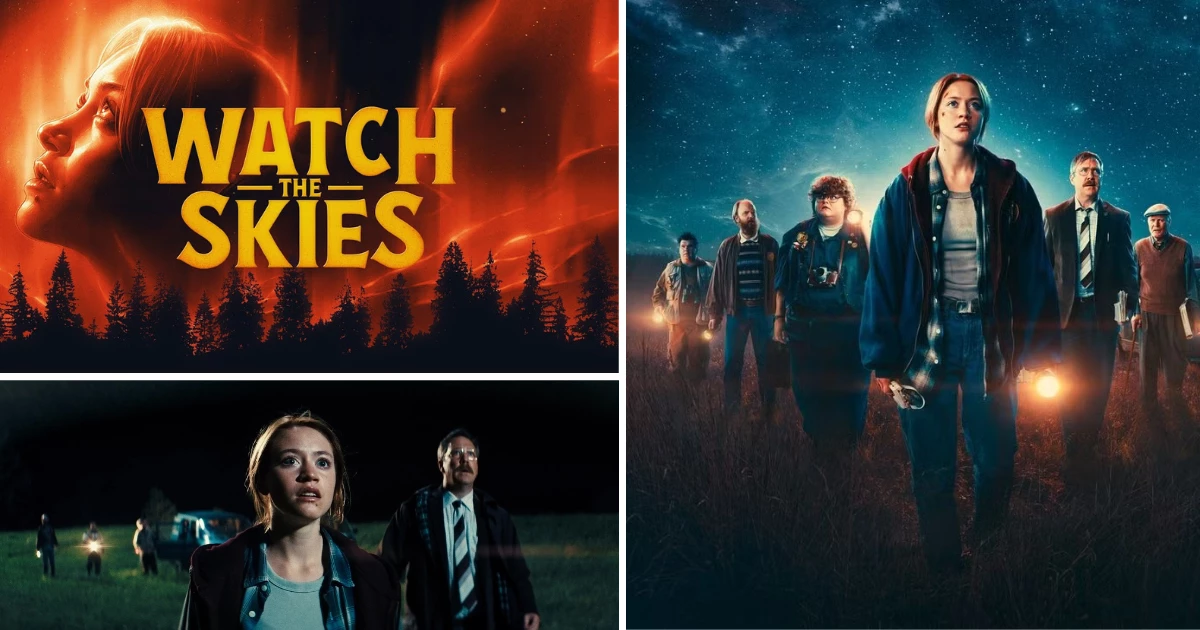
In the ever-evolving landscape of global cinema, ‘Watch the Skies’ emerges as a bold statement in technological storytelling. This Swedish sci-fi adventure made its American debut on May 9, 2025, signalling a shift in how a film can transcend language. With artificial intelligence now stepping into the dubbing booth, a new chapter begins for international film experiences. Let’s get to know the 2025 film 'Watch The Skies' and uncover the impact of this groundbreaking leap into AI-dubbed cinema.
Plot, Direction, Cast
Set in 1996, this nostalgic sci-fi adventure follows the journey of a teenage girl named Denise. Her world is still haunted by the sudden disappearance of her father. Years ago, he vanished one night while chasing a report of a flying saucer in the woods near their quiet town.
Denise’s search for answers draws her to a group of misfit investigators at a local UFO club- UFO Sweden. The story unfolds with eerie mystery and quiet intensity, echoing the spirit of the iconic ‘The X-Files.’
Read more: Asif Ali-starrer Tiki Taka Filmmaking in Full Swing, Release Window Revealed
This sci-fi movie comes to life under the direction of Victor Danell, produced by his banner, Crazy Pictures. Danell also co-wrote the script with Jimmy Nivren Olsson.
The movie stars Inez Dahl Torhaug, Jesper Barkselius, Sara Shirpey, Eva Melander, Hakan Ehn, Isabelle Kyed, Jean-Paul Lucasson, Joakim Sallquist, and Christoffer Nordenrot.
Albin Pettersson and Olle Tholen steer the production.
New Era of the Film Industry
‘Watch the Skies’ stands as the first feature film to showcase an innovative leap in cinematic technology: AI-powered visual dubbing. At its core is TrueSync, a tool developed by British AI startup Flawless. It adjusts actors’ facial movements and spoken lines to align seamlessly with dubbed audio. To ensure authenticity, the original Swedish cast re-recorded their lines in English. It allows the AI to sync both voice and lip movement without replacing the actors themselves.
Read more: 8 New K-Dramas to Watch in June 2025
The result is a dubbed version that preserves the actors' on-screen presence while eliminating the usual disconnect often found in traditional dubbing. XYZ Films, in partnership with Flawless, led this initiative.
It addresses the long-standing language barrier that foreign films face beyond their domestic markets. This method opens doors for international stories to be experienced by broader audiences, without losing their visual and emotional integrity.
Producer Pettersson, in a behind-the-scenes trailer, remarked that this shift represents a breakthrough for the global film industry. He emphasised how language can limit reach and that this technology overcomes that challenge.
Read more: Paresh Rawal Quits Hera Pheri 3, Leaving Franchise Fans Shocked
Director Danell acknowledged that while initial apprehension is natural among creatives, the process allowed them to retain full artistic control. He described the experience of re-performing the film in English as both unusual and exciting.
Following the 2025 movie ‘Watch the Skies,’ XYZ Films and Flawless are continuing their AI-dubbing collaborations with more multinational titles. The lineup includes ‘The Book of Solutions’ (France), ‘Smugglers’ (Korea), ‘Tatami’ (Iran), and ‘The Light’ (Germany).
Challenges to Embrace
Despite the growing excitement around visual dubbing, not all voices in the global film community are in full support.
Simon Kennedy, president of the Australian Association of Voice Actors (AAVA), acknowledged that the technology behind visual dubbing is undeniably fascinating. However, he pointed out that the ethical framework guiding its use remains unclear. He emphasised that issues of consent, control, and fair compensation must be taken seriously.
Read more: Bhool Chuk Maaf Movie Update: New Theatrical and OTT Release Dates
Kennedy stressed that artists should be fully informed and involved when their vocal likeness is used. He warned against scenarios where voices are manipulated without permission. Some potential risks lead to unauthorised content that an actor may never agree to deliver.
He also noted that Australia does not have a large dubbing industry. Instead, much of the English-language dubbing work for foreign films is carried out in the UK and the US.
Replacing Human Voice Artists
Kennedy expressed apprehension over how rapidly advancing technology could displace human talent. He noted that if Australian film companies gain access to sufficiently convincing AI-generated voices, many would likely adopt them without hesitation. Kennedy pointed to two recent ad campaigns that had quietly employed AI voices without disclosing their use.
These fears intensified in April 2025 with the recent incident in CADA, a Sydney-based station under the Australian Radio Network. They had used an AI-generated radio host for roughly six months without informing its audience.
Read more: Top 10 Netflix Originals Streaming in June 2025
Teresa Lim, vice president of AAVA and a fellow voice actor, reinforced the need for transparency. She acknowledged that ‘Watch the Skies’ still involved human translation and performance, despite relying on AI tools. In her view, this balanced approach remained acceptable. The real issue, she argued, emerges when human contributions are entirely removed. That’s when ethical risks deepen, ranging from the erosion of artistic integrity to the cultural dilution of performances.
Lim also warned that the technology is dangerously efficient and inexpensive. It predicts that such cost-saving appeal might lead producers to bypass traditional dubbing altogether.
Concerns raised by Australian voice artists align with those voiced across the global dubbing community. On March 28, prominent German dubbers, including Peter Flechtner and Claudia Urbschat-Mingues, released a widely circulated video. In it, they warned of growing threats to their profession and urged the public to prioritise ‘artistic intelligence’ over AI.
Read more: Godzilla x Kong: Supernova Teased for 2027 with Another Epic Monster Clash
Flechtner and Urbschat-Mingues are known, respectively, as the German voices for renowned Hollywood artists Ben Affleck and Angelina Jolie.
In France, resistance to AI-dubbing gained traction through the petition #TouchePasMaVF (Don’t Touch My Dubbing). It was initiated by the French Union of Performing Artists and Les Voix, a leading dubbing association. At the time of reporting, it had amassed 221,693 signatures, underscoring the depth of unease within the industry.
Palace Cinemas CEO Benjamin Zeccola, speaking from the Cannes Film Festival, reacted to the Swedish film with visible emotion. He admitted feeling disheartened, explaining that much of his joy in cinema stemmed from hearing actors speak in their native languages. For him, the natural cadence carried by original dialogue reflects one of humanity’s richest traits.
Still, Zeccola also recognised the potential of AI-dubbing to make international cinema more accessible. He acknowledged that such technology might help many reach wider audiences, especially in places like Australia. There, foreign-language titles often remain underexposed.
Read more: Top Amazon Prime Originals to Binge-Watch in June 2025
In a Nutshell
As the world’s first AI-dubbed feature, ‘Watch The Skies’ is truly set to shift how audiences experience foreign films. Backed by Flawless and XYZ Films, the TrueSync tool syncs English dialogue with actors' lip movements. Yet, concerns over ethics, consent, and job loss dominate global voice artist communities. Australian and European professionals warn of fading artistic integrity. Despite its accessibility gains and clear risks, this early stage of innovation is likely to spark further debate.