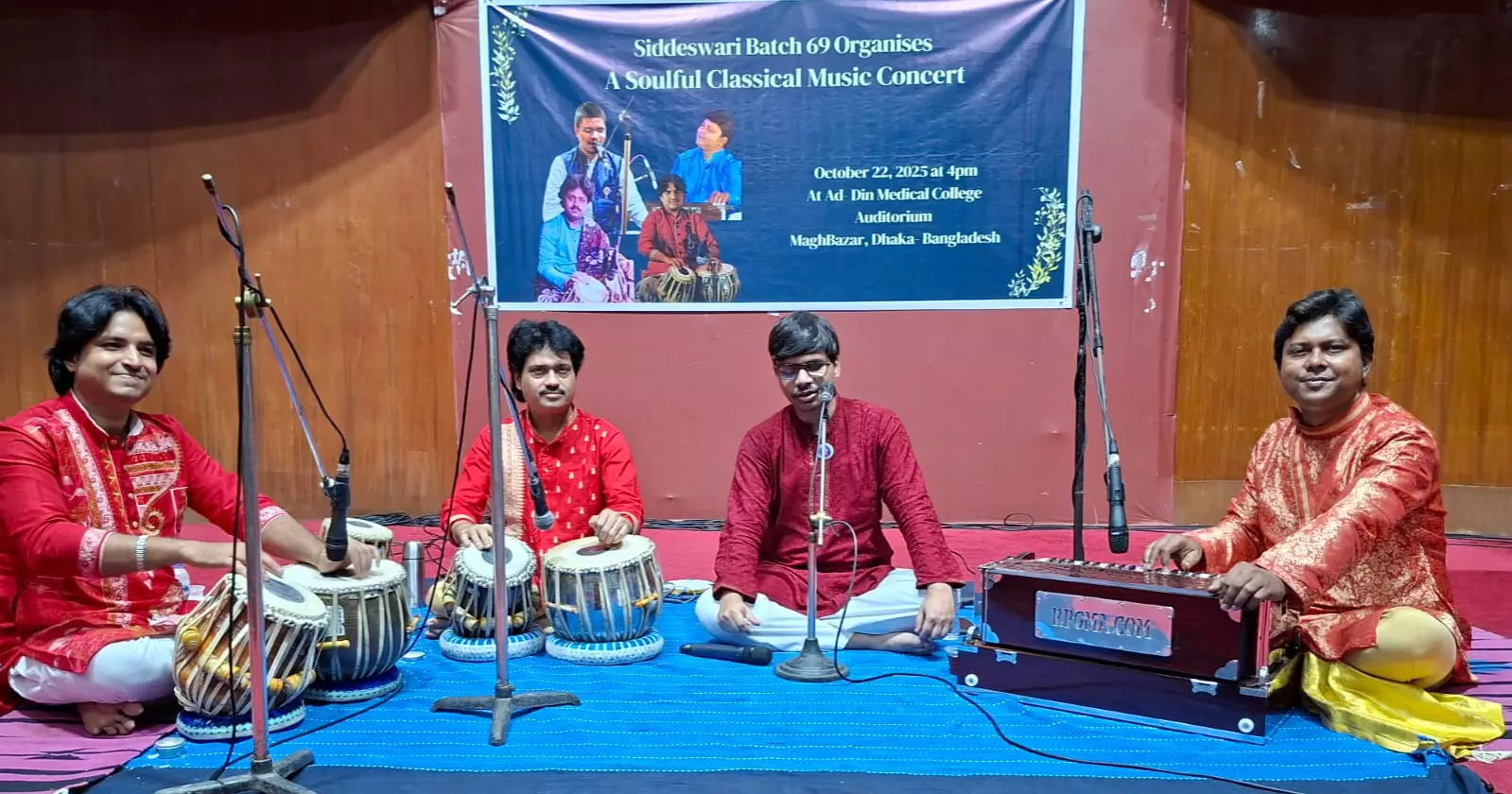
A soulful musical evening of classical music, storytelling, and narration was conducted by Shri Aditya Nirmal, a distinguished disciple of Pandit Samaresh Chowdhury under the school of Pandit Ravi Shankar, from Lucknow, India. Was held in the city.
The soulful and mesmerizing Classical Music Concert was organized by Siddeshwari 69 Batch and held at An Auditorium in Dhaka.
The concert drew a full house of music lovers, turning into a celebration of melody, rhythm, and emotion.
The concert was inaugurated by the Advisor of Ad-Din Medical College, Dr. Munshi Anwar Hossain, and began with a warm welcome address by the Convener of Siddeshwari Batch ’69, Mr. Fazlul Karim Abid. Professor Mostafizur Rahman, an esteemed alumnus and inspiration for generations of students, graced the event with his presence.
Aditya led the session as the principal vocalist, narrator, storyteller, and music presenter, weaving together an intricate musical and cultural dialogue. The event was designed to explore the evolution of Bengali culture, people, and language, intertwined with the historical development of Indian classical music—tracing its roots from Dhrupad to Khayal, Thumri, and Bhajan traditions.
The narration was delivered in Bengali, accompanied by live renditions of several classical Ragas, including Raag Kaushik Dhvani, Raag Khamaj, Raag Bhairavi, Raag Yaman, and Raag Vasant. The presentation also featured Chhota Khayal and Bengali Khayal compositions—fields in which Aditya has been recognized as a pioneer and innovator.
Aditya Nirmal (Vocal) captivated the audience with his deep and expressive renditions of Raag Kaushik Dhvani, Raag Bhairavi, and Bangla Khayal, creating a serene connection between sound and soul. Aditya also shared the history of the Bangla language and people and its relationship with the history of Indian classical music. Simultaneously, the evolution of society and its interconnection with religion was expressed through Nazrul Sangeet, Hamnad, and Rabindra Sangeet.
The evening further included Nazrul Sangeet, among which “Bagichay Bulbuli Tui” and “Bhoriyapuran” were performed and beautifully rendered by Aditya Nirmal on harmonium. Another Nazrul Sangeet composition was also presented, enriching the musical diversity of the evening.
Several Rabindra Sangeet pieces were performed, deepening the audience’s connection to Bengali musical heritage. Additionally, the Thumri “Kakaroo Sajni” was rendered with profound emotion and classical depth, highlighting the expressive nuances of Hindustani semi-classical tradition.
The instrumental segment featured Dilip Biswas on harmonium, accompanied by Pandit Ujjwal Roy and Rahul Chatterjee on tabla in Teental, presenting an engaging jugalbandi and solo rhythmic dialogue.
Pandit Ujjwal Roy, one of India’s eminent tabla maestros, is a disciple of Pandit Swapan Chaudhuri, Pandit Ashok Mehta, Pandit Suresh Talwalkar, Pandit Yogesh Samsi, and Pandit Swaraj Bhattacharya. His co-performer, Rahul Chatterjee, is a devoted disciple of Pandit Ujjwal Roy, while Dilip Biswas has been trained under the guidance of Pandit Jyoti Goho.
Alongside the classical and instrumental performances, the session offered Rabindra Sangeet, Nazrul Sangeet, Thumri, and insightful interpretations of Bengali Khayal compositions by Kabir Suman, giving the audience a profound musical experience that seamlessly bridged tradition, innovation, and cultural depth.
The narration and session also incorporated the poetic and philosophical points of Jibanananda Das, Kazi Nazrul Islam, and Jasimuddin, as well as Hamnad, enriching the presentation with literary essence and spiritual reflection.
Throughout the evening, the audience remained spellbound, responding to every alaap, taan, and rhythm cycle with heartfelt applause. The performers’ dedication and artistry reminded everyone that music, in its truest form, transcends words and unites hearts.
The program was beautifully coordinated and hosted by Siddeshwari (69 Batch), whose efforts in promoting classical heritage were widely appreciated.