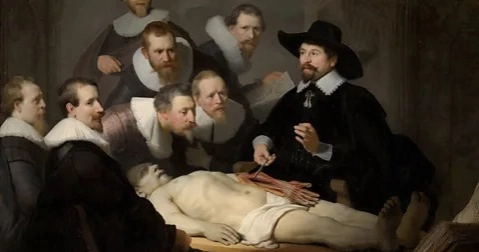
A new exhibition at the Thackray Museum of Medicine in Leeds exposes the grim history behind centuries of anatomical art and illustrations. Beneath the Sheets: Anatomy, Art and Power explores how executed criminals, the poor, women, and other marginalized people were dissected without consent and became subjects for medical textbooks and artworks.
Rembrandt’s 1632 painting The Anatomy Lesson of Dr Nicolaes Tulp, which depicts the dissection of a man executed for theft, exemplifies the practice. Across Europe, anatomists relied on bodies from prisons, workhouses, or even stolen graves. In notorious cases like Burke and Hare in Scotland, murder was committed specifically to supply anatomy schools.
The exhibition also shows how many illustrations idealized the human form, reflecting the cultural, gender, and racial biases of their time. Some works blurred the line between science and erotica, revealing how societal tastes influenced supposedly objective studies.
Curators emphasize that while anatomical knowledge has advanced, ethical questions remain. As Jamie Taylor, museum director of collections, says, the exhibition challenges visitors to consider “whose bodies feature in anatomical textbooks, who was drawing them, and why.”
The display spans five centuries of anatomical illustration, tracing the complex relationship between art, power, and medical science.
Source: BBC