BNP on Tuesday announced that it will share four parliamentary seats with its alliance partner Jamiat Ulema-e-Islam Bangladesh for the upcoming 13th national parliamentary election.
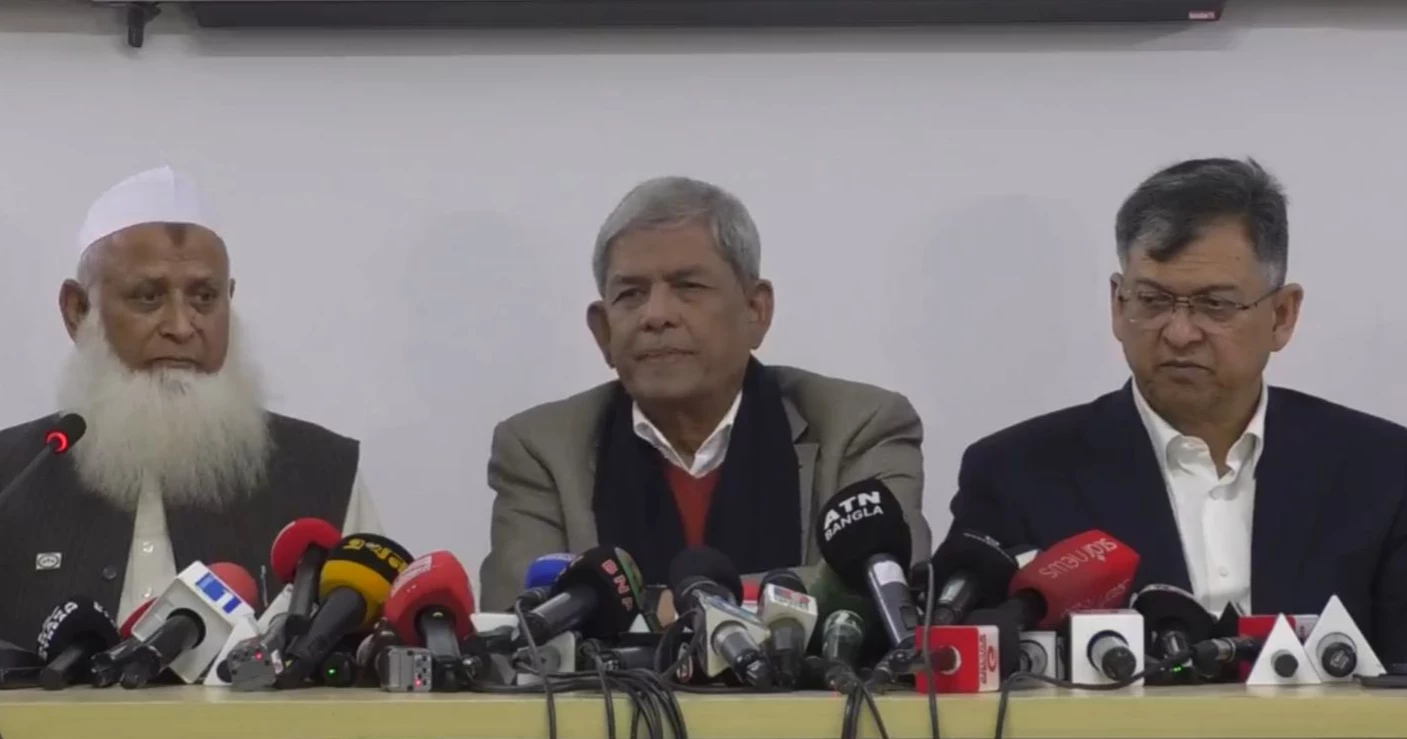
BNP Secretary General Mirza Fakhrul Islam Alamgir disclosed the decision at a press conference at the party Chairperson’s Gulshan office, saying the seats were given as part of seat-sharing arrangements with alliance partners.
“Jamiat Ulema-e-Islam Bangladesh will contest the upcoming election with BNP on the basis of an understanding. BNP has left Nilphamari-1, Narayanganj-4, Brahmanbaria-2 and Sylhet-5 constituencies for Jamiat Ulema-e-Islam Bangladesh, where the party will contest the election with the ‘Date Palm Tree’ symbol,” Fakhrul said.
On behalf of BNP, he congratulated and welcomed the four candidates of Jamiat Ulema-e-Islam Bangladesh.
Fakhrul also said BNP will not field any candidate in the four agreed constituencies, and Jamiat Ulema-e-Islam Bangladesh will not contest in other seats across the country as part of the understanding.
Calling upon BNP leaders and activists, Fakhrul urged them to fully cooperate with Jamiat candidates in the four constituencies.
“I appeal to our leaders and workers, and to voters in those areas, to vote for the ‘Date Palm Tree’ symbol and thereby strengthen the ‘Sheaf of Paddy’,” he said.
Fakhrul warned that if any BNP leader or activist contests the election as an independent candidate in seats already allocated to alliance partners, organisational action will be taken against them.
The Jamiat candidates are Maulana Md Manjurul Islam Afendi in Nilphamari-1, Mufti Monir Hossain Kasemi in Narayanganj-4, Maulana Md Ubaidullah Faruq in Sylhet-5 and Maulana Junayed Al Habib in Brahmanbaria-2.
BNP has already announced party candidates for 272 seats in two phases ahead of the 13th national parliamentary election.
Of the remaining 28 seats, four have now been allocated to Jamiat Ulema-e-Islam Bangladesh as part of the alliance arrangement.
Speaking at the programme, BNP Standing Committee Member Salahuddin Ahmed said their party has reached an understanding on seat sharing with Jamiat Ulema-e-Islam Bangladesh as it is one of the country’s leading Islamic parties.
“Under this understanding, BNP will not field any candidate in the agreed constituencies, and Jamiat Ulema-e-Islam Bangladesh will not contest in other constituencies across the country,” he said.
The BNP leader said details of further seat-sharing arrangements with other parties would be announced later, and mentioned that their party would uphold faith and trust in Almighty Allah in the Constitution, as incorporated through the Fifth Amendment by late President Ziaur Rahman.
He said BNP has already declared that no law contradictory to the Quran and Sunnah will be enacted and that graduates from Qawmi madrasas will receive due recognition.
Salahuddin also said BNP plans to include in its election manifesto provisions for state allowances for imams, khatibs and muezzins, including festival allowances, and to strengthen the existing trust for their welfare.
He said priority consideration will also be given to them in recruitment as religious teachers in schools, colleges and madrasas, following existing rules.
Jamiat Ulema-e-Islam Bangladesh Ameer Maulana Md Ubaidullah Farroque said the country is currently not in a normal situation and has become polarised over the election issue. “We believe the BNP is more trustworthy than others when it comes to running the country in the interest of the nation and its people.”
Farroque said Jamiat decided to contest the election with BNP after careful analysis, citing BNP’s past governance experience and stability.
“As an Islamic values-based party, we consider BNP suitable for the welfare of the nation and the country. We have not seen any such past record or actions of the eight-party alliance so far. However, we have seen BNP govern the country for three terms, which is why we can place our trust in BNP,” he said.
Farroque expressed the hope that if BNP forms the government, it will energise the Islamic sphere in the same way the country is governed and taken forward with its people.