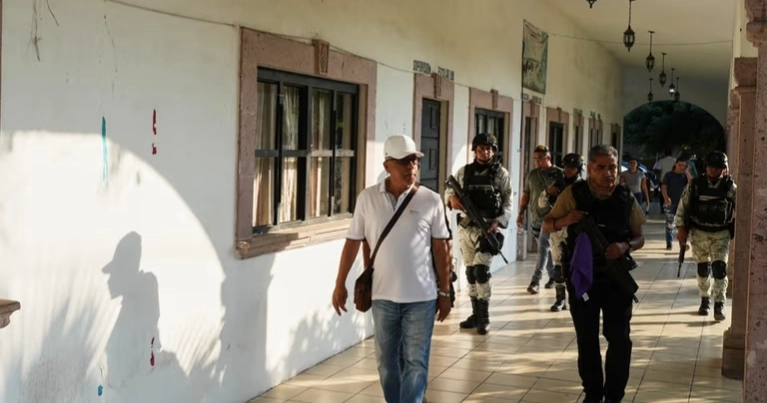
Two recent killings in Mexico’s Michoacan state — one of a lime growers’ representative and the other of a popular mayor — have laid bare the extent to which drug cartels dominate the region’s economy, politics and daily life.
The violence underscores a grim reality long known to residents: organized crime controls large swaths of Michoacan, from its lime orchards and avocado farms to its most vulnerable towns. Even as U.S. President Donald Trump launches strikes on suspected drug-smuggling boats and offers military help to Mexico, President Claudia Sheinbaum faces intensifying pressure to rein in cartels that generations of leaders have failed to subdue.
The crisis was brought into sharp focus when a farmer approached Rev. Gilberto Vergara in Tierra Caliente, saying cartel extortion was so severe that harvesting limes no longer made financial sense. Residents feared that speaking up meant death, but staying silent meant going hungry. Vergara drove home through cartel-controlled roads where land mines and drone attacks are constant threats. “They have the state in their hands,” he said.
The assassination of Uruapan’s 40-year-old mayor, Carlos Manzo, shocked the country. The outspoken Morena politician, known for confronting criminal groups and firing corrupt officers, was gunned down during Day of the Dead festivities despite a 22-member security team. His killing — allegedly linked to the Jalisco New Generation Cartel — sparked protests across Michoacan and Mexico City, with residents calling him “the Mexican Bukele” for his hard-line stance.
Manzo’s death also intensified fear among other local leaders. In La Ruana, activist Guadalupe Mora, whose brother was murdered two years ago, now moves with a 20-person security detail. “It seems we made the government and organized crime uncomfortable,” he said.
Cartels have expanded their tactics with drone-dropped explosives, improvised mines, surveillance networks and 3D-printed weapons. Extortion has become as profitable as drug trafficking, crippling industries from agriculture to transport. Even avocados — vital to U.S. consumers — have become more expensive due to cartel control.
Sheinbaum’s government has deployed 2,000 additional troops, raising the regional presence to more than 8,000, and insists coordination and intelligence will make the difference. Yet many residents remain skeptical after decades of failed plans. Security analysts warn that targeting smaller groups may inadvertently strengthen the dominant Jalisco cartel.
For farmers in the hills, the war feels endless. One woman, who fled her home earlier this year, returned only when the army arrived. She sent her teenage son to the U.S. fearing he would be recruited or kidnapped. Mines still detonate when animals cross them, and civilians remain trapped between shifting front lines.
Communities are increasingly taking security into their own hands. In several Indigenous towns, residents have set up their own patrols after cartels stormed guard posts. Yet in lime-growing regions, the loss of key leaders has left producers voiceless.
Growers say extortion has pushed them to abandon orchards, with prices controlled entirely by organized crime. Representative Bernardo Bravo, who called it “permanent commercial kidnapping,” was killed just weeks before Manzo. Without him, farmers say they have no one to advocate for them.
“We don’t see a resolution,” one grower said. “The criminals are squeezing us tight.”