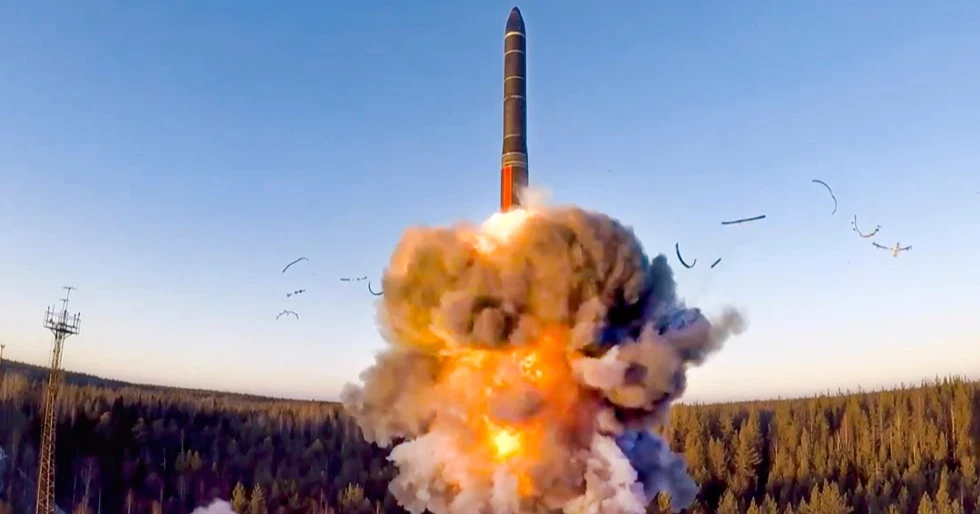
The final remaining nuclear arms agreement between the United States and Russia expired on Thursday, eliminating limits on the world’s two largest nuclear arsenals for the first time in over 50 years. Experts warn that the end of the New START Treaty could trigger an unchecked nuclear arms race.
Russian President Vladimir Putin had previously expressed willingness to extend the treaty for another year if Washington agreed, but U.S. President Donald Trump has remained noncommittal. Trump has suggested including China in any future deal, an idea Beijing has rejected.
Kremlin adviser Yuri Ushakov said Putin discussed the treaty’s expiration with Chinese President Xi Jinping on Wednesday, noting that the U.S. has not responded to Russia’s extension proposal. “Russia will act in a balanced and responsible manner based on thorough analysis of the security situation,” Ushakov added.
Russia’s Foreign Ministry stated Wednesday night that, under the current circumstances, both parties are no longer bound by any obligations under the New START Treaty and are free to choose their next steps.
US launches plan to reduce reliance on China for critical minerals
Signed in 2010 by President Barack Obama and Russian President Dmitry Medvedev, New START limited each side to 1,550 nuclear warheads and 700 delivery systems, including missiles and bombers. The treaty, originally set to expire in 2021, was extended for five years and included on-site inspections to verify compliance, which halted in 2020 due to the COVID-19 pandemic.
In February 2023, Putin suspended Russia’s participation in inspections, citing concerns over U.S. and NATO statements regarding Russia’s defeat in Ukraine, while emphasizing that Moscow would still respect the warhead limits. In September, he proposed adhering to New START’s limits for one more year to allow negotiations on a successor pact, warning that the treaty’s expiration could destabilize global security and fuel nuclear proliferation.
New START follows a series of previous U.S.-Russia nuclear arms reduction agreements, all of which have since ended. While Trump has expressed a desire to maintain nuclear limits, he insists China be included in any new treaty. Beijing, which has a smaller but expanding nuclear arsenal, has refused to participate in nuclear disarmament talks, urging the U.S. to resume dialogue with Russia.
US seeks critical minerals trading bloc with allies to counter China
“China’s nuclear forces are not on the same scale as those of the U.S. and Russia, and thus China will not participate in nuclear disarmament negotiations at the current stage,” Foreign Ministry spokesperson Lin Jian said Thursday, calling on Washington to respond positively to Russia’s suggestion to continue observing the treaty’s core limits.