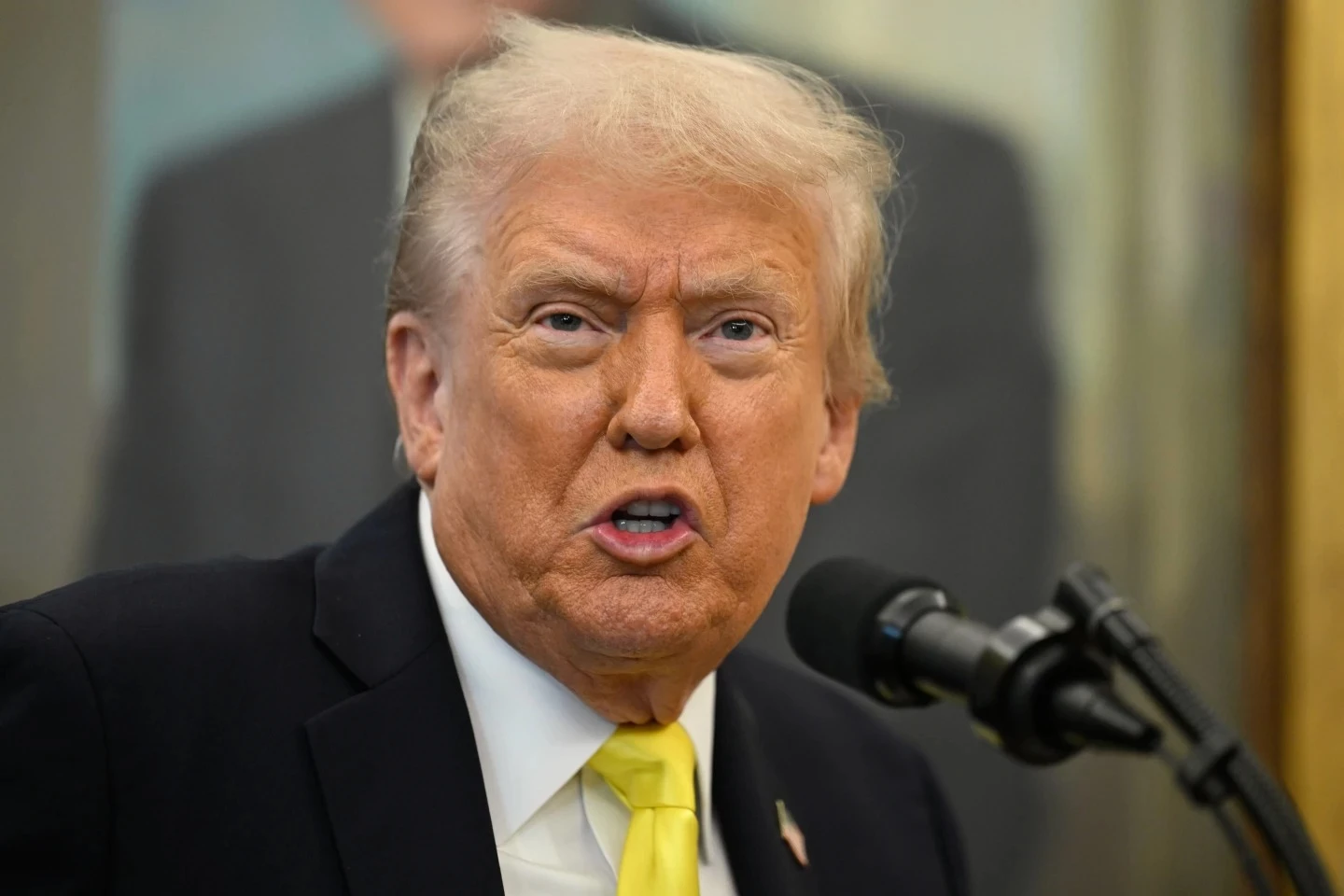
US President Donald Trump on Wednesday confirmed that he has authorized the Central Intelligence Agency (CIA) to conduct covert operations inside Venezuela and said his administration is also weighing possible land operations there.
The rare public acknowledgement of a CIA operation follows a series of recent US military strikes targeting alleged drug-smuggling boats in the Caribbean. Since early September, US forces have destroyed at least five vessels — four of them reportedly originating from Venezuela — killing 27 people.
Asked at the Oval Office why he had authorized the CIA to take action, Trump said he did so for two main reasons.
“I authorized for two reasons, really,” he said. “No. 1, they have emptied their prisons into the United States of America. And the other thing, the drugs — we have a lot of drugs coming in from Venezuela, and a lot of the Venezuelan drugs come in through the sea.”
Trump added that his administration is “looking at land” as it considers further strikes in the region. However, he declined to say whether the CIA has been given authority to act against President Nicolás Maduro directly.
His comments came shortly after The New York Times reported that the CIA had been authorized to carry out covert operations in Venezuela.
Maduro hits back
In response, President Nicolás Maduro criticized the record of the US spy agency in various global conflicts, though he did not directly address Trump’s remarks.
“No to regime change that reminds us so much of the overthrows in the failed eternal wars in Afghanistan, Iraq, Libya, and so on,” Maduro said during a televised meeting of the National Council for Sovereignty and Peace, which includes representatives from political, economic, academic, and cultural sectors.
He accused the CIA of being behind numerous coups and human rights abuses in Latin America, referencing Argentina’s “30,000 disappeared” during its military dictatorship (1976–1983) and the 1973 coup in Chile.
“How long will the CIA continue to carry on with its coups? Latin America doesn’t want them, doesn’t need them, and repudiates them,” Maduro declared.
Calling for peace, he said: “The objective is to say no to war in the Caribbean, no to war in South America, yes to peace.” Switching to English, he added, “Not war, yes peace. The people of the United States, please, please, please.”
Venezuela’s Foreign Ministry also issued a statement rejecting Trump’s “bellicose and extravagant statements,” calling them a “serious violation of international law and the United Nations Charter.”
“This unprecedented statement obliges the international community to denounce these clearly immoderate and inconceivable remarks,” the ministry said in a statement posted by Foreign Minister Yván Gil on Telegram.
Pushback in Congress
Earlier this month, the Trump administration declared drug cartels to be “unlawful combatants” and said the United States is now in an “armed conflict” with them — a move that has drawn bipartisan criticism in Congress.
Lawmakers from both parties accused the administration of effectively committing acts of war without congressional approval.
Senator Jeanne Shaheen, the ranking Democrat on the Senate Foreign Relations Committee, said while she supports efforts to curb trafficking, the administration’s actions have gone too far.
“The Trump administration’s authorization of covert CIA action, conducting lethal strikes on boats and hinting at land operations in Venezuela, slides the United States closer to outright conflict with no transparency, oversight or apparent guardrails,” Shaheen said. “The American people deserve to know if the administration is leading the U.S. into another conflict, putting servicemembers at risk or pursuing a regime-change operation.”
Two US officials, speaking on condition of anonymity, said the administration has yet to present lawmakers with concrete evidence proving that the targeted boats were carrying narcotics. Instead, officials have pointed to unclassified video clips of the strikes shared on social media by Trump and Defense Secretary Pete Hegseth.
Lawmakers have expressed frustration at the lack of clarity about how the administration determined that the United States is engaged in armed conflict with cartels, or which groups it considers “unlawful combatants.”
While the US military continues to launch missile strikes, the Coast Guard has maintained its regular interdiction operations to seize drugs from suspect vessels.
Defending the shift in strategy, Trump said the traditional approach has failed.
“Because we’ve been doing that for 30 years, and it has been totally ineffective,” he said. “They have faster boats — world-class speedboats — but they’re not faster than missiles.”
Human rights organizations have expressed alarm, warning that the strikes could violate international law and amount to extrajudicial killings.
Source: AP