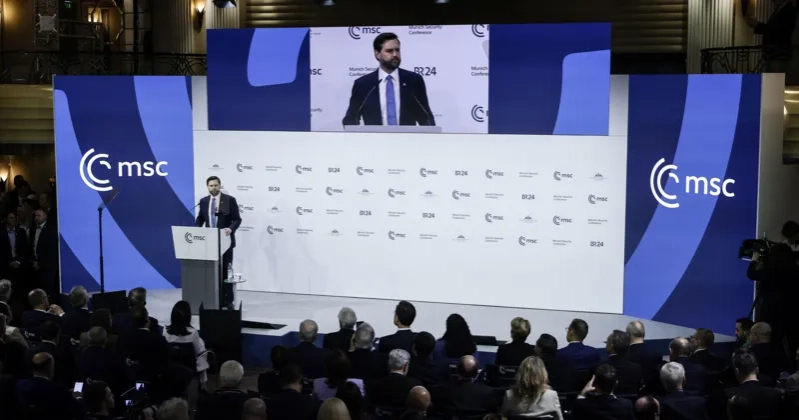
Europe’s security outlook is under renewed scrutiny as leaders prepare to gather for the Munich Security Conference this week, with the legacy and ongoing impact of US President Donald Trump’s foreign policy casting a long shadow over transatlantic relations.
It has been a year since US Vice President JD Vance delivered a controversial address at the same forum, sharply criticising Europe over migration and free speech and arguing that the continent’s greatest threats were internal. The remarks stunned delegates and signalled a deeper shift that has since reshaped US relations with both allies and rivals.
Over the past year, the Trump administration has imposed punitive tariffs on partners, taken an aggressive stance abroad and pursued diplomacy on Ukraine that many in Europe see as favouring Moscow. Trump has also made provocative statements, including suggesting that Canada should become the 51st US state.
As the conference opens later this week, more than 50 world leaders are expected to attend. The US delegation will be led by Secretary of State and National Security Adviser Marco Rubio, amid growing European concerns about Washington’s long-term commitment to the continent’s defence.
Those concerns were heightened by the latest US National Security Strategy, published late last year, which urged Europe to take primary responsibility for its own security. The document reinforced fears that the United States is increasingly reluctant to continue underwriting European defence.
Tensions were further strained by a recent crisis over Greenland, after Trump repeatedly said the United States needed to “own” the Arctic island for security reasons and at one point did not rule out the use of force. Greenland is a self-governing territory under Denmark, a Nato member, and Danish leaders warned that any hostile takeover would effectively end the alliance that has underpinned European security for decades.
Although the immediate Greenland dispute has subsided, it has left lingering doubts about the durability of the US-Europe security partnership.
Former UK intelligence chief Sir Alex Younger said the transatlantic alliance has changed but is not broken, noting that Europe still benefits greatly from its security and intelligence ties with the United States. He also argued that Trump was right to push Europe to shoulder more of the defence burden, pointing to long-standing imbalances in military spending.
However, divisions extend beyond defence budgets. The Trump administration has clashed with Europe over trade, migration and free speech, while many European governments have been alarmed by Trump’s approach to Russian President Vladimir Putin and his tendency to criticise Ukraine despite Russia’s invasion.
Ahead of the conference, organisers released a report warning of a fundamental break with long-standing US post-World War II strategy, which had prioritised multilateral institutions, economic integration and the promotion of democracy and human rights as strategic assets. The report said all three pillars have been weakened or openly questioned under the Trump administration.
US-based analysts at the Centre for Strategic and International Studies described the new National Security Strategy as a painful wake-up call for Europe and evidence of a deep divergence between European expectations and Washington’s current vision.
The strategy includes language supporting groups opposed to Europe’s current political direction and criticises European migration policies, while still acknowledging that Europe remains strategically important to the United States.
A central concern for many European officials is whether Nato’s Article 5, the collective defence clause, can still be relied upon. Although Nato leaders insist the commitment remains intact, Trump’s unpredictability and his administration’s scepticism towards Europe have raised doubts.
These questions are sharpened by the ongoing war in Ukraine and hypothetical scenarios involving Nato’s eastern flank, where any hesitation or miscalculation could have serious consequences.
As discussions begin in Munich, European leaders hope for clarity on the future of the transatlantic alliance, even as many fear the answers may confirm a more uncertain and fragmented security order.
With inputs from BBC