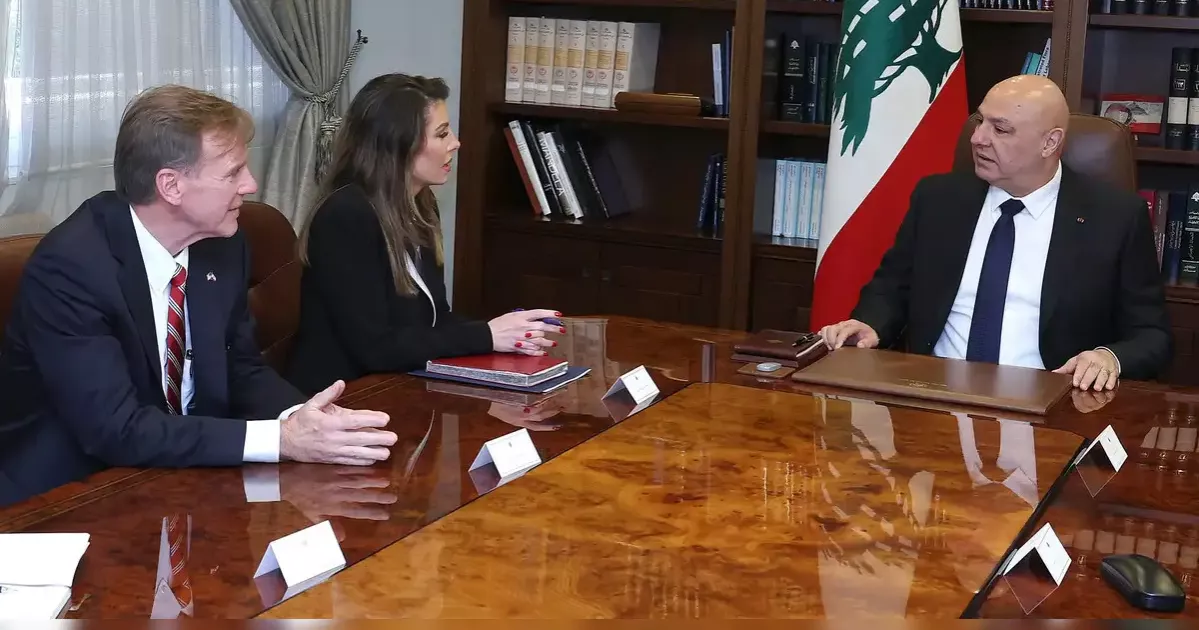
The U.S. special envoy for Syria on Saturday described Lebanon as “a failed state,” highlighting Washington’s growing frustration with Beirut’s deadlocked leadership even as Syria edges toward cooperation with the United States.
Speaking at the Manama Dialogue summit in Bahrain during a session on “U.S. Policy in the Levant,” envoy Thomas Barrack praised developments in Syria since the fall of Bashar Assad in December. He confirmed that Syria’s new president, Ahmad al-Sharaa, is scheduled to visit Washington on November 10 — the first trip by a Syrian head of state since the country’s independence in 1946.
Barrack said Syria is expected to join the U.S.-led coalition against the Islamic State group, calling it “a big step” and “remarkable.” The coalition, comprising about 80 nations, aims to prevent any resurgence of IS.
Turning to Lebanon, Barrack said it was “the only state in the region not jumping in line” with shifting Middle Eastern alliances. “The state is Hezbollah,” he remarked, arguing that the Iran-backed group provides social and financial support where the Lebanese government has failed to deliver basic services like power and water.
“It is really up to the Lebanese,” Barrack added. “America is not going to get deeper involved in the situation with a foreign terrorist organization and a failed state dictating the pace and asking for more resources, more money and more help.”
He also said the U.S. would stay out of regional conflicts but “support its ally if Israel becomes more aggressive toward Lebanon.”
Israel airstrikes in southern Lebanon kill 1, wound 7
Israel has recently stepped up strikes on southern Lebanon, accusing Hezbollah of breaching a ceasefire agreed last November that ended their latest war. The hostilities began after Hamas’ October 7, 2023, attack on Israel, which sparked the war in Gaza. Hezbollah responded by firing rockets into northern Israel, triggering Israeli airstrikes that escalated into a full-scale conflict in September 2024.
Although a ceasefire was reached, Israel continues daily air raids on southern Lebanon, claiming to target Hezbollah positions and weapon depots. Lebanese officials accuse Israel of bombing civilian areas and vital infrastructure, urging respect for Lebanon’s sovereignty.
Barrack said Israel’s continued bombing stems from “thousands of rockets and missiles” still hidden in the area. Yet, he admitted it was “not reasonable for us to tell Lebanon to forcibly disarm one of its political parties — everybody is scared to death to go into a civil war.”
“The path is very clear — it needs to go through Jerusalem or Tel Aviv for a conversation along with Syria. Syria is showing the way,” Barrack said, noting that Syria and Israel are expected to hold their fifth round of de-escalation talks soon.
Washington is currently mediating direct negotiations between Syria and Israel to revive the 1974 ceasefire agreement that established a demilitarized buffer zone between their forces under U.N. supervision.
Netanyahu signals possible Israeli withdrawal from Lebanon if Hezbollah is disarmed
Tensions between the two nations have risen sharply since Assad’s overthrow in December, following a rapid rebel advance led by Islamist factions. After the fall of Assad, Israeli troops seized parts of the U.N.-patrolled buffer zone and carried out airstrikes near Damascus, saying they aimed to prevent hostile forces from taking root along the border.
Israel has insisted it will not tolerate any Iranian-backed groups returning to positions near its frontier, expressing deep mistrust of Syria’s new leadership — composed largely of former Islamist insurgents.
Source: AP