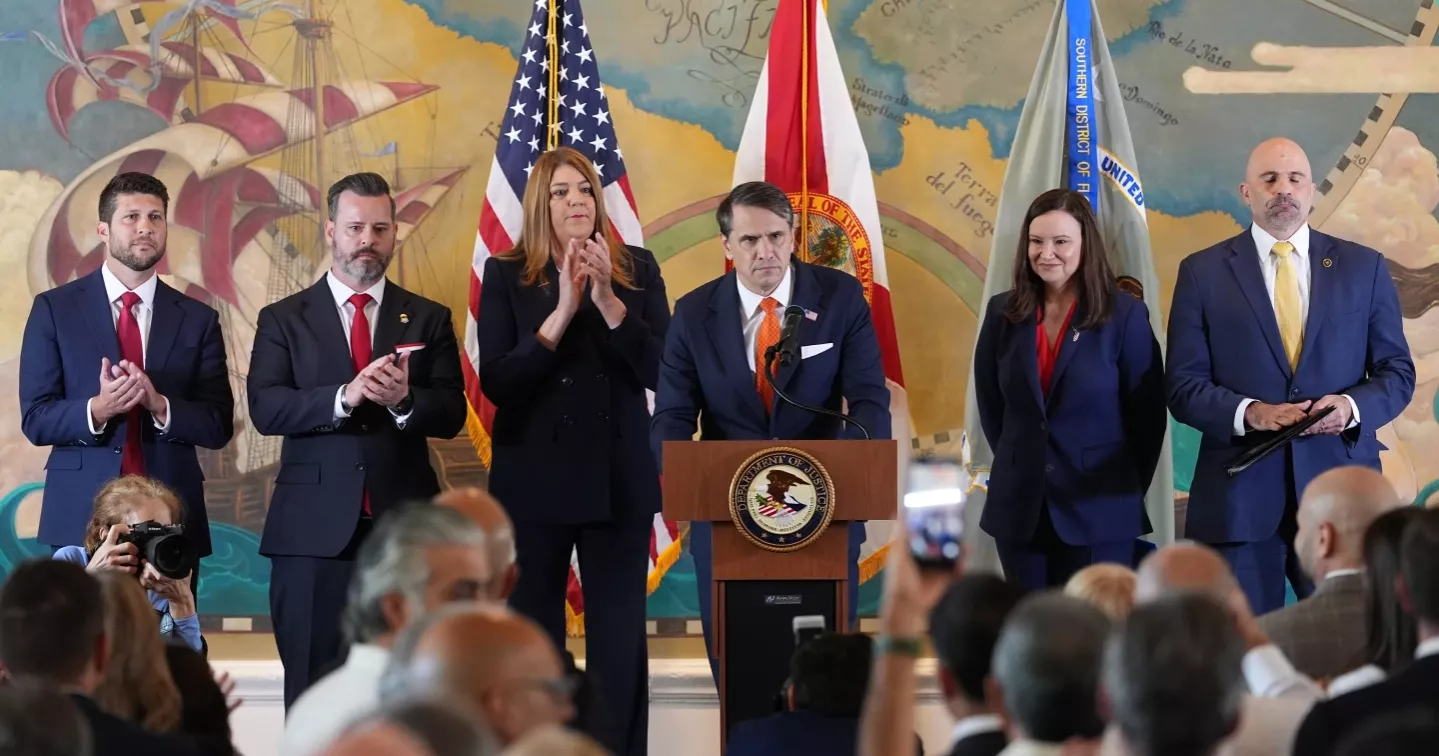
US federal prosecutors on Wednesday announced criminal charges against former Cuban President Raúl Castro over the 1996 downing of two civilian planes operated by a Miami-based exile group, in a move that further increases pressure on Cuba’s socialist government under President Donald Trump.
The indictment accuses Castro of ordering the destruction of two small aircraft flown by the exile organization Brothers to the Rescue. Castro, who will turn 95 next month, was Cuba’s defense minister at the time.
The charges, filed secretly by a grand jury in April, include murder and destruction of an aircraft. Five Cuban military pilots were also charged.
“For nearly 30 years, the families of four murdered Americans have waited for justice,” acting Attorney General Todd Blanche said during a ceremony in Miami marking Cuban Independence Day.
“They were unarmed civilians and were flying humanitarian missions for the rescue and protection of people fleeing oppression across the Florida Straits,” he said.
Asked how far US authorities would go to bring Castro to the United States, Blanche said: “There was a warrant issued for his arrest. So we expect that he will show up here, by his own will or by another way.”
Asked what could happen next in Cuba, Trump said: “We’re going to see.” He added that the United States is prepared to provide humanitarian assistance to what he described as a “failing nation.”
Analysts said the charges could pose a serious threat, especially after US forces captured former Venezuelan President Nicolás Maduro in January to face drug charges in New York.
“He’s going to have to keep his head pretty low from now on,” said Peter Kornbluh, a specialist on US-Cuba relations at the National Security Archive.
Although it remains uncertain whether Castro will ever appear in a US courtroom, the murder and conspiracy charges carry the possibility of life imprisonment or the death penalty if he is convicted.
Cuban President Miguel Díaz-Canel condemned the indictment, calling it a political stunt intended to “justify the folly of a military aggression against Cuba.”
In a social media post, Díaz-Canel accused the United States of distorting the events surrounding the shootdown and ignoring repeated warnings from Cuban officials that they would respond to what he called “dangerous violations” of Cuban airspace by “notorious terrorists.”
Among those attending the Miami ceremony was Marlene Alejandre-Triana, whose father, Armando Alejandre Jr., was killed in the incident.
She said she had spoken with several federal investigators over the years and considered Castro “one of the main architects of the crime.”
“It has been long overdue,” she said while standing before a large photograph of her father.
Trump has repeatedly threatened military action against Cuba since Maduro’s capture. Following that operation, the White House imposed a blockade that sharply reduced fuel shipments to Cuba, contributing to widespread blackouts, food shortages and a worsening economic crisis.
Trump has also intensified calls for regime change after saying earlier this year that he would pursue a “friendly takeover” of Cuba unless its leaders opened the economy to American investment and expelled US adversaries.
During Trump’s first term, the United States indicted Maduro on drug trafficking charges and later used those allegations to justify removing him from power and bringing him to New York for trial.
Secretary of State Marco Rubio on Wednesday urged Cubans to demand a free-market economy and new leadership.
“In the U.S., we are ready to open a new chapter in the relationship between our people,” Rubio said in a video message in Spanish. “Currently, the only thing standing in the way of a better future are those who control your country.”