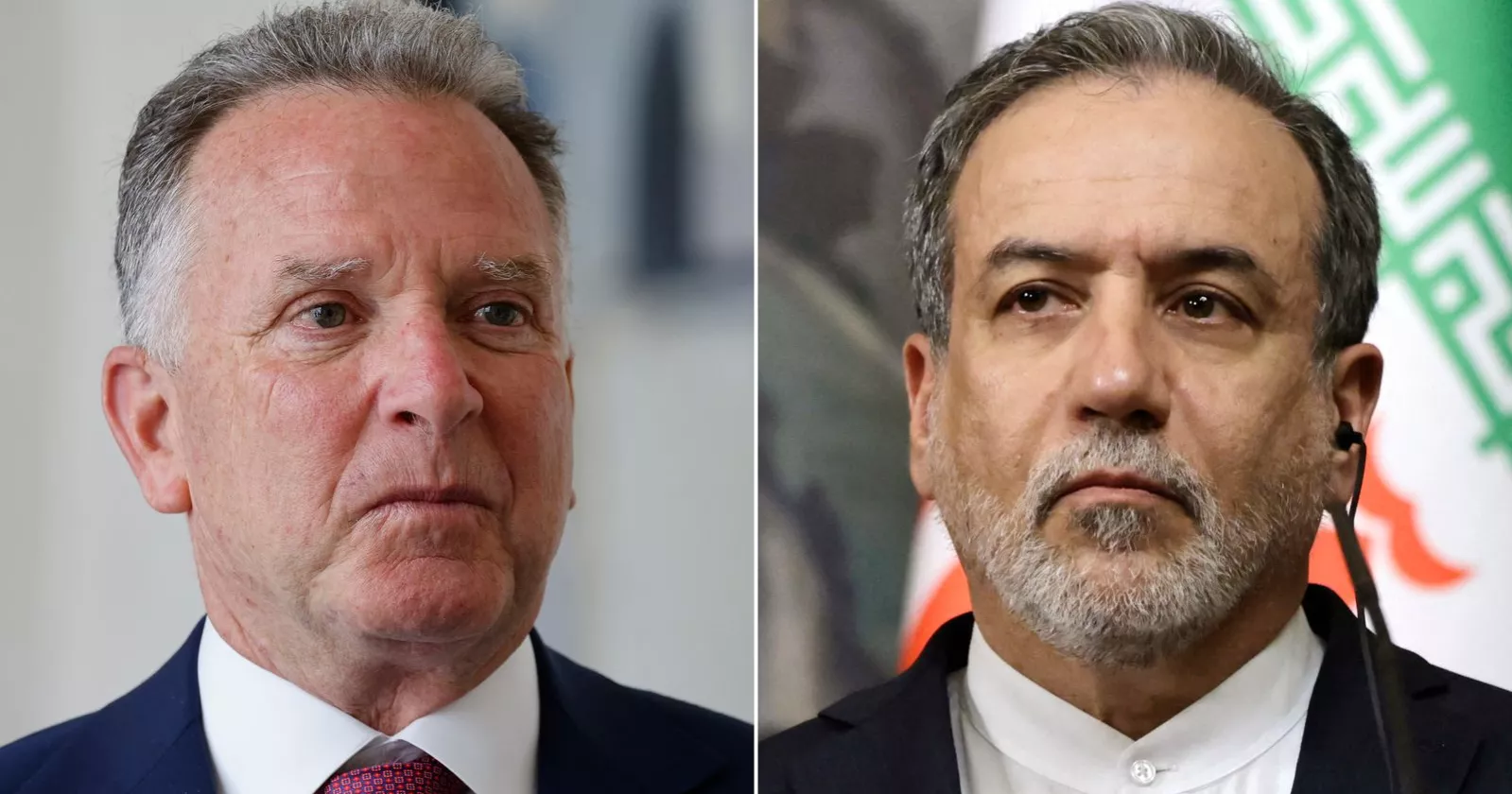
Senior officials from the United States and Iran are expected to hold direct talks in Oman later, as tensions between the two adversaries continue to raise fears of a possible military confrontation.
The discussions follow a significant US military build-up in the Middle East, which Washington says was prompted by Iran’s violent crackdown on nationwide anti-government protests last month. Human rights groups claim the repression resulted in thousands of deaths.
Uncertainty over the venue and scope of the talks had earlier threatened to derail the meeting. The dialogue is part of a broader diplomatic push by regional mediators to ease escalating tensions between the two countries.
Despite the talks, Washington and Tehran remain sharply divided. Officials hope that if the meeting proves successful, it could pave the way for a broader framework for future negotiations.
The United States has demanded that Iran freeze its nuclear programme and abandon its stockpile of enriched uranium. US officials have also said the discussions should address Iran’s ballistic missile programme, its backing of armed groups across the region, and its human rights record.
Iran, however, has insisted that the talks will focus solely on its nuclear programme, and it remains unclear whether the differing positions have been reconciled.
In recent weeks, President Donald Trump has threatened to bomb Iran if a deal is not reached. The US has deployed thousands of additional troops to the region, along with what Trump described as an “armada,” including an aircraft carrier, other warships and fighter jets.
Iran has warned it would retaliate forcefully against any attack, threatening strikes on US military assets in the Middle East and on Israel.
Trump administration launches TrumpRx website to promote discounted drugs
The Iranian delegation will be led by Foreign Minister Abbas Araghchi, who last week said Iran’s armed forces were “with their fingers on the trigger.” The US side will be represented by special envoy Steve Witkoff and Trump’s son-in-law Jared Kushner.
The meeting will be the first direct engagement between US and Iranian officials since last June’s war between Israel and Iran, during which the US bombed Iran’s three main nuclear facilities. Iran says its uranium enrichment activities ceased following those attacks.
For Iran’s embattled leadership, analysts say the talks may represent a last opportunity to avert US military action that could further destabilise the regime, which is seen as being in its weakest position since the 1979 Islamic Revolution.
Trump’s threats have coincided with Iran’s forceful suppression of widespread protests sparked by a worsening economic crisis, during which demonstrators called for the end of the Islamic Republic. The Washington-based Human Rights Activists News Agency said it had confirmed at least 6,883 deaths, warning the toll could be higher, and reported that more than 50,000 people had been arrested.
The current crisis has renewed focus on Iran’s nuclear programme, a long-standing source of dispute with Western powers. Iran has repeatedly said its nuclear activities are peaceful, while the US and Israel accuse it of seeking to develop nuclear weapons.
Tehran insists it has the right to enrich uranium on its own territory and has rejected demands to transfer its stockpile of highly enriched uranium, estimated at 400kg (880lb), to another country. Iranian officials have signalled openness to certain concessions, including the possible creation of a regional uranium enrichment consortium, an idea previously discussed in talks that collapsed when Israel launched a surprise war last year.
At the same time, Iran has firmly rejected demands to curb its ballistic missile programme or end its support for regional allies – an alliance it calls the “Axis of Resistance,” which includes Hamas in Gaza, militias in Iraq, Hezbollah in Lebanon and the Houthis in Yemen – saying such demands violate its sovereignty.
On Tuesday, Iranian President Masoud Pezeshkian said he had instructed Araghchi to pursue “fair and equitable negotiations” with the US, provided that appropriate conditions exist.
Iran is also expected to press for the lifting of economic sanctions that have severely damaged its economy. Critics of the regime argue that sanctions relief would provide a crucial lifeline to Iran’s clerical rulers.
For the United States, the talks could offer a way out of Trump’s military threats, depending on the outcome. Regional countries have warned that a US strike could trigger a wider conflict or prolonged instability in Iran, and cautioned that air power alone would be unlikely to topple the country’s leadership.
Asked whether Iran’s Supreme Leader Ayatollah Ali Khamenei should be concerned, Trump told NBC News on Wednesday, “I would say he should be very worried.”
US-Russia nuclear arms pact expires, ending limits
US Secretary of State Marco Rubio said any meaningful outcome would require the talks to extend beyond the nuclear issue. “I’m not sure you can reach a deal with these guys, but we’re going to try,” he said, adding that there was no harm in exploring possible solutions.
The talks were initially planned to take place in Istanbul as part of mediation efforts led by Egypt, Turkey and Qatar. However, Iran requested at the last moment that the venue be shifted to Oman – which hosted talks last year – and that the meeting be limited to Iranian and American officials only.
#With inputs from BBC