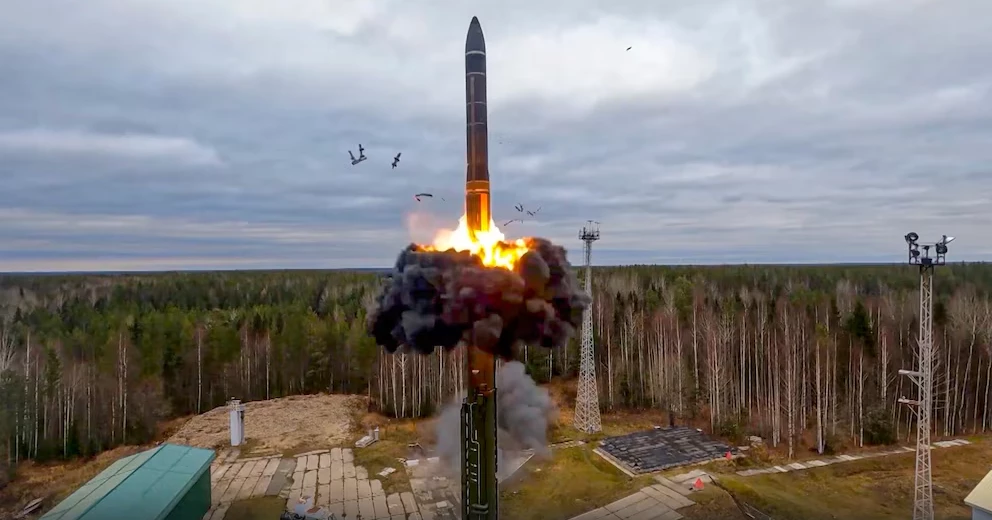
Recent warnings from both the United States and Russia about restarting nuclear weapons testing have triggered deep concern worldwide, threatening a long-standing international norm that has curbed such tests for decades. Analysts say the rhetoric from the two biggest nuclear powers risks undermining global nonproliferation efforts and heightening geopolitical tensions.
U.S. President Donald Trump announced in late October that Washington would resume nuclear weapons testing “on an equal basis” with other countries, a directive that he said would begin immediately. Moscow quickly countered, with President Vladimir Putin telling his Security Council that Russia would respond in kind if the U.S. or any signatory of the Comprehensive Nuclear-Test-Ban Treaty (CTBT) conducts a test.
The CTBT, adopted in 1996 after growing concerns about radioactive fallout from Cold War–era atmospheric tests, established a near-universal expectation against nuclear testing, even though it has never formally entered into force. Of the 44 states required for activation, nine — including the U.S., China, India and Pakistan — have not ratified it. Russia ratified the treaty but revoked its ratification in 2023, citing U.S. inaction.
The Vienna-based Comprehensive Nuclear-Test-Ban Treaty Organization oversees a vast global detection system with 307 monitoring stations capable of identifying nuclear tests using seismic, hydroacoustic, infrasound and radionuclide technology. Its 2025 budget exceeds $139 million.
Experts warn that renewed U.S. testing could open the door for countries with less experience — particularly China and India — to conduct full-scale tests that could help them advance smaller, more sophisticated warheads, ultimately weakening U.S. and global security.
Since 1996, only 10 nuclear tests have been carried out, all by India, Pakistan and North Korea. Historically, the U.S. and the Soviet Union conducted the overwhelming majority of roughly 2,000 tests before the CTBT’s adoption.
No evidence Iran seeks nuclear weapons: Putin
While Washington has not clarified the type of testing Trump meant, U.S. Energy Secretary Chris Wright said any upcoming activities would involve subcritical experiments — tests that do not trigger a nuclear chain reaction and do not violate the CTBT’s zero-yield standard. However, experts note that some extremely low-yield hydronuclear tests can evade detection, highlighting a verification gap.
The CTBTO says its main mission is to assure member states that any nuclear explosion “anywhere, anytime” would be detected. Its network has successfully identified all six North Korean tests between 2006 and 2017.
Source: AP