Share-Market
DSE plans to launch derivative market by January 2028
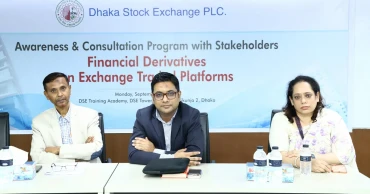
The Dhaka Stock Exchange (DSE) is planning to launch derivative products in the capital market by January 2028, with regulators stressing that a functional Central Counterparty (CCP) and stronger risk-management infrastructure are prerequisites for the rollout.
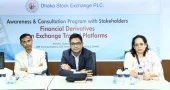
The plan was discussed on Monday at an event in DSE Tower, introducing financial derivatives in the country's capital market, where officials outlined the roadmap, challenges and preparatory steps needed before trading can begin.
Commissioner of the Bangladesh Securities and Exchange Commission (BSEC) Nafeez Al Tarik said it will be difficult to launch derivative operations without an effective CCP in place, adding that the capacity of brokers, traders and other market participants must be enhanced alongside the required technological infrastructure.
He noted that international experience shows future markets create opportunities for investors to manage portfolio risks and hedge exposure, with derivatives playing a particularly important role in addressing market liquidity and volatility risks.
Nafeez said the commission, exchanges, Central Counterparty Bangladesh Limited (CCBL) and other market stakeholders must work in a coordinated manner to introduce derivatives, adding that the goal would be achieved by ensuring the necessary rules, infrastructure and capacity within the set timeline.
DSE Managing Director Nuzhat Anwar said the initiative to introduce new financial products on the exchange-traded platform marks a significant step towards developing the country's capital market.
She expressed gratitude to the BSEC for its cooperation and guidance in implementing the initiative, saying a specific roadmap and timeline have been set jointly by the DSE and the commission, and the initiative will move forward in phases based on stakeholders' feedback.
Nuzhat added that detailed workshops and awareness programmes on the matter will be organised in the future.
BSEC Executive Director Abul Kalam said financial derivatives, particularly index derivatives settled in cash, can be introduced relatively easily, but their successful implementation requires a robust regulatory, technological, clearing, settlement and risk-management framework.
He said the existing Exchange Derivatives Rules will be updated to formulate the necessary regulatory framework.
Alongside this, a suitable trading platform, CCP, real-time margining, position monitoring and mark-to-market systems will be put in place. Progress on preparations will be monitored regularly against a set action plan and timeline, he said, adding that the derivatives market launch will be expedited to increase the depth and diversity of the capital market.
General Manager of the Market Development Division Saied Mahmud Zubayer said the DSE is planning to launch derivatives products in January 2028 to introduce modern financial instruments and deepen the market, a plan that has been approved by the BSEC.
He said the DSE has prepared a strategy and action plan covering the regulatory framework, technological infrastructure and stakeholder readiness required for the launch, and has submitted it to the BSEC, with preparations progressing with the commission's cooperation.
In the first phase, DSE plans to introduce its own index-based Stock Index Futures, followed by Single Stock Deliverable Futures, with an Options Market planned for the long term.
The programme also aimed to raise awareness among market participants about derivatives products while gathering stakeholders' opinions on the potential, challenges and preparations needed for introducing such instruments.
5 days ago
BSEC holds stakeholder consultation on draft Direct Listing Rules 2026
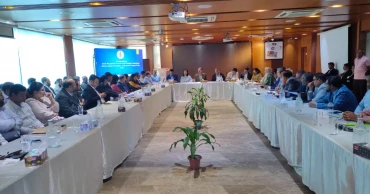
The Bangladesh Securities and Exchange Commission (BSEC) on Thursday held a stakeholder consultation meeting on its draft "BSEC (Direct Listing of Securities by Stock Exchange) Rules, 2026" at the commission's Agargaon office, as part of efforts to frame a modern, transparent and effective regulatory framework for direct listing of fundamentally strong companies on the capital market.
The meeting was chaired by BSEC Chairman Masud Khan and attended by BSEC commissioners, managing directors and senior officials of the Dhaka Stock Exchange and Chittagong Stock Exchange, the president of the Bangladesh Association of Publicly Listed Companies (BAPLC), the president of the Bangladesh Merchant Bankers Association (BMBA), and top representatives of listed and non-listed companies, merchant banks, issue managers, professional bodies and other market stakeholders.
Senior representatives from more than two dozen companies took part, including Unilever, Metlife, Nestlé Bangladesh, Banglalink, Karnaphuli Fertilizer Company Ltd (KAFCO), bKash, Incepta Pharmaceuticals, Healthcare Pharmaceuticals, Essential Drugs, Sinovia Pharmaceuticals, Nagad, Meghna Group of Industries (MGI), PRAN-RFL Group, DBL Group, Abul Khair Group, United Group, Kazi Farms Group, Confidence Group, Confidence Infrastructure PLC, BRB Cables, Edison Power, Edison Footwear, Borak Real Estate, Paschimanchal Gas Company, Sylhet Gas Fields Ltd, Impress-Newtex Composite Textiles Ltd, National Polymer, Karnaphuli Gas Distribution Company, Walton, Akij Resources, ACI PLC, North-West Power Generation Company Ltd, and Seiler Ring Cement.
A presentation was made on the draft rules, covering eligible companies for direct listing, the application and listing process, listing conditions, and the price discovery mechanism.
Participants shared their views, observations, suggestions and practical experience on the proposed provisions, with several emphasising the need to bring genuine and capable companies to the market through direct listing while safeguarding investors' interests and market discipline.
Speaking at the meeting, BSEC Chairman Masud Khan said the number of fundamentally strong companies in the country's capital market remains inadequate, and the commission wants to bring good, well-established family-run companies into the market through direct listing to deepen and widen it.
This, he said, would boost participation of quality companies while attracting more domestic and foreign investment.
He said listing brings companies enhanced reputation and credibility, along with the opportunity to establish themselves as strong corporate brands.
Listed companies also enjoy tax benefits, potential share price appreciation and greater share liquidity, he added, noting that sponsors gain an avenue to liquidate their shareholdings, while the arrangement would also help companies raise additional capital for future expansion.
The BSEC chairman further said the commission is also working to make its IPO rules more practical and effective alongside the direct listing framework.
He noted that a hybrid approach, combining existing share offloading with fresh share issuance, is under consideration, which would further expand listing opportunities for eligible companies and create new investment avenues in the market.
Some senior company representatives expressed interest in entering the market through direct listing, while others favoured the hybrid route combining IPO and share offloading. Participants welcomed the commission's initiative on direct listing and pledged their cooperation and continued input on the matter.
9 days ago
BSEC proposes major amendments to margin loan rules
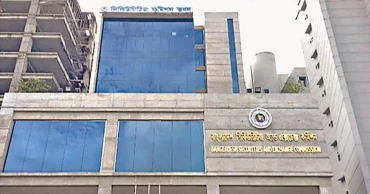
The Bangladesh Securities and Exchange Commission (BSEC) has framed draft amendments to the BSEC (Margin) Rules, proposing fundamental relaxations to make margin loans more accessible for investors and to expand lending capacity for market intermediaries.
The proposed changes aim to eliminate practical operational complexities, foster an investor-friendly framework, and boost liquidity across the country's capital market.
Key Proposals in the Draft Rules
Extension to Low-Dividend Companies: Under the draft rules, investors will be eligible for margin loans to purchase shares of B-category companies even if the companies pay less than a 5 percent dividend. Currently, only B-category companies paying a minimum 5 percent dividend qualify for margin finance.
Lower Minimum Account Threshold: The required minimum equity value in a Beneficiary Owner (BO) account to qualify for margin loans is set to be reduced to Tk 3 lakh from the current requirement of Tk 5 lakh held for a minimum of one year.
Higher Intermediary Lending Cap: Stockbrokers and merchant banks will be allowed to disburse margin loans up to five times their core capital or net worth, up from the existing cap of three times.
Removal of Free-Float Cap Requirement: The mandatory requirement for a listed company to maintain a minimum Tk 50 crore in free-float market capitalisation to qualify for margin loans will be scrapped.
Single Stock Exposure Limit Raised: The maximum margin exposure limit for a single stock is proposed to be increased to 20 percent from the existing 15 percent.
Adjustment to Maintenance Margin: A margin call will be triggered when a portfolio's value falls below 70 percent, down from the existing 75 percent threshold. The compulsory forced-sale trigger remains unchanged at 50 percent.
P/B Ratio Limits for Financial Institutions: While non-financial companies will retain the maximum Price-to-Earnings (P/E) ratio limit of 30, financial institutions will be evaluated using the Price-to-Book (P/B) ratio. Banks and financial institutions with a P/B ratio exceeding 3 will be excluded from margin financing, while insurance companies will face a P/B cap of 1.
The BSEC noted that the draft amendment was approved in principle during its 913th meeting and has been published to solicit public feedback and opinions from market stakeholders before finalization.
25 days ago

DSE grants FIX certification to five more brokerage houses
The Dhaka Stock Exchange (DSE) PLC has awarded FIX certification to five more brokerage houses, paving the way for them to launch their own Order Management Systems (OMS) through API connectivity.
The newly certified firms are Emperor Securities & Wealth Management Ltd, Global Securities Ltd, Md Fakhrul Islam Securities Ltd, SIBL Securities Limited, and Stock & Bond Limited.
DSE Chief Technology Officer Asifur Rahman handed over the certificates to the brokerage houses at a ceremony held at the DSE boardroom on Wednesday.
With the latest additions, the total number of brokerage houses that were awarded FIX certification has risen to 66. Of them, 56 houses have already gone live with their own OMS through API connectivity after receiving the certification.
The DSE took the initiative to launch the API-based Broker House Order Management System (BHOMS) in 2020, after which 93 brokerage houses applied for API connectivity with the Nasdaq matching engine to trade through their own order management systems.
The FIX (Financial Information eXchange) certification allows brokerage houses to connect their proprietary trading platforms directly to the exchange's matching engine, enabling faster and more efficient order execution for investors.
1 month ago
Index rises at DSE, but turnover slips
The Dhaka Stock Exchange (DSE) closed higher on Monday, the second trading day of the week, as its key index and most listed companies posted gains, even though overall turnover declined.
The DSE's benchmark index, DSEX, rose 22 points during the day's trading. The Shariah-based index, DSES, remained unchanged, while the blue-chip index DS30 gained 8 points.
DSE terminates 17 employees as part of long-term restructuring, says exchange
Prices advanced for the majority of listed firms, with 199 companies seeing their share prices rise, against 129 that declined and 64 that remained unchanged.
Shares and units worth Tk 908 crore changed hands on the DSE, down from Tk 964 crore in the previous session, a fall of Tk 56 crore in a single day.
Northern Islami Insurance PLC topped the gainers' list, rising nearly 10 percent, while People’s Leasing and Financial Services Ltd led the losers, shedding 9 percent.
Meanwhile, the Chittagong Stock Exchange (CSE) also ended in positive territory, with its all-share index CASPI adding 10 points.
However, unlike the DSE, price declines outnumbered gains at the CSE – 99 companies saw their share prices fall, compared to 85 that rose, while 28 remained unchanged.
Turnover at the CSE stood at Tk 35 crore, up from Tk 31 crore in the previous session.
City Insurance PLC topped the CSE gainers, rising 10 percent, while Uttara Finance & Investments Limited and Prime Finance & Investment Ltd tied at the bottom, each losing 10 percent.
1 month ago
Week begins with steep index fall on Dhaka, Ctg bourses
Bangladesh's stock market opened the week on a bearish note on Sunday, with both the Dhaka Stock Exchange (DSE) and the Chittagong Stock Exchange (CSE) recording sharp falls in their key indices as share prices declined for most listed companies.
The DSE's benchmark index, DSEX, fell 38 points during the day's trading. The Shariah-based index, DSES, dropped 6 points, while the blue-chip index, DS30, lost 14 points.
Of the 392 companies traded on the DSE, 286 saw their share prices fall, 79 posted gains, and 27 remained unchanged.
Overall turnover on the DSE declined, with shares and units worth Tk 964 crore changing hands during the day, down from Tk 1,147 crore in the previous session.
Nitol Insurance PLC topped the DSE gainers' list, rising nearly 10 percent, while Peoples Leasing and Financial Services Limited was the worst performer, losing more than 8 percent.
The CSE also witnessed a steep fall, with its overall index, CASPI, shedding 106 points.
Prices fell for the majority of companies on the CSE, with 139 issues declining against 52 advancing and 24 remaining unchanged.
Turnover on the CSE, however, edged up slightly, with shares and units worth Tk 31 crore traded during the day, compared to Tk 29 crore in the previous session.
Bangladesh Lamps PLC led the CSE gainers, rising close to 10 percent, while Envoy Textiles Limited posted the sharpest decline, losing 10 percent.
1 month ago
Bank, NBFI shares remain under pressure despite weekly index gains
The Dhaka Stock Exchange (DSE) closed the week with its key indices in positive territory, but the banking and financial institutions sector failed to recover from the previous week's slump, according to the bourse's weekly Market Pulse report.
Over the five trading sessions through July 30, the benchmark DSEX index rose 91 points, while the blue-chip DS30 index gained 24 points and the Shariah-based DSES index added 12 points.
General investors, institutions to access private bonds, funds through DSE's new PI category
Compared with the corresponding period last year, DSEX has climbed 21 percent so far this year, with DS30 and DSES each up 19 percent.
Despite the index gains, average daily turnover slipped slightly week-on-week, falling to around Tk 1,060 crore from Tk 1,063 crore in the previous week.
Prices rose for the majority of listed companies during the week, 264 stocks advanced against 35 that declined, while 89 remained unchanged. Market capitalisation increased by Tk 3,863.75 crore over the week.
However, the banking sector could not shake off its earlier losses, with bank stocks falling nearly 14 percent and non-bank financial institution (NBFI) shares dropping more than 35 percent.
Life insurance stocks slid 37 percent even as general insurance shares climbed about 20 percent. Corporate bond prices surged 78 percent, while mutual fund prices fell around 20 percent.
Elsewhere, pharmaceuticals and chemicals shares dropped 14 percent, and paper and printing stocks fell more than 35 percent. The fuel and power sector declined nearly 28 percent, and tannery industry shares were down 19 percent.
EXIM First Mutual Fund topped the week's gainers' list, posting a weekly return of about 37 percent, while Renwick Jajneswar & Co (Bd) Ltd. finished at the bottom, losing roughly 13 percent.
The mixed sectoral performance underscores a market still searching for balance, broad-based investor appetite is lifting the headline indices and pushing up overall market capitalisation, but confidence in the financial sector, particularly banks and NBFIs, remains fragile.
Analysts will likely watch whether this divergence narrows in the coming weeks, as sustained weakness in financial stocks, a heavyweight segment of the DSE could cap further index gains even if broader sentiment stays positive.
1 month ago
Stocks tumble on both bourses as week ends in red
The country's stock markets closed the week on a downbeat note on Thursday, with both the Dhaka and Chattogram bourses recording sharp declines as prices fell for the majority of listed companies.
The Dhaka Stock Exchange's (DSE) benchmark index, DSEX, shed 66 points during the day's trading. The other two indices also slid, with the Shariah-based DSES falling 16 points and the blue-chip DS30 losing 23 points.
All three DSE indices posted declines of more than 1 percent compared to the previous session. Of the issues traded, 310 companies saw their share prices fall, while 59 advanced and 20 remained unchanged.
Turnover at the DSE also dropped sharply, falling by around Tk 300 crore from Wednesday. The bourse saw transactions worth Tk 930 crore on Thursday, down from Tk 1,211 crore a day earlier.
M.L. Dyeing Limited topped the gainers' list, rising nearly 6 percent, while Shyampur Sugar Mills Ltd was the worst performer, losing about 9 percent.
The Chittagong Stock Exchange (CSE) mirrored the downturn, with its overall index CASPI falling 158 points. Of the companies traded, 186 declined, 54 advanced, and 22 remained unchanged.
Total transactions on the CSE stood at Tk 20 crore, up from Tk 16 crore the previous day.
GSP Finance Company (Bangladesh) PLC led the gainers on the CSE, rising nearly 10 percent, while Usmania Glass Sheet Factory Limited was the top loser, falling by a similar margin.
1 month ago

BSEC, IMF mission discuss expanding green bond market in Bangladesh
Bangladesh Securities and Exchange Commission (BSEC) held a meeting with a visiting International Monetary Fund (IMF) technical assistance team on Wednesday, exploring ways to expand green and sustainability bonds in the country's capital market.
BSEC Commissioner Tanwir Habib Rahman led the commission's side at the meeting at BSEC while the IMF delegation was headed by mission team leader Suphachol Suphachalasai.
The discussion centred on developing Bangladesh's green bond, sustainability bond and other thematic bond markets, with both sides also exchanging views on progress in sustainable finance taxonomy, impact reporting, strengthening external review systems, identifying prospective issuers, assessing investor demand, and improving coordination among regulators and development partners.
Participants stressed expanding the capital market's role in strengthening sustainable financing and climate-resilient investment structures in Bangladesh.
The meeting concluded with a productive discussion on capacity building, policy development, and strengthening market infrastructure in line with international best practices.
1 month ago
DBA welcomes BSEC move to amend Margin Rules
The DSE Brokers Association of Bangladesh (DBA) has welcomed the initiative of the Bangladesh Securities and Exchange Commission (BSEC) to amend the Bangladesh Securities and Exchange Commission (Margin) Rules, 2025.
In a message on Saturday, the DBA said the pragmatic and market-friendly initiative marks a positive step for the country's capital market.
It said the amended Margin Rules, 2025 would help establish a balanced, modern and forward-looking regulatory framework that would play a significant role in ensuring the orderly, transparent and sustainable development of Bangladesh's capital market.
The association expressed hope that the draft of the amended margin rules would soon be published to seek public opinion, adding that it would submit detailed feedback and recommendations to the commission after reviewing the draft, if deemed necessary.
DBA President Saiful Islam said the association fully supports the reform initiatives undertaken by the BSEC to make Bangladesh's capital market stronger, more modern and investment-friendly.
He said the DBA would remain ready to work closely with the BSEC on all necessary reform initiatives for the development of the country's capital market in the future as well.
1 month ago