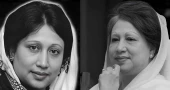
Begum Khaleda Zia
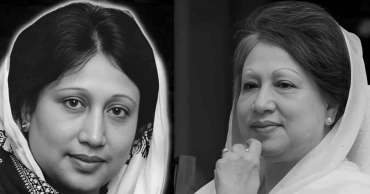
Citizens call for building future Bangladesh by upholding Khaleda’s democratic ideals
Eminent members of Bangladesh’s civil society on Friday called for building future Bangladesh by upholding the ideals, democratic journey, political decency, tolerance towards opponents and overall restraint demonstrated by former Prime Minister and ex-BNP Chairperson Begum Khaleda Zia.
The call was made at a citizens’ condolence meeting organised in memory of the late Khaleda Zia at the South Plaza of the Jatiya Sangsad.
Media personalities, leading business figures, former government officials, academics and prominent members of civil society arranged the programme to pay tribute to the departed leader.
BNP Chairperson Tarique Rahman attended the condolence meeting along with his wife Dr Zubaida Rahman, daughter Zaima Rahman and other family members.
Programme chair former Chief Justice Syed JR Mudassir Husain described Khaleda Zia’s imprisonment as the captivity of democracy.
He said the vision of a vengeanceless society that she articulated after her painful incarceration could serve as the blueprint for a civilised Bangladesh. “The path of achievement through tolerance that she showed and the call for unity she made should be the guiding force for the Bangladesh of the future.”
Law Adviser Asif Nazrul described the verdict against Khaleda Zia in the Zia Orphanage Trust corruption case as one of the most heinous trials in Bangladesh’s history.
He advised internalising Khaleda Zia’s ideals to build the Bangladesh of the future. “Hurt and astonished, Khaleda Zia repeated the question—‘Did I embezzle orphan money?’ The court treated this as her statement and convicted her on that basis. As a student of law, I can say with certainty that there cannot be a more disgraceful trial than this.”
Editors’ Council President Nurul Kabir, recalling Khaleda Zia, said her death proved how deeply loved she was by the people of the country.
“The massive turnout of people at her janaza is clear testimony to that,” he said.
Offering advice to BNP, Nurul Kabir urged the party not to deviate from Khaleda Zia’s ideals, cautioning that BNP should not do anything that would make people say Khaleda Zia was spared from witnessing such actions only because she is no longer alive.
The Daily Star Editor Mahfuz Anam recalled starting his career as a young journalist during Khaleda Zia’s first tenure with aspirations for independent journalism. “I was fortunate to meet Prime Minister Khaleda Zia several times. Her respect for free journalism, tolerance and ability to accept dissent and criticism deeply impressed me and earned my lasting respect.”
Founder Editor of Daily Jaijaidin Shafik Rehman said paying full tribute to Khaleda Zia meant restoring democracy through votes. “She fought for democracy until her last days. Under no circumstances should the February 12 national election be derailed.”
Amar Desh Editor Mahmudur Rahman compared the massive turnout at Khaleda Zia’s funeral to that of late President Ziaur Rahman’s janaza.
He said although Khaleda Zia was not in power at the time of her death, millions gathered because she lived in people’s hearts. “Her name will remain unforgettable in the democratic journey of the subcontinent.”
Veteran economist and CPD Distinguished Fellow Debapriya Bhattacharya said Khaleda Zia demonstrated farsightedness by deciding against exporting natural gas in 2003.
He noted that she paid serious attention to technical experts, describing it as one of her key strengths.
Mahbubur Rahman, President of the International Chamber of Commerce Bangladesh (ICCB), highlighted Khaleda Zia’s contribution to the country’s economic transformation.
He said the private sector became stronger due to her timely and prudent decisions, which instilled confidence among businesspeople and transformed the economy.
Khaleda Zia’s legacy honoured in Washington National Press Club
Writer and researcher Mohiuddin Ahmad said Khaleda Zia set a record in Bangladesh by becoming the first woman prime minister elected through a free and fair election and attaining the highest executive power after joining politics.
Prof Rashed Titumir highlighted Khaleda Zia’s economic reforms, saying Bangladesh’s economy was largely restructured during her tenure, forming the foundation of today’s economy.
Writer Faham Abdus Salam said Khaleda Zia was the only political leader he had seen who transformed from a legal leader to a moral leader. “Many think the highest achievement of a politician is becoming prime minister, but Khaleda Zia rose far above that position in the hearts of the people.”
Former caretaker government Chief Adviser’s Special Assistant Raja Devasish Roy said Khaleda Zia left two significant legacies in the Chattogram Hill Tracts.
He noted that no government before her had given such importance and recognition to grassroots leaders like village heads and traditional leaders. “We expect to move towards a non-communal, pluralistic and inclusive Bangladesh by following Khaleda Zia’s path.”
Former diplomat Anwar Hashim, who served as Bangladesh’s envoy to Pakistan and Geneva during her 1991 government, spoke on Khaleda Zia’s foreign policy.
Former Public Service Commission Chairman Prof SMA Faiz, who served during Khaleda Zia’s tenure, said she prioritised merit-based recruitment and never interfered in cadre appointments or exerted pressure for political recruitment.
Khaleda Zia’s grace, sense of dignity were truly admirable: Nurul Kabir
Referring to Khaleda Zia’s final days, her medical team chief and medicine and chest disease specialist Dr FM Siddique said she had to endure immense suffering due to medical negligence.
He said when treatment began at Evercare Hospital, they found she had been given certain harmful medications that led to liver cirrhosis.
He also blamed wrong treatment for her arthritis and other complications. “Despite her immense contributions to the country’s healthcare sector, she had to leave this world due to prolonged medical negligence. There should be a specific investigation into this matter.”
Bangladesh Puja Udjapan Parishad President Basudeb Dhar said Khaleda Zia always stood by oppressed people wherever she heard their voices.
He said the history of democracy in Bangladesh remains incomplete without her, adding that completing the country’s democratic struggle would be the highest tribute to her.
Abdus Sattar Dulal, President of Disabled Peoples’ International, recalled the enactment of laws and policies for persons with disabilities and the introduction of disability allowances during Khaleda Zia’s tenure.
Transcom Managing Director Simeen Rahman said Khaleda Zia, as a person, was uncompromising, firm and dignified. “Her contributions to Bangladesh’s business sector and economic development were far-reaching.”
Condolence meeting preparation committee president Prof Mahbub Ullah recalled Khaleda Zia’s words, “We have friends abroad, not masters. We hold the flag of independence in our hands, while they hold the chains of subjugation. I have no address outside the country; this country is my final address.”
He said these three messages of Khaleda Zia should serve as guiding principles for statesmen in building the future of Bangladesh.
At the outset, Saleh Uddin, coordinator of the programme and executive editor of The Daily Ittefaq, read out the condolence note. He said the event was not a political programme but a tribute from the country’s civil society to Khaleda Zia.
Khaleda was convicted in Bangladesh’s most disgraceful trial: Asif Nazrul
“Today, people across the country are remembering two-time Prime Minister Khaleda Zia not as a powerful political leader, but as a humane leader,” he said.
BNP standing committee members, political activists, diplomats from different countries, civil society members and representatives of various professional organisations from both public and private sectors were present at the meeting.
The programme followed by prayers seeking eternal peace for Khaleda Zia’s departed soul.
8 months ago
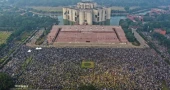
Khaleda Zia’s janaza held with tears of lakhs of mourners
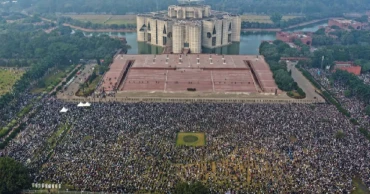
Hundreds of thousands of people on Wednesday offered prayers at Manik Mia Avenue as the namaz-e-janaza of BNP Chairperson and three-time former Prime Minister Begum Khaleda Zia was held, bidding her a final farewell amid waves of grief.
Renowned Islamic scholar and Baitul Mukarrom Mosque Khatib Mufti Mohammad Abdul Malek led the namaz-e-janaza at 3:02pm
Dhaka stands still as Khaleda’s coffin being taken to Manik Mia Avenue
Chief Adviser Professor Muhammad Yunus, interim government advisers, BNP leaders, leaders of other political parties, and the chiefs of the three services joined the janaza.
Foreign dignitaries, including representatives from India, Pakistan, and other South and Southeast Asian countries, were also present.
Khaleda Zia’s body was taken to a temporary stage set up at the South Plaza of the Jatiya Sangsad around 2:45pm.
Later, BNP Standing Committee member Nazrul Islam Khan read out a brief life sketch of Khaleda Zia on behalf of the party.
Khaleda Zia’s body taken to Tarique Rahman’s Gulshan residence
He explained the circumstances that led her to enter politics and highlighted her long struggle for democracy, her unwavering commitment to democratic values and her deep patriotism.
He also recalled her contributions to the country and urged everyone to pray for her departed soul.
At around 2:58pm, BNP Acting Chairman Tarique Rahman delivered a short address to the gathering, requesting people to forgive his mother if she had hurt anyone, knowingly or unknowingly, at any time in her life.
He said if Khaleda Zia owed anything to anyone, they should inform him and he would make arrangements to repay it.
People from across the country thronged Manik Mia Avenue, Khamar Bari, Bijoy Sarani, Asad Gate, Karwan Bazar and surrounding areas.
Around 11:50 am, a freezer-van draped in the red-and-green national flag, carrying Khaleda Zia’s body, arrived at the avenue from the Gulshan Avenue residence of her elder son, Tarique Rahman.
A multi-layered security arrangement was in place around Manik Mia Avenue to maintain law and order as thousands of mourners gathered. Members of the army, police, RAB, BGB, and other law enforcement agencies remained deployed throughout the event.
After the janaza, she will be laid to rest beside her husband, late President Ziaur Rahman, at Zia Udyan in Sher-e-Bangla Nagar, where a grave has been prepared next to his.
Despite the biting winter cold, people from across the country arrived in the capital from early morning to attend the janaza and pay their respects.
Crowds were also seen overnight near the National Parliament area, Evercare Hospital, the Gulshan office, and Firoza.
Khaleda Zia, a three-time Prime Minister, passed away at Evercare Hospital at around 6:00 am on Tuesday (December 30) after receiving treatment for more than a month.
8 months ago

BNP's allegation over Shaheed Minar incident 'false': Info Minister
Information and Broadcasting Minister Dr Hasan Mahmud on Thursday said BNP made false allegations over what happened while placing their floral wreath at Shaheed Minar along with anti-liberation forces and the persons who were against the language.
He made this comment in response to questions from journalists over Mirza Fakhrul's complaint at the meeting room of his ministry at the Secretariat in the capital.
Read more: Ansar al-Islam threatens to bomb Amar Ekushey Boi Mela
"It is a false allegation. Last year, we placed wreaths after them (BNP) and it took over three and a half hours. And this year, we stood in silence for 30 seconds after paying tributes and then left. BNP started late when the Shaheed Minar was crowded. No one obstructed them," Hasan Mahmud said. In fact, "BNP doesn't have the spirit of Amar Ekushey or the Liberation War. They talk about 21st February and the spirit of the Liberation War but they do politics with the anti-liberation forces who tried to do so-called Islamization of the language by introducing Bengali writing in Arabic alphabet and banned Rabindranath's songs in East Bengal," he said.
Read more: BNP pays homage to Language Movement martyrs Replying to another query over Begum Khaleda Zia, Hasan Mahmud said if any person is convicted for more than two years, he or she cannot take part in the election as per the law of the country. As she was sentenced for more than two years. So, there is no question of her participation in the election, he added. In addition, the government has given her conditional permission to stay home considering her health and age. As per the condition, she can not do politics, he added.
Read more: Khaleda has no chance to do politics as convict: Quader Earlier, the minister unveiled covers of five books at the meeting room and congratulated the writers. The books are 'Bangabandhur Jiban and Shilpa Bhabna' written by Sowmithra Dev, 'Sheikh Hasina ekti Kaljoyee Upakkhyan' and 'Sheikh Rehana ek Dipto Shikha' written by Shamima Sultana, Swapno Loker Nadi and 'HIV-Aids Risk and 'Gender Relation: Women Sex Worker in Bangladesh' written by deputy secretary of the information ministry Dr Sheikh Muslima Moon.
3 years ago

PM suspended Khaleda's sentence out of humanity
Regarding various statements made by BNP leaders about Begum Khaleda Zia's illness, Awami League general secretary Obaidul Quader said Sheikh Hasina had suspended Begum Zia's sentence because of her humanity.
He said this while addressing a discussion meeting organized by Dhaka Metropolitan North Awami League on the occasion of Prime Minister Sheikh Hasina's Homecoming Day on Bangabandhu Avenue this morning.
He questioned the BNP leaders and said it is not humanity?
Also read: Khaleda still suffering from post-Covid complications: Doctor
Obaidul Quader further said that the BNP leaders did not even appreciate this humanity.
Obaidul Quader said the BNP has become a world champion in the politics of revenge with observance of Khaleda Zia's fake birthday by cutting a cake on the day of Bangabandhu's assassination on August 15.
Quader also said that there is no one else who has created this record.
He remarked that Bangladesh will be able to move forward at a relentless pace in the quest for development and prosperity by tackling the Corona crisis.
Referring to Sheikh Hasina as the most honest, courageous and humane leader in post-75 Bangladesh, Obaidul Quader said Bangabandhu's Bangladesh is a wonder of the world today under the farsighted leadership of Sheikh Hasina.
Mentioning that Sheikh Hasina has been successfully leading the party for the last four decades as a symbol of unity of the Awami League, the General Secretary of the Awami League said that Sheikh Hasina has come a long way and stood on the rubble and repeatedly triumphed over life.
Also read: ‘Vindictive politics’ behind govt’s negative decision on Khaleda: BNP
Noting that Bangladesh has evolved from a least developed country to a developing country today with the return of Sheikh Hasina, Obaidul Quader said it is another golden feather in the crown of Sheikh Hasina's success.
Dhaka Metropolitan North Awami League President Sadek Khan presided over the meeting at Bangabandhu Avenue while Awami League presidium member Jahangir Kabir Nanak, joint secretary Mahbubul Haque Hanif, organisational secretary Mirza Azam also spoke among others.
5 years ago