illegal migration
Bangladesh reiterates zero-tolerance stance on human trafficking, illegal migration
Bangladesh on Wednesday reiterated Bangladesh’s zero-tolerance policy towards human trafficking and all forms of irregular migration, while emphasising ng the Government’s commitment to promoting safe, orderly, and regular migration.
Visiting Director for International Affairs, Returns and Visa of the European Commission, Henrik Nielsen paid a courtesy call on Shama Obaed Islam, State Minister for Foreign Affairs at the Ministry of Foreign Affairs and discussed the issues of mutual interest.
Michael Miller, Ambassador of the European Union Delegation to Bangladesh, was also present during the meeting.
The State Minister reaffirmed Bangladesh’s commitment to further strengthening its multifaceted partnership with the European Union (EU) and appreciated the EU’s continued engagement in Bangladesh’s development journey.
She recalled the recent high-level exchanges between Bangladesh and the EU and expressed satisfaction with the growing momentum in bilateral relations.
Migration and mobility cooperation featured prominently in the discussions, said the Ministry of Foreign Affairs.
She appreciated the EU Talent Partnership initiative and urged EU member states to create new legal migration pathways and expand opportunities for Bangladeshi skilled workers and professionals.
The two sides also exchanged views on the EU’s forthcoming Asylum and Return Border Procedure and underscored the importance of close coordination, regular dialogue and due process, in migration and return matters.
Both sides highlighted ongoing efforts to raise awareness about the risks and consequences of irregular migration.
The discussions further covered a broad range of issues, including political and economic developments, employment generation, skills development, the Bangladesh-EU Free Trade Agreement (FTA), Bangladesh’s graduation from LDC status, education, sports, regional and multilateral cooperation.
The State Minister thanked the European Union for its continued support to the Rohingyas and host communities and reiterated the importance of maintaining international attention on the safe, voluntary, dignified, and sustainable repatriation of the Rohingyas to Myanmar.
Both sides reaffirmed their commitment to further deepening Bangladesh-EU relations and enhancing collaborative efforts across a wide range of areas of mutual interest.
3 months ago
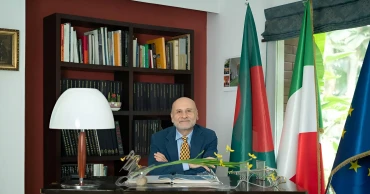
Irregular entry, false asylum claims harm Bangladesh’s global standing: Italian Ambassador
Italian Ambassador to Bangladesh Antonio Alessandro on Monday (10th November 2025) said Illegal migration affects Bangladesh’s passport ranking and complicates bilateral cooperation, stressing that migration must take place through legal channels.
“Irregular entry into Italy and false asylum claims ultimately harm Bangladesh’s global standing and passport ranking,” he said.
The Italian Ambassador said his country attaches high importance to its relations with Bangladesh, particularly in migration, investment, and cooperation, while calling for stronger institutional reforms and lawful migration to deepen bilateral ties.
He was speaking at a seminar titled “Strengthening Ties: The Future Vision of Bangladesh–Italy Relations” at the Bangladesh Institute of International and Strategic Studies (BIISS).
Ambassador Alessandro said Bangladesh and Italy remain “important partners” in migration and development.
He said around 18,000 Bangladeshis entered Italy illegally through Libya this year, while 9,000 Bangladeshi nationals received legal visas, including 530 students.
Read more: Prof Yunus leaves for Rome to attend World Food Forum
The Ambassador said Italy maintains defence cooperation with Bangladesh but “does not sell weapons to any country under the pretext of geopolitical considerations or partnerships.”
He said Bangladesh would decide independently if and when it wishes to purchase defence equipment from Italy.
Ambassador Alessandro expressed optimism that the upcoming general election in February would be free and fair, saying Italy supports Bangladesh’s democratic process.
“We believe reforms will bring stability, ensuring no one feels compelled to seek political asylum abroad,” he said.
Highlighting investment challenges, he pointed to the need for greater credibility of public documents and lower customs duties to attract small and medium-sized Italian companies.
He noted that Bangladesh’s readymade garments are exported to Italy, while industrial machinery is imported from Italy.
UNHCR welcomes Italy’s contribution of EUR 2.5mn for essential assistance to Rohingyas
He stressed the importance of fair and transparent procedures to build investor confidence and promote mutually beneficial growth.
The Ambassador also mentioned that Italian Prime Minister Giorgia Meloni is expected to visit Dhaka soon, after postponing her earlier Asian tour due to discussions on the Ukraine war.
BIISS Director General Major General Iftekhar Anis chaired the seminar.
Professor Dr. Syeda Rozana Rashid of Dhaka University and Md. Mosharraf Hossain, Director General (East Europe, CIS, West Europe and EU) of the Ministry of Foreign Affairs, presented papers, while Professor Dr. Kazi Maruful Islam moderated the session.
The seminar underscored the growing importance of Bangladesh–Italy relations, highlighting mutual interest in strengthening cooperation across labour migration, economic partnership, defence dialogue, and institutional transparency.
Both sides reiterated their shared vision of advancing a stable, prosperous and inclusive future built on mutual respect and strategic cooperation.
Read more: Bangladesh-Italy’s economic ties in focus as Meloni mulls Dhaka visit
10 months ago
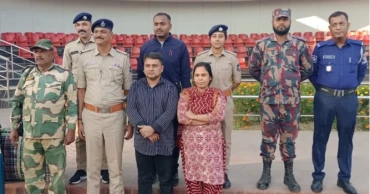
Bangladeshi couple returns home after serving jail in India
A Bangladeshi couple, sentenced to five years in prison for illegal migration to India, returned home through the Benapole check post on Sunday, authorities said.
The returnees are Md. Rashid Sheikh, 40, and his wife Jhorna Khatun, 32, from Mallik Para village in Jhikargachha upazila of Jashore.
The Petrapole immigration police handed them over to the Benapole Immigration Police on Sunday evening through a special travel permit issued by the Indian government.
Bangladeshi, Indian civilians face off along Chapainawabganj border
Imtiaz Bhuiyan, officer-in-charge (OC) of Benapole Immigration Police, said they were handed over to the Benapole Port Police Station after due procedures. From there, an NGO called Rights Jessore will receive them and hand them over to their families, he added.
Md. Jawadul Karim, Psychosocial Counsellor at Rights Jessore, said the couple had illegally crossed into India through the Chaugachha border in Jashore in March 2018 in search of better job opportunities.
They found work in a vegetable shop in Gujarat but were arrested by Indian police in January 2020.
Later, they were sentenced to five years in prison and sent to Gujarat Central Jail. After completing their sentence, the couple was placed in a shelter run by an Indian NGO.
BGB detains 2 Indian nationals with smuggled goods
With support from the embassies of both countries, the couple returned to Bangladesh on Sunday evening.
Rights Jessore has confirmed that the couple will stay at their shelter home before being safely handed over to their families.
1 year ago

Desperate journey to Europe: 8 Bangladeshis among those who drowned in the Mediterranean
In a somber announcement on Tuesday (February 20, 2024), the Ministry of Foreign Affairs (MoFA) revealed the identities of eight Bangladeshis who met a tragic fate while attempting to cross the Mediterranean Sea. The individuals, embarking on an unauthorized voyage from Libya to Europe, drowned in a devastating incident that underscores the perilous journey faced by many seeking a better life abroad.
The victims, identified as Sajal, Nayan Biswas, Mamun Seikh, Kazi Sajeeb, Kaisar, Rifat, Russell, and Imrul Kayes Apon, hailed from the Madaripur and Gopalganj districts of Bangladesh. Specifically, the first five victims originated from various villages within the Rajoir upazila of Madaripur, while the remaining were from Muksudpur upazila in Gopalganj.
Read more: Out of options, Rohingya fleeing Myanmar and Bangladesh by boat despite soaring death toll
The details were shared in a press release distributed by MoFA, which aimed to shed light on the tragic event and its impact on the victims’ communities.
The ill-fated journey began on February 13, when a boat carrying individuals from Bangladesh, Pakistan, Egypt, and Syria set sail from a Libyan coastal area with hopes of reaching Europe. The group comprised 27 Bangladeshis, 8 Pakistanis, 3 Egyptians, 5 Syrians, and an Egyptian individual who navigated the boat. However, their aspirations were cut short when the vessel capsized off the Tunisian coast in the early hours of February 14.
Rescue operations later recovered the bodies of the eight Bangladeshis and one Pakistani, which were subsequently transferred to local hospitals. The foreign ministry's report further highlighted that among the Bangladeshi victims, seven were traveling without passports, indicating the desperate measures taken by individuals in pursuit of better opportunities.
Read more: Bangladesh wants to boost cooperation with Libya to curb illegal migration
2 years ago

Out of options, Rohingya fleeing Myanmar and Bangladesh by boat despite soaring death toll
Across a treacherous stretch of water, the Rohingya came by the thousands, then died by the hundreds. And though they know the dangers of fleeing by boat, many among this persecuted people say they will not stop — because the world has left them with no other choice.
Last year, nearly 4,500 Rohingya — two-thirds of them women and children — fled their homeland of Myanmar and the refugee camps in neighboring Bangladesh by boat, the United Nations’ refugee agency reported. Of those, 569 died or went missing while crossing the Bay of Bengal and Andaman Sea, the highest death toll since 2014.
The numbers mean one out of every eight Rohingya who attempted the crossing never made it, the UNHCR said last week.
Yet despite the risks, there are no signs the stream of Rohingya is ebbing. On Thursday, Indonesian officials said another boat carrying Rohingya refugees landed in the country’s northern province of Aceh.
Not a good time for Rohingya repatriation, UN Resident Coordinator says
Fishermen provided food and water to 131 Rohingya, mostly women and children, who had been on board, said Marzuki, the leader of the local tribal fishing community, who like many Indonesians goes by one name.
Some passengers told officials they had been at sea since last month and their boat's engine had broken down, leaving them adrift, said Lt. Col. Andi Susanto, commander of the navy base in Lhokseumawe.
“Southeast Asian waters are one of the deadliest stretches in the world and a graveyard for many Rohingya who have lost their lives,” says Babar Baloch, UNHCR’s spokesman for Asia and the Pacific. “The rate of Rohingya who are dying at sea without being rescued — that’s really alarming and worrying.”
Inside the squalid refugee camps in Bangladesh, where more than 750,000 ethnic Rohingya Muslims fled in 2017 following sweeping attacks by Myanmar’s military, the situation has grown increasingly desperate. Not even the threat of death at sea is enough to stop many from trying to traverse the region’s waters in a bid to reach Indonesia or Malaysia.
“We need to choose the risky journey by boat because the international community has failed their responsibility,” says Mohammed Ayub, who is saving up money for a spot on one of the rickety wooden fishing boats traffickers use to ferry passengers 1,800 kilometers (1,100 miles) from Bangladesh to Indonesia.
Global indifference toward the Rohingya crisis has left those languishing in the overcrowded camps with few alternatives to fleeing. Because Bangladesh bans the Rohingya from working, their survival is dependent upon food rations, which were slashed last year due to a drop in global donations.
Returning safely to Myanmar is virtually impossible for the Rohingya, because the military that attacked them overthrew Myanmar’s democratically elected government in 2021. And no country is offering the Rohingya any large-scale resettlement opportunities.
Meanwhile, a surge in killings, kidnappings and arson attacks by militant groups in the camps has left residents fearing for their lives. And so, starving, scared and out of options, they continue to board the boats.
Ayub has lived in a sweltering, cramped shelter for more than six years in a camp where security and sanitation are scarce, and hope even scarcer. There is no formal schooling for his children, no way for him to earn money, no prospects for returning to his homeland and no refuge for his family amid spiraling gang violence.
World must find an end to Rohingya crisis for their return to Myanmar: PM Hasina tells UK MPs
“Of course I understand how dangerous the boat journey by sea is,” Ayub says. “We could die during the journey by boat. But it depends on our fate. ... It’s better to choose the dangerous way even if it’s risky, because we are afraid to stay in the camps.”
Two hundred of the people who died or went missing at sea last year were aboard one boat that left Bangladesh in November. Eyewitnesses on a nearby boat told The Associated Press that the missing vessel, which was crowded with babies, children and mothers, broke down and was taking on water before it drifted off during a storm as its passengers screamed for help. It has not been seen since.
It was one of several distressed boats that the region’s coastal countries neglected to save, despite the UNHCR’s requests for those countries to launch search and rescue missions.
“When no action is taken, lives are lost,” says UNHCR’s Baloch. “If there is no hope restored in Rohingya lives either in Myanmar or in Bangladesh, there are no rescue attempts, (then) sadly we could see more desperate people dying in Southeast Asian seas under the watch of coastal authorities who could act to save lives.”
Six of Mohammed Taher’s family members were aboard the boat that vanished in November, including his 15-year-old brother, Mohammed Amin, and two of Taher’s nephews, aged 3 and 4. Their ultimate destination was Malaysia, a Muslim-majority country where many Rohingya seek relative safety.
Taher and his parents now struggle to sleep or eat, and spend their days agonizing over what became of their loved ones. Taher’s mother saw a fortune teller who said her relatives were still alive. Taher, meanwhile, dreamed that the boat made it to shore, where his relatives took refuge in a school and were able to bathe in warm water. But he remains unconvinced their journey ended so happily.
And so he has vowed to tell everyone to stay off the boats, no matter how unbearable life on land has become.
“I will never leave by boat on this difficult journey,” Taher says. “All the people who reached their destination are saying that it’s horrific traveling by boat.”
Yet such warnings are often futile. Ayub is now preparing to sell his daughter’s jewelry to help pay for his spot on a boat. While he is frightened by the stories of those who didn’t make it, he is motivated by the stories of those who did.
“Nobody would consider taking a risk by boat on a dangerous journey if they had better opportunities,” he says. “Fortunately, some people did reach their destination and got a better life. I am staying positive that Allah will save us.”
FM hopeful of Rohingya repatriation soon
2 years ago

Italy to take skilled workers from Bangladesh, contain illegal migration
Bangladesh and Italy have agreed to contain illegal migration to the European country.
Italy has agreed to take skilled workers from Bangladesh under bilateral migration and mobility arrangement, particularly in the construction, shipbuilding and hospitality sectors.
The decisions were shared at the Political Consultations held on June 7 in Rome.
The Italian side expressed satisfaction that at present over 46% of workers under Flussi Decree are coming to Italy from Bangladesh for seasonal and non-seasonal work.
Also read: ‘Bangladeshi migrant workers’ being prepared for post-pandemic labour market’
Bangladesh and Italy held the first-ever Political Consultations at the Ministry of Foreign Affairs and International Cooperation in Rome.
Foreign Secretary Masud Bin Momen and Secretary General of the Italian Ministry of Foreign Affairs and International Cooperation Riccardo Guariglia led the respective sides at the consultations, according to the Ministry of Foreign Affairs.
Before the Political Consultations, Foreign Secretary Momen and Secretary General Guariglia signed am memorandum of understanding on Political Consultations between the foreign ministries of Bangladesh and Italy.
During the meeting, both countries expressed keen desire to deepen the relations and further engage in multiple areas including trade and investment, technological intervention in Bangladesh’s textile sector, cooperation in defence and security, ICT, agriculture, migration and mobility.
Also read: Italy declares state of emergency as migrant numbers surge
3 years ago

Bangladesh wants to boost cooperation with Libya to curb illegal migration
State Minister for Foreign Affairs Md Shahriar Alam has said Bangladesh supports legal migration to other countries and wants to enhance cooperation with Libya in order to curb illegal migration.
He conveyed this to newly appointed Ambassador of the State of Libya in Bangladesh Abdulmutalib S M Suliman.
State Minister Alam thanked the Libyan government for their continued support to the Bangladeshi workers working in Libya.
Read more: Libya seeks joint commission with Bangladesh to expand cooperation
He particularly sought cooperation of Libya in contract farming of Bangladesh agro-entrepreneurs in Libya by leasing land there.
Alam also proposed establishment of collaboration between Bangladesh and Libya in food security area in the backdrop of the current global food crisis.
He said Bangladesh and Libya can celebrate the 50th anniversary of diplomatic relations jointly by undertaking different programmes.
3 years ago