Russia-Bangladesh
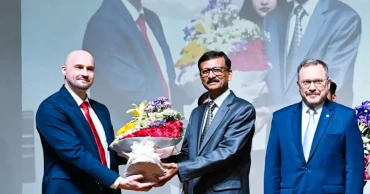
Russian House, formerly the Russian Cultural Centre, celebrates 50 years in Bangladesh
Foreign Affairs Adviser Md Touhid Hossain on Tuesday said Bangladesh and Russia need to continue the legacy of bonhomie, work together to address regional and global challenges, and ensure that the bonds between Bangladesh and Russia remain as strong as ever.
"May the next 50 years be filled with even greater success, collaboration, and shared achievements. May our two countries work together to achieve a brighter, more harmonious future for both our nations and the world at large," he said.
Adviser Hossain was speaking at an event “50 Years of The Russian House in Dhaka: A Legacy of Friendship and Cultural Exchange” at the Russian House in the evening.
Alexander Khozin, Ambassador of the Russian Federation to Bangladesh,Dr. Syed Jamil Ahmed, Director General, Bangladesh Shilpakala Academy, Yevgeny Primakov, Head of Rossotrudnichestvo, and Pavel Dvoychenkov, Director, Russian House, were also present.
The Foreign Adviser hoped that the Russian House in Dhaka, formerly the Russian Cultural Centre, will continue to inspire and foster a deeper connection between the two peoples for many more years to come.
Indeed, today, the House has been a home for those seeking knowledge, and a deeper connection to the Russian heritage, fostering a deep sense of camaraderie and mutual appreciation, Hossain said.
This House has also been a beacon of cultural diplomacy, a place where the thinkers, intellectuals, artists and professionals of two countries can come together to celebrate and understand each other’s culture, he said.
Many Bangladeshis have also had the privilege to learn the Russian language, explore Russian literature, and witness firsthand the beauty of Russian customs and traditions.
Dr Yunus urges Maldives to regularise undocumented Bangladeshi expats
"From the enchanting performances of Russian ballet to the captivating exhibitions of literature and visual arts, we have witnessed a flourishing exchange that transcends borders and enhances our mutual understanding," said the Adviser.
He said they have also seen how this Russian House has been enriching Bangladesh’s cultural landscape and providing our citizens with a unique window into the rich cultural heritage of Russia.
"Through this way, our own cultural heritage has found a valuable space to be shared with our Russian friends," he said.
On the other hand, a significant number of Bangladeshi students have benefited from the educational opportunities offered by the Russian institutions.
And today, many of them have gone on to become leaders in their respective fields.
"This exchange of knowledge and expertise has not only enriched our individual lives but has also contributed to the progress of our societies as a whole," Hossain said.
The Bangladesh-Russia historic ties, born in the 1970s, continue to evolve and flourish today. In addition to education and culture, and collaboration spans a wide range of fields, encompassing trade and commerce, science and technology, defence and security.
"As we celebrate the 50th anniversary of the Russian House in Dhaka, let us also look ahead to the future. Indeed, the celebration of this significant milestone is not only a reflection of the past but also a renewed commitment to building an even stronger, more vibrant partnership in the years to come," Hossain said.
Bearing this in mind, he said, they need to continue to build on the foundations laid by the Russian House, embracing new opportunities for cultural exchange, enhancing people-to-people ties, and further deepening the partnership.
1 year ago

UNGA Resolution on Ukraine: 32 countries including Bangladesh, India and China abstain
The UN General Assembly has adopted a resolution that demands Russia leave Ukraine.
Thirty-two countries including Bangladesh, India, China, Pakistan and Sri Lanka abstained from voting while seven countries including Russia voted against the resolution.
A total of 141 countries voted in favour of the resolution.
The U.N. General Assembly approved the non-binding resolution Thursday that calls for Russia to end hostilities in Ukraine and withdraw its forces, sending a strong message on the eve of the first anniversary of the invasion that Moscow's aggression must stop, reports AP.
The resolution, drafted by Ukraine in consultation with its allies, passed 141-7, with 32 abstentions.
Read more: China calls for Russia-Ukraine cease-fire, peace talks
Ukrainian Foreign Minister Dmytro Kuleba said the vote was more evidence that not only the West backs his country.
“This vote defies the argument that the global south does not stand on Ukraine’s side," Kuleba said. "Many countries representing Latin America, Africa, Asia voted in favor.”
The General Assembly has become the most important U.N. body dealing with Ukraine because the Security Council, which is charged with maintaining international peace and security, is paralyzed by Russia’s veto power. General Assembly resolutions are not legally binding, unlike Security Council resolutions, but serve as a barometer of world opinion.
The seven countries voting against Thursday's resolution were Belarus, Nicaragua, Russia, Syria, North Korea, Eritrea and Mali, which has developed close military ties with Russia. Amendments proposed by Belarus would have weakened or stripped much of the language but were resoundingly defeated.
The vote was slightly below the highest total for the five previous resolutions approved by the 193-member world body since Russia sent troops and tanks across the border into its smaller neighbor on Feb. 24, 2022. That tally, in an October resolution against Russia’s illegal annexations, won approval by 143 countries.
Foreign ministers and diplomats from more than 75 countries addressed the assembly during two days of debate, with many urging support for the resolution that upholds Ukraine’s territorial integrity, a basic principle of the U.N. Charter that all countries must subscribe to when they join the world organization.
The war has killed tens of thousands on both sides and has reduced entire Ukrainian cities to ruins and its impact has been felt worldwide in higher food and fuel costs and rising inflation.
Venezuela’s deputy ambassador addressed the council on behalf of 16 countries that either voted against or abstained on almost all of five previous resolutions on Ukraine: Belarus, Bolivia, Cambodia, China, Cuba, Eritrea, Equatorial Guinea, Iran, Laos, Mali, Nicaragua, North Korea, St. Vincent, Syria, Venezuela and Zimbabwe.
3 years ago

Bangladesh envoy to Moscow summoned over barring Russian ships from entering Bangladesh: report
Bangladesh Ambassador to Russia Kamrul Ahsan was summoned to the Russian foreign ministry following Bangladesh’s decision to ban Russian ships from calling at Bangladeshi ports, reports Russia's state-owned news agency TASS on Tuesday.
"We drew attention of the head of the diplomatic mission to the reports about the decision of his country’s authorities to ban Russian ships carrying cargoes for Bangladesh from calling at Bangladeshi ports," the agency reported quoting the Russian Ministry of Foreign Affairs.
"This step runs counter to the traditionally friendly charater of bilateral relations and can have a negative effect on the prospects for our cooperation in various spheres," the report reads.
Dhaka has not made any comment yet regarding the report.
Last week, Russia’s embassy in Dhaka confirmed to TASS that 69 Russian ships (sanctioned) had been barred from calling at the country’s ports.
However, according to the embassy, this step did not mean that Bangladesh had banned imports of Russian goods.
Russian Foreign Ministry Spokeswoman Maria Zakharova said later that Bangladesh had made this decision under the threat of US secondary sanctions, according to TASS report.
3 years ago