weapons package
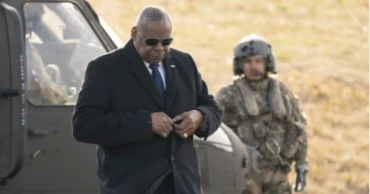
Biden administration set to announce 'substantial' final weapons package for Ukraine
The Biden administration is set to announce a massive, final weapons aid package for Ukraine as part of Defense Secretary Lloyd Austin’s visit to Germany on Thursday to meet with representatives of about 50 partner nations who have come to Ukraine’s defense since Russia invaded nearly three years ago, two senior defense officials said.
The officials did not provide an exact dollar amount but said the package was expected to be “substantial," although it would not include all of the roughly $4 billion left in the congressionally authorized funding for Ukraine. There likely would be “more than a couple billions dollars” remaining for the incoming Trump defense team to provide to Ukraine if it chose to do so, the officials said Tuesday in briefing reporters traveling with Austin.
Ukraine is in the midst of launching a second offensive in Russia's Kursk region and is facing a barrage of long-range missiles and ongoing advances from Russia as both sides seek to put themselves in the strongest negotiating point possible before President-elect Donald Trump takes office on Jan. 20.
Ukraine will ask allies to boost its air defenses at a meeting in Germany: Zelenskyy
Austin's trip to Ramstein Air Base will be his final meeting with the group he organized to come to Ukraine's defense after Russia's invasion in February 2022. Together those nations have provided more than $126 billion in weapons and military training and assistance. Those packages have included millions of rounds of ammunition, advanced fighter jets, air defense systems, counter-UAV systems and even tanks.
The US has provided $66 billion of that total.
The package to be announced on Thursday will be drawn from existing stockpiles with a goal of getting most of the weapons pledged to Ukraine by the time Trump is sworn in., one of the defense officials said.
On Dec. 30, the administration announced a separate $1.25 billion aid package, part of a series of aid announcements as it hurried to get as much military assistance to Ukraine as it can before President Joe Biden leaves office.
1 year ago
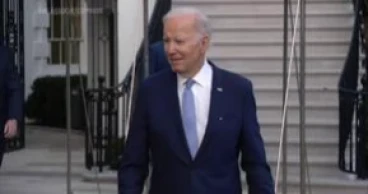
Biden unveils new Ukraine weapons package, Russia sanctions
The Biden administration declared its Ukraine solidarity with fresh action as well as strong words on Friday, piling sweeping new sanctions on Moscow and approving a new $2 billion weapons package to re-arm Kyiv a year after Russia’s invasion.
Despite the U.S. and allies’ continued ambitious efforts to bolster the Ukrainians, there are no signs of an endgame in the war, which seems destined to enter an even more complicated phase in the months ahead.
On the somber anniversary, Biden and fellow leaders from the Group of Seven allies that have been at the forefront of backing Ukraine stayed focused on a unified front.
“Our solidarity will never waver in standing with Ukraine, in supporting countries and people in need, and in upholding the international order based on the rule of law," the G-7 leaders said in a joint statement after a virtual meeting with Ukrainian President Volodymyr Zelenskyy.
As Ukraine mourned its war dead and vowed it would ultimately emerge victorious, the Pentagon unveiled its latest weapons package. It includes more ammunition, electronic warfare detection equipment and other weapons to counter Russia’s unmanned systems, and several types of drones, including the upgraded Switchblade 600 Kamikaze attack drone.
The latest aid package uses the Ukraine Security Assistance Initiative to provide funding for longer-term contracts to buy weapons and equipment. Unlike the presidential drawdown authority that the Pentagon has used repeatedly over the past year to pull weapons from its own stocks and quickly ship them to Ukraine, the USAI-funded equipment could take a year or two to get to the battlefront. As a result, it will do little to help Ukraine prepare for an expected new offensive in the spring.
“Difficult times may lie ahead, but let us remain clear-eyed about what is at stake in Ukraine,” U.S. Defense Secretary Lloyd Austin said, “to ensure that a world of rules and rights is not replaced by one of tyranny and turmoil.”
Biden said in an ABC News interview on Friday that he's not ready to send F-16 fighter jets to Ukraine. Zelenskyy has been pressing the U.S. and allies for jets, but White House officials have pushed back that they are not the weaponry that Ukrainians need in the near term.
“There is no basis on which there is a rationale, according to our military now to provide F-16s,” Biden said. “I am ruling it out for now.”
Meanwhile, the White House said that new sanctions hitting over 200 people and entities will “further degrade Russia’s economy and diminish its ability to wage war against Ukraine.” The Biden administration will also further restrict exports to Russia and raise tariffs on some Russian products imported to the U.S.
Read more: White House announces $270M military package for Ukraine
"Now, not only does Ukraine stand, but the global coalition in support of Ukraine is stronger than ever, with the G7 as its anchor," Biden said on Twitter following Friday's virtual meeting with Zelenskyy.
Still, as the conflict enters a second year, there are no indications that President Vladimir Putin will retreat from the conflict. And the avalanche of international sanctions that have been steadily hoisted on Moscow over the past year have yet to deliver the sort of knockout blow to the Russian economy that the White House — and independent economists — predicted at the outset of the war.
The Russian economy has weathered sanctions better than expected in 2022, in part due to “the slow introduction of commodities sanctions," according to a Moody’s Investors Service report on Friday.
The Russian economy is expected to weaken in 2023, with GDP shrinking by 3% this year, according to the Moody's projection. The economy shrank 2.2% in 2022, far short of predictions of 15% or more that Biden administration officials had showcased at the start of the war. Export controls and financial sanctions are gradually eroding Russia’s industrial capacity, but oil and other energy exports last year enabled Putin to keep funding the war.
White House National Security Council spokesman John Kirby acknowledged that Russia's economy was “showing some resilience” but he also said it's not clear that it “can be sustained for the long haul.”
Of Putin, he said, “He has had to take some drastic measures to prop up his economy, to prop up his currency, including playing pretty aggressively with interest rates for instance."
The new sanctions introduced by U.S. Treasury on Friday hit Russian firms, banks, manufacturers and individuals, taking aim at entities that helped Russia evade earlier rounds. Russia’s metals and mining sector are among those targeted in what Treasury called one of the “most significant sanctions actions to date.”
Treasury Secretary Janet Yellen, attending meetings in India on Friday with fellow financial chiefs of the Group of 20 leading economies, called out Russian officials in attendance and insisted the world's biggest economies must do more to support Ukraine.
Read more: Biden says US sending medium-range rocket systems to Ukraine
“I urge the Russian officials here at the G-20 to understand that their continued work for the Kremlin makes them complicit in Putin’s atrocities,” Yellen said. “They bear responsibility for the lives and livelihoods being taken in Ukraine and the harm caused globally.”
The U.S. State and Commerce departments as well as the Office of the U.S. Trade Representative also issued plans Friday to increase pressure on Russia. These steps impose visa restrictions on 1,219 members of the Russian military, increase tariffs on Russian products such as metal, worth roughly $2.8 billion, and add nearly 90 Russian and third-country companies, including from China, to a list of identified sanctions evaders.
More than 30 countries representing more than half the world’s economy have already imposed sanctions on Russia, making it the most sanctioned nation in the world.
The sanctions have imposed price caps on Russian oil and diesel, frozen Russian Central Bank funds and restricted access to SWIFT, the dominant system for global financial transactions.
The U.S. and allies have directly sanctioned roughly 2,500 Russian firms, government officials, oligarchs and their families. The sanctions are depriving them of access to their American bank accounts and financial markets, preventing them from doing business with Americans, traveling to the U.S. and more.
By Friday afternoon, the Paris-based Financial Action Task Force, an international standard-setting body on illicit finance, suspended Russia from its membership. The removal occurred for the first time in the body's 34-year history.
Britain also announced new sanctions Friday on firms that supply Russia’s battlefield equipment and says it will bar export to Russia of all items it has used in the war, such as aircraft parts, radio equipment and electronic components of weapons.
“We don’t think the job is by any means done," Britain’s Treasury chief Jeremy Hunt said.
3 years ago