Iran’s nuclear program
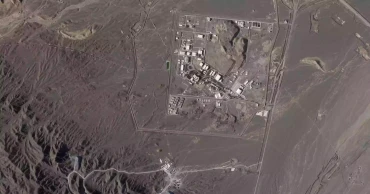
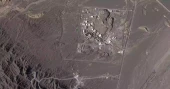
Pickaxe Mountain: Could Iran’s nuclear program retreat beneath this mountain near Natanz?
Satellite photos taken in April 2023 by Planet Labs PBC and analyzed by the AP showed Iran burrowing into the Kūh-e Kolang Gaz Lā, or “Pickaxe Mountain,” just to the south of the existing perimeter of the known nuclear facility at Natanz (see Image 1), part of the 1500-km Zagros Mountains range extending over Iran, northern Iraq, and southeastern Turkey.
A different set of images analyzed by the James Martin Centre for Nonproliferation Studies revealed that four entrances had been dug into the mountainside, two to the east and another two to the west. Each was 6 metres (20 feet) wide and 8 metres (26 feet) tall.
The scale of the work could be measured in large dirt mounds, two to the west and one to the east. Based on the size of the spoil piles and other satellite data, experts at the James Martin Centre told AP that Iran was likely building a facility at a depth of between 80 metres (260 feet) and 100 metres (328 feet). The Centre’s analysis, which it provided exclusively to AP, was the first to estimate the tunnel system’s depth based on satellite imagery.
The Institute for Science and International Security, a Washington-based nonprofit long focused on Iran’s nuclear program, suggested the tunnels could go even deeper.
The Pickaxe Mountain facility, which since its discovery has been at times referred to as part of one large facility at Natanz, is said to be even deeper underground than the one at Fordow, that was the main target of the US attack on Saturday using its never-used-before GBU-57 bomb, which can plow through at least 60 metres (200 feet) of earth before detonating.
The facility at Pickaxe Mountain, roughly 330 feet below the mountain itself, is between 30 to 70 feet deeper than Fordow. That is believed to exceed the striking depth of the GBU-57, the most powerful bunker-busting weapons in the US arsenal.
1 year ago
UN nuclear head says Iran pledges more access for inspectors
The head of the U.N.’s nuclear agency said Saturday that Iran pledged to restore cameras and other monitoring equipment at its nuclear sites and to allow more inspections at a facility where particles of uranium enriched to near weapons-grade were recently detected.
But a joint statement issued by the International Atomic Energy Agency and Iran’s nuclear body only gave vague assurances that Tehran would address longstanding complaints about the access it gives the watchdog’s inspectors to its disputed nuclear program.
IAEA Director General Rafael Mariano Grossi met with Iranian President Ebrahim Raisi and other top officials in Tehran earlier Saturday.
“Over the past few months, there was a reduction in some of the monitoring activities” related to cameras and other equipment “which were not operating,” Grossi told reporters upon his return to Vienna. “We have agreed that those will be operating again.”
He did not provide details about which equipment would be restored or how soon it would happen, but appeared to be referring to Iran’s removal of surveillance cameras from its nuclear sites in June 2022, during an earlier standoff with the IAEA.
“These are not words. This is very concrete,” Grossi said of the assurances he received in Tehran.
His first visit to Iran in a year came days after the IAEA reported that uranium particles enriched up to 83.7% — just short of weapons-grade — were found in Iran’s underground Fordo nuclear site.
The confidential quarterly report by the nuclear watchdog, which was distributed to member nations Tuesday, came as tensions were already high amid months of anti-government protests in Iran and Western anger at its export of attack drones to Russian forces fighting in Ukraine.
The IAEA report said inspectors in January found that two cascades of IR-6 centrifuges at Fordo were configured in a way “substantially different” to what Iran had previously declared. That raised concerns that Iran was speeding up its enrichment.
Grossi said the Iranians had agreed to boost inspections at the facility by 50%. He also confirmed the agency’s findings that there has not been any “production or accumulation” of uranium at the higher enrichment level, “which is a very high level.”
Iran has sought to portray any highly enriched uranium particles as a minor byproduct of enriching uranium to 60% purity, which it has been doing openly for some time.
The chief of Iran’s nuclear program, Mohammad Eslami, acknowledged the findings of the IAEA report at a news conference with Grossi in Tehran but said their “ambiguity” had been resolved.
Nonproliferation experts say Tehran has no civilian use for uranium enriched to even 60%. A stockpile of material enriched to 90%, the level needed for weapons, could quickly be used to produce an atomic bomb, if Iran chooses.
Iran’s 2015 nuclear deal with world powers limited Tehran’s uranium stockpile and capped enrichment at 3.67% — enough to fuel a nuclear power plant. It also barred nuclear enrichment at Fordo, which was built deep inside a mountain in order to withstand aerial attacks.
The U.S. unilaterally withdrew from the accord in 2018, reimposing crushing sanctions on Iran, which then began openly breaching the deal’s restrictions. Efforts by the Biden administration, European countries and Iran to negotiate a return to the deal reached an impasse last summer.
The joint statement issued Saturday said Iran “expressed its readiness to continue its cooperation and provide further information and access to address the outstanding safeguards issues.”
That was a reference to a separate set of issues from the highly enriched particles.
Over the past four years, the IAEA has accused Iran of stonewalling its investigation into traces of processed uranium found at three undeclared sites in the country. The agency’s 35-member board of governors censured Iran twice last year for failing to fully cooperate.
The board could do so again when it meets on Monday, depending in part on how Western officials perceive the results of Grossi’s visit.
Western officials have suggested the so-called safeguards probe of the three sites could confirm longstanding suspicions that Iran had a nuclear weapons program up until 2003. Iran has long denied ever seeking nuclear weapons and continues to insist that its nuclear program is entirely for peaceful purposes.
The dispute over the safeguards probe was the main obstacle in negotiations last year to restore the nuclear agreement.
“The process has been long. I have not hidden that for us, it has been too long,” Grossi said, referring to the safeguards issue. But he said there was a “marked improvement” in his dialogue with Iranian officials.
“I was heard,” he said. “I hope we will be seeing results soon. We will see.”
3 years ago