narcotics
Myanmar’s drug empire poses growing threat to Bangladesh
The ongoing civil war in Myanmar, now spanning over three years, has provided an opportunity for drug cartels to thrive, with Shan State emerging as a major hub for illicit narcotics production.
This situation poses a significant threat to neighbouring Bangladesh, which is increasingly becoming a key destination for these dangerous drugs.
According to the Department of Narcotics Control, the largest shipments of Yaba (methamphetamine tablets) entering Bangladesh are sourced from Myanmar's Shan State.
Alongside Yaba, the region has become a hotspot for the production of other potent drugs, including crystal meth (ice) and heroin. Although the spread of ice in Bangladesh was once rare, recent reports indicate a surge in seizures by law enforcement agencies.
In one of the most recent instances, in November last year, Bangladesh's Coast Guard seized one kilogram of crystal meth, worth approximately Tk 5 crore, from Shahporir Island in Teknaf.
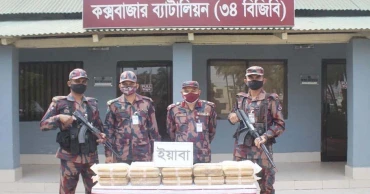
Earlier in August, large consignments of Yaba and ice, worth Tk 21 crore, were intercepted by the Border Guard Bangladesh (BGB) along the Teknaf and Naikhong border areas.
The United Nations Office on Drugs and Crime (UNODC) reports that Myanmar has ascended to the top of global opium production in 2024. Poppy flowers, which grow on the slopes of Shan State’s mountains, are used to produce heroin, while nearly fifty factories in the region manufacture Yaba and ice.
While 37 Yaba production factories were previously identified in Myanmar, the number has more than doubled in recent years due to the ongoing conflict.
Shan State shares borders with China, Thailand and Laos, and drug production thrives in this region due to a steady supply of raw materials such as methamphetamine and caffeine from the Golden Triangle.
Read more: Rampant use of antibiotic drugs causing health hazards
Besides, ephedrine, a key ingredient in the production of ice, is largely sourced from China. The growing network of drug factories in Shan State reflects the extent to which the region has become a major illicit narcotics hub.
Recent reports from The New York Times describe Shan State as a central node for warlords, smugglers, and drug traffickers.
Despite being initially hindered by local and central government forces, drug cartels in the region have flourished, partly due to bribes and the weakening of governmental authority in the wake of civil unrest. Armed insurgent groups have also capitalised on the drug trade to fund their operations.
In interviews with the media, drug dealers revealed that while the government and military had previously posed obstacles, the collapse of the state apparatus has allowed these illegal operations to flourish.
According to them, the insurgent groups operating in the region rely heavily on profits from the drug trade to sustain their armed activities.
With the market growing, competition between traffickers has intensified, leading to a drop in prices. For instance, while a can of beer costs around 10 US dollars, a single Yaba tablet can be bought for as little as 25 cents.
Bangladesh’s Struggle with Drug Proliferation
The spread of narcotics in Bangladesh has been accelerating since 2006, when the price of Yaba was over 1,200 Tk per tablet. The price has since plummeted, with current rates ranging from 100 to 120 Tk per tablet in Cox's Bazar, and between 200 to 250 Tk in Dhaka.
The Narcotics Control Department and law enforcement agencies are facing increasing challenges in curbing the trade, which predominantly flows into the country through the Teknaf border.
According to Khondokar Mostafizur Rahman, Director General of the Narcotics Control Department, the vast majority of Yaba entering Bangladesh is sourced from Myanmar. "The drug trade is flourishing, and we are struggling to control it," he said.
The department’s intelligence reports reveal several hotspots in Dhaka for Yaba trade, including railway stations, bus terminals, and launch ghats. Areas such as Mohammadpur’s Geneva Camp, Mirpur Kalshi, Old Dhaka, Kamrangirchar, and Karwan Bazar are also identified as active drug hubs.
In addition to Yaba, there has been a rise in the circulation of ice in affluent areas of the capital, including Gulshan, Banani, and Uttara. Some dealers are even selling ice online, further complicating enforcement efforts.
Despite the growing concern, many people mistakenly believe that heroin use has declined in the country due to the widespread availability of Yaba and cannabis.
But the Department of Narcotics Control reports that heroin is once again gaining traction.
Since Myanmar’s opium production has increased, heroin shipments to Bangladesh have also surged. Traffickers are now using India as a route to bypass direct shipments through the Teknaf border, further complicating enforcement efforts.
Read more: RAB arrests 2 siblings with drugs in Brahmanbaria
In 2020, the department seized 210 kilograms of heroin, but by 2023, that number had jumped to over 700 kilograms. In just the first half of 2024, more than 357 kilograms of heroin were seized.
The Path Forward
Experts argue that despite repeated calls for zero tolerance, the government has not taken enough decisive action to curb the spread of narcotics. According to UNODC research, only 10% of the drugs entering a country are intercepted by law enforcement. In Bangladesh’s case, due to its proximity to Myanmar, it has become a hotspot for drug proliferation.
Dr. Touhidul Haque, Associate Professor at Dhaka University and an expert in criminology, noted that the actual amount of narcotics entering Bangladesh is likely even higher than the UNODC estimate.
"Drugs have become far more accessible than before. When narcotics become easier to obtain, their spread becomes inevitable," he said.
To effectively combat the issue, experts recommend heightened vigilance along Bangladesh’s border with Myanmar, with an emphasis on preventing the entry of yaba, ice, and heroin into the country.
1 year ago

Narcotics department is to crack down on 3,500 listed drug dealers in Dhaka
Up to 3,500 people are involved in illicit drug business in the capital, the Department of Narcotics Control said on Friday vowing to crack down on them soon.
Some of the listed people are directly involved in drug dealing, some are patrons or investors, Fazlur Rahman, Head and Additional Director of Department of Narcotics Control’s Dhaka Division, told a press conference in Dhaka.
Recently, a team of the Narcotics Control Department (DNC) of Dhaka Metro-North arrested five drug dealers along with 560 grams of ice and 1,200 pieces of yaba worth Tk 90 lakh after conducting drives in Gulshan, Bhatara, Kuril and Ramna areas of the capital.
This was the largest-ever seizure of ice in Dhaka, claimed the agency.
Read: Detectives arrest fugitive drug dealer in Natore
The list of drug dealers was compiled after analyzing information from the imams, public representatives, locals, victims, drug addicts, previous drug related crimes and law enforcement agencies, he said.
5 years ago
.jpg)
HC issues rule on depiction of smoking in movies, theatre
The High Court on Tuesday issued a rule asking the government to explain as to why the ineffectiveness of the authorities concerned in preventing scenes depicting smoking in movies and plays, should not be declared illegal.
The HC bench of Justice JBM Hassan and Justice Razik-Al-Jalil issued the rule following a writ petition.
It also asked the authorities concerned to explain as to why directives should not be given to them for implementing the Narcotics Control Act.
Also read: Polluting canal: HC issues contempt of court rule against 5 govt officials
Secretaries to the Public Health and Family Planning, Law, Home, Information and Bangladesh Film Censor Board Chairman have been made respondents to the rule which is returnable in four weeks.
Advocate Maniruzzaman Linkon stood for the petitioner while deputy attorney general Tushar Kanti Roy represented the state.
On February 3, Bangladesh Cancer Society, Anti drug organisation ‘Prattyasha’ and Population Development Organisation (PDO) filed a petition seeking ban on use of smoking and showing smoking scenes in movies and plays.
“There is a law on using drugs and tobacco but it is ineffective,” said Advocate Maniruzzaman.
On March 11, 2020, a legal notice was sent to the Secretaries to the Public Health and Family Planning, Law, Home, Information and Bangladesh Film Censor Board Chairman seeking implementation of the law. But no response came from the respondent, he said.
Also read: HC issues rule on ethics code for news media
According to the writ, Bangladesh has signed the ‘Framework Convention on Tobacco Control’ (FCTC) in an effort to discourage people from smoking and tobacco during the 56th conference of World Health Organisation (WHO) in 2003.
To make the issue a success, the government enacted a law on Smoking and Using of Tobacco Products (Control) Act, 2005.
According to the law, smoking in public places is an offence and there is a provision to fine Tk 300 to those who are found smoking in public places or public transport.
As per the section 5 (1) of the law, Prohibition of advertisement of tobacco products. -(1) No person shall-display advertisement on tobacco products in cinema hall or government and non-government radio and television channel, and shall not make any exhibition of photographs audible or made audible :print or publish or make published any advertisement in any books, magazines, handbills, bill-board, newspaper or printed papers published in Bangladesh; and distribute or supply to public any leaflet, handbill or documents containing the name of brand of tobacco product, colour, logo, trade mark, sign, symbol or advertisement.
5 years ago

4 held with 44,000 yaba pills in Dhaka
Detective Branch (DB) of Dhaka Metropolitan Police on Sunday arrested four members of a narcotics ring with 44,000 pieces of contraband yaba pills from the capital's Khilgaon.
The arrestees were identified as Md Sujon, 30, Md Mosharaf Hossain, 40, Md Ashraf Ali, 26, and Md Jahirul Islam, 31.
Also read: RAB arrests drug dealers, recovers yaba, hemp
Policemen nabbed the four from the Banashree area during a drive and also seized a truck, used for carrying narcotics, from them, said Assistant Commissioner of DB Madhusudan Das.
"A case has been filed with Khilgaon Police Station in connection with the incident," he added.
Also read: Bangladesh Coast Guard seizes 30,000 yaba pills in Teknaf
"The arrestees would transport yaba pills to Dhaka from Cox's Bazar in a special chamber created on the roof of the driving seat of the truck," Madhusudan said.
5 years ago

Rajshahi youth held with Tk1.8 crore heroin
Rapid Action Battalion (RAB) on Sunday arrested a suspected drug trader with heroin of Tk1.8 crore from Rajshahi city’s Gopalpur.
5 years ago

RAB seizes 7,900 Yaba pills, 250 Phensidyle bottles
Rapid Action Battalion(RAB) arrested two alleged drug traders and recovered 7,900 Yaba pills and 250 bottles of Phensidyle on Saturday.
5 years ago

‘Robber’ killed in Faridpur ‘gunfight’
A man, believed to be the leader of a robber gang, was killed in a reported gunfight with police in Barankhola area of Boalmari upazila on early Wednesday.
6 years ago