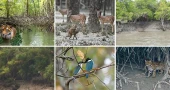
Bangladesh Sundarbans
The Majestic Bengal Tiger: Conservation Success in the Sundarbans
The Sundarbans, the world’s largest mangrove forest, straddling the border of Bangladesh and India, is a vital stronghold for the Bengal tiger (Panthera tigris tigris). In a really engaging interview with the UNB digital team on August 4, 2025, Prof. Dr. Md. Anwarul Islam, the CEO of Wildteam, gave some eye-opening updates about the tigers living in this incredible place and other areas, sharing stories of conservation triumphs and a bit of historical context.
Rising Tiger Numbers in the Bangladesh Sundarbans
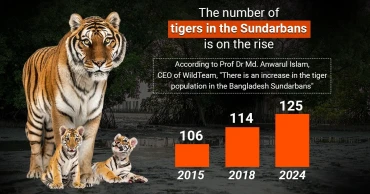
Recent surveys indicate a promising upward trend in the tiger population within the Bangladesh portion of the Sundarbans. According to Prof Islam, the Forest Department recorded 106 tigers in 2015 using camera trapping techniques. By 2018, a collaborative effort between the Forest Department and Wildteam counted 114 tigers. The most recent survey in 2024, conducted by the Forest Department, reported 125 adult tigers, reflecting a nearly 10% increase since 2018 and a 17.92% rise since 2015. This growth is attributed to enhanced conservation measures, including anti-poaching patrols and habitat protection initiatives.
The Sundarbans ecosystem is divided between Bangladesh and India, with approximately 60% of the forest located in Bangladesh and 40% in India. Prof Islam noted that while Bangladesh hosts 125 tigers, the Indian Sundarbans is estimated to have around 100 tigers, based on the latest available data from 2022. This brings the total tiger population in the Sundarbans to an estimated 225-250. The mangrove forest, a UNESCO World Heritage Site, is the only mangrove habitat in the world inhabited by tigers, making it a critical conservation area.
Read more: Poacher held with 300 deer traps in Sundarbans
Table 1: Tiger population distribution in the Sundarbans.
Region
Estimated Tiger Count
Percentage of Sundarbans Area
Bangladesh
125 (2024)
60%
India
100 (2022)
40%
Total
225-250
100%
.
Global Tiger Population and India’s Role
According to Prof. Islam, Globally, the tiger population is estimated at approximately 5,500, with India accounting for about 70% of this total, or roughly 3,850 tigers. According to a 2022 census, India’s tiger population stood at 3,682, with key reserves like Jim Corbett (260 tigers), Bandipur (150), and the Sundarbans (100) contributing significantly. This dominance underscores India’s pivotal role in global tiger conservation, supported by initiatives like Project Tiger and the expansion of tiger reserves.
Historical Presence of Tigers in Bangladesh
Prof Islam reflected on the historical distribution of tigers in Bangladesh, noting that they once roamed freely in regions such as Gazipur, Sylhet, Modhupur, and other areas. However, habitat loss, deforestation, and human encroachment have restricted their range to the Sundarbans. He cited an example of a tiger killed in Gazipur approximately 100 years ago, illustrating the significant contraction of tiger habitats over time. Today, the Sundarbans remains the last refuge for tigers in Bangladesh, emphasizing the need to protect this critical ecosystem.
Read more: UNESCO World Heritage Sites in Bangladesh
Clarifying the Royal Bengal Tiger
A common misconception is that the "Royal Bengal tiger" is a distinct subspecies. Prof Islam clarified that the term refers to the habitat rather than a unique taxonomic classification. The Bengal tiger (Panthera tigris tigris) is found across Bangladesh, India, Myanmar, Nepal, and Bhutan, thriving in diverse environments from mangrove swamps to deciduous forests. The Sundarbans’ tigers are morphologically distinct due to their adaptation to the mangrove habitat, but they are part of the broader Bengal tiger population.
Tiger Subspecies and Habitat Loss
Historically, there were nine recognized tiger subspecies, but only six remain today due to extinction events over the past century. These include:
Bengal tiger (Panthera tigris tigris): Found in India, Bangladesh, Nepal, Bhutan, and Myanmar.Indochinese tiger (Panthera tigris corbetti): Inhabits Cambodia, Laos, Myanmar, Thailand, and Vietnam.Malayan tiger (Panthera tigris jacksoni): Found in peninsular Malaysia.Siberian tiger (Panthera tigris altaica): Resides in the Russian Far East and parts of China.Sumatran tiger (Panthera tigris sondaica): Found only on the Indonesian island of Sumatra.South China tiger (Panthera tigris amoyensis): Functionally extinct in the wild, with small populations in captivity.
Prof. Islam’s words stayed with me. The Sundarbans’ 125 tigers in Bangladesh are a sign of hope, thanks to years of hard work. But the fight isn’t over. We need to keep protecting this forest. The Bengal tiger, with its quiet strength, depends on the Sundarbans and on us. This interview reminded me why we can’t look away from this fight to save a piece of our wild heritage.
Read more: Govt to ban new industrial units within 10km of Sundarbans ECA
1 year ago
Top 3 Books in English on the Bangladesh Sundarbans
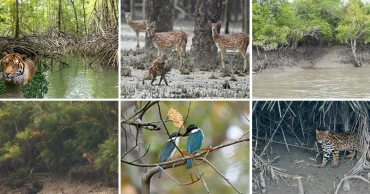
The Sundarbans, the world’s largest mangrove forest, stretches across Bangladesh and India, with approximately 60% of its vast 10,000 sqkm expanse lying within Bangladesh’s borders. Recognized as a UNESCO World Heritage Site in 1997 and a RAMSAR site in 1992, this unique ecosystem is home to rich biodiversity and serves as Bangladesh’s last stronghold for the endangered Bengal tiger. For those looking to explore the history, ecology, and mysteries of this remarkable forest, here are three essential English-language books on the Sundarbans.
3 Best English-Language Books on Sundarbans in Bangladesh
If you're specifically looking for books on the Sundarbans in Bangladesh, here are three top recommendations covering its ecology, history, culture, and conservation:
The Man-Eating Tigers of Sundarbans by Montgomery
"The Man-Eating Tigers of Sundarbans" by Sy Montgomery is an engaging exploration of the Sundarbans, a vast mangrove forest along the Bay of Bengal in India and Bangladesh, renowned for its unique population of tigers.
Montgomery's narrative delves into the mysteries surrounding these tigers, blending scientific inquiry with local folklore and firsthand accounts. She offers insights into the tigers' behavior, the challenging environment of the mangrove swamps, and the complex relationship between the tigers and the local communities who both revere and fear them.
Read more: Tracing the Roots of Ekushey Boi Mela
Critics have praised Montgomery's ability to turn a scientific study into a page-turning mystery. Her writing is noted for its fresh, engaging style that captivates readers, making complex subjects accessible and intriguing.
Overall, "The Man-Eating Tigers of Sundarbans" offers a fascinating and informative journey into one of the world's most enigmatic regions, providing a balanced perspective that honors both scientific understanding and the rich cultural narratives of the local people.
The Bangladesh Sundarbans by Enayetullah Khan
"The Bangladesh Sundarbans" by Enayetullah Khan, published in 2011, offers a detailed description of the world's largest mangrove forest. The book delves into the diverse flora and fauna of the Sundarbans and provides insights into the lives of its inhabitants, exploring their lifestyle, beliefs, social customs, and the profound connection they share with the forest.
The author illustrates the natural history of this spectacular forest. A brief overview of the lives and means of subsistence of the forest's resource users is also included in this book. "The Bangladesh Sundarbans" reveals how this forest serves as a natural barrier against cyclones and tidal surges.
Read more: Rich Dad Poor Dad– Worth Reading in Your Quarantine
The book is enriched with photographs that capture the landscape, people, and wildlife of the Sundarbans, providing readers with a visual context to the compelling narrative.
Critics have praised the book for its comprehensive portrayal of the Sundarbans' natural beauty and cultural richness. Readers interested in the intricate relationship between the Sundarbans' ecosystem and its people may find this book particularly enlightening.
Sundarbans and its Ecosystem Services: Traditional Knowledge, Customary Sustainable Use and Community-Based Innovation by Rashed Al Mahmud Titumir (Editor)
This edited collection explores traditional knowledge, customary sustainable usage, and community-based innovation in the Sundarbans, the world's largest single-tract continuous mangrove forest. To show that indigenous and local knowledge (ILK) is crucial for the preservation and sustainable use of natural resources, the book examines the Sundarbans' current condition as well as its many values and ecosystem services.
In addition to being crucial to the achievement of SDGs 14 (life below water) and 15 (life on land), this forest also actively aids in the accomplishment of numerous other objectives. By placing human-nature relationships in the context of the COVID-19 pandemic-heightened interest in biodiversity and climate change, the book offers a fresh perspective on sustainability.
Read more: 10 Best eBook Reader Apps for Android, iOS
For sustainable development, the book connects scientific knowledge with the multi, inter, and trans-disciplinary character of ILK gathered from the bottom-up level. The market-based approach to valuing natural resources is contested in this book.
Conclusion
The Sundarbans in Bangladesh is the largest mangrove forest in the world and a UNESCO World Heritage Site. It covers about 6,017 sqkm in Bangladesh and extends into India. This unique ecosystem is located in the southwestern coastal region of Bangladesh, mainly in the Khulna, Satkhira, and Bagerhat districts.
So far, we have reviewed the top 3 English books written on the Sundarbans in Bangladesh. These books can enlighten readers about the location, geography, ecosystem, and biodiversity of the Sundarbans.
Read more: Benefits of Reading Habit for Mind and Body
1 year ago

Three-month ban in Sundarbans worries local communities
Local communities, including fishermen, Bawal (wood collectors), and Mowal (honey collectors), who rely on the Sundarbans for their livelihoods, are concerned about a three-month ban on all activities in the forest starting today (June 01, 2024).
These communities returned home a few weeks ago due to the cyclonic storm Remal, and the forest department has since restricted re-entry into the Sundarbans. With the ban in place, they face a period without income.
Forest Dept declares Sundarbans closed to visitors for 3 months
The local administration has assured the affected communities of food assistance through the Fisheries Department. Fishermen have expressed their worries, stating their families depend on collecting fish, crabs, and honey in the Sundarbans. With their limited catch prior to returning home due to the storm, many have no savings to sustain them through the ban period.
The three-month ban on fishing and tourism in the Sundarbans, effective from June 1 to August 31, aims to provide a safe breeding environment for fish and wild animals. The movement of all vessels, including boats and fishing trawlers, is prohibited, along with the entry of fishermen and honey collectors. Local and foreign tourists are also barred from entering the forest during this time.
AKM Iqbal Hossain Chowdhury, Assistant Forest Conservator of the West Sundarbans, explained that June to August is the primary breeding season for fish in the region's rivers and canals.
Cyclone Remal: 15 more dead deer recovered from Sundarbans
During these three months, most fish release eggs, and it is also the breeding season for many wild animals. Restricting access helps protect biodiversity and wildlife, he said. The damage caused by Cyclone Remal to the forest’s biodiversity and wildlife is expected to recover more quickly with the ban in place.
Abu Naser Mohsin Hossain, a forest official of the Sundarbans West Division, confirmed that entry into the Sundarbans will resume on September 1. Since 2019, the Integrated Resource Management Plan (IRMP) has recommended closing the Sundarbans' rivers and canals to fishing from July 1 to August 31 annually. In 2021, this restriction was extended to three months, starting June 1, in coordination with the Fisheries Department.
The Sundarbans is home to about 289 species of animals, including 42 species of mammals, 35 species of reptiles, 8 species of amphibians, and 219 species of aquatic animals.
Cyclone Remal: Animal death toll in Sundarbans rises to 100
If boats ply the rivers and canals, it disrupts the fish during their egg-laying period, so all types of boats are banned, explained Mihir Kumar Doe, Khulna Forest Conservator. He noted that this year's ban follows the same pattern as previous years.
The local communities remain hopeful that the promised assistance will help them navigate through this challenging period.
2 years ago