Social Islami Bank
Capital flight forces merger of 5 Shariah-based banks: BB Governor
Bangladesh Bank Governor Dr Ahsan H Mansur on Sunday (November 16) said a substantial portion of the capital from the country’s five troubled Shariah-based banks has been siphoned off abroad, leaving no option but to merge them to safeguard the sector.
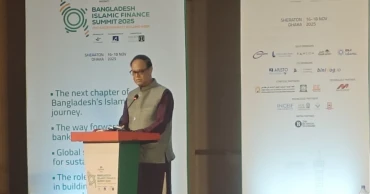
He made the remarks while speaking at the opening session of the Bangladesh Islamic Finance Summit 2025, held at a city hotel.
The three-day summit aims to position Bangladesh as a key Islamic finance hub in South Asia.
“Much of the capital from the five Shariah-based banks has been taken out of the country. Unfortunately, even the most dynamic Islamic bank in the country was hollowed out,” the governor said.
The five banks currently undergoing the merger process are EXIM Bank, First Security Islami Bank, Global Islami Bank, Union Bank, and Social Islami Bank.
Read more: Compensation for small investors in merged banks under review: Central Bank
Bangladesh Bank dissolved the boards of all five banks and appointed administrators on November 5, initiating the formation of a new entity named Sammilito Islami Bank (Combined Islamic Bank).
Dr Mansur emphasised that transparency is essential to revitalising and strengthening the banking sector.
He urged active participation from all stakeholders, including investors, depositors and employees, to ensure the success of the consolidation. If strong governance can be maintained during the merger process, the initiative will ultimately benefit the country’s economy, he added.
City Bank Managing Director and CEO Mashrur Arefin attended the event as the special guest. Among others, M Kabir Hassan, professor of finance at the University of New Orleans and Dr Eskandar Shah Mohd Rashid, CEO of ISRA, also spoke at the opening ceremony.
The summit brought together regulators, Shariah scholars, Islamic banking professionals, and high-level delegates from countries including Bahrain, Pakistan, Malaysia, and the United States.
Discussions will focus on strengthening governance, expanding financial inclusion, and integrating AAOIFI’s global Shariah, governance and accounting standards into Bangladesh’s Islamic finance framework.
Read more: BB orders strict loan data updates to bar defaulters from election race
10 months ago
Depositors of Bangladesh’s troubled banks still anxious despite security assurances
Abdul Aziz, a middle-aged migrant worker who recently returned from Saudi Arabia, visited the Tangail branch of First Security Islami Bank (FSIB) to withdraw Tk 100,000 for his daughter’s wedding, but the bank provided him with only Tk 25,000.
Aziz, a resident of Ghatail Upazila in Tangail, informed the bank officer of his urgent need. Despite his plea, he was given just a quarter of the amount, citing a cash crisis at the bank.
Talking to UNB over the phone, Aziz expressed concern but remained hopeful that the ongoing merger of five Islamic banks, including FSIB, would ease the current liquidity crunch.
Similar incidents have reportedly occurred at the Tangail branches of Union Bank, EXIM Bank and other struggling Islamic banks currently undergoing the merger process.
When contacted, FSIB Chairman Muhammad Abdul Mannan acknowledged the ongoing liquidity issues, saying the merger would protect every depositor’s interest, especially as state ownership would ensure government backing to meet obligations.
Merger of 5 Islamic banks at final stage: Bangladesh Bank Governor
Mannan, who also chairs the Islamic Banks Consultative Forum, admitted that many of the banks had previously kept numerous loans classified as ‘regular’ through methods such as rescheduling.
“When I assumed office, FSIB’s non-performing loans (NPLs) were reported at just 4.5 percent. But by December, the bank’s own assessment, following a more rigorous review, placed the figure at 29 percent,” he said.
He explained that the ongoing Asset Quality Review (AQR) considered loan quality, collateral and even the existence of borrowing entities, which led to the sharp rise.
Mannan stressed that government support would be vital for recovery and said merging the five banks into one robust Islamic institution would protect depositors and restore public trust in the banking sector.
Under current regulations, Shariah-compliant Islamic banks must maintain 4 percent of their total deposits as Cash Reserve Ratio (CRR) and 5.5 percent as Statutory Liquidity Ratio (SLR) with the central bank.
Several Islamic banks have failed to meet these requirements since 2022, due to excessive and uncontrolled lending.
Despite this, no significant regulatory action was initially taken. These banks were even permitted to maintain negative balances in their current accounts with the central bank.
But, with Dr Ahsan H. Mansur assuming the role of Bangladesh Bank Governor, such irregular practices have been stopped. To help depositors access their funds, the central bank has even printed money to offer special loans to these banks.
Governor's London visit adds impetus to efforts to recover stolen assets: Bangladesh Bank
Bangladesh Bank data shows that EXIM Bank received the highest special loan at Tk 8,500 crore. FSIB followed with Tk 7,050 crore, SIBL received Tk 6,675 crore, Global Islami Bank Tk 2,295 crore, and Union Bank Tk 2,400 crore.
The central bank is now moving forward with plans to merge these five ailing Islamic banks into a single, more resilient entity, after uncovering approximately Tk 85,000 crore in previously undisclosed NPLs through the AQR process.
AQR findings have revealed that combined non-performing loans across the five banks now stand at around Tk 1,47,000 crore—equivalent to nearly 77 percent of their total loan portfolios. This has resulted in a massive provision shortfall of Tk 74,501 crore.
Bangladesh Bank had commissioned two international audit firms in January to assess the actual financial condition of six Islamic banks that had become reliant on liquidity support to meet depositor demands.
Ernst & Young is auditing the assets of EXIM Bank, Social Islami Bank (SIBL), and ICB Islamic Bank, while KPMG is reviewing FSIB, Global Islami Bank, and Union Bank. Due to its foreign ownership, ICB Islamic Bank has been temporarily excluded from the merger plan.
Discussions regarding the merger of the remaining five banks took place just before Eid-ul-Azha.
This initiative is part of the newly introduced Bank Resolution Ordinance 2025, which aims to address the challenges faced by weak financial institutions.
The first phase of the merger is expected to conclude between July and October, with five Bangladesh Bank teams assigned to monitor the banks closely.
The audit reports are based on financial indicators as of September and generally align with Bangladesh Bank’s own ‘Quick Summary’ reports for December. However, significant discrepancies exist between the audit findings and the banks’ self-reported figures.
A common pattern is that total loans exceed total deposits—primarily because the banks failed to recover loans while depositors continued to withdraw funds.
1 year ago
Estimates suggest over Tk 1 lakh crore in embezzled funds: Govt launches major banking reforms
Bangladesh Bank and the interim government are undertaking significant efforts to restructure the country’s banking sector, focusing on recovering both local and foreign assets embezzled by corrupt individuals. Officials have confirmed that these assets, laundered abroad, are being targeted for repatriation as part of a broader initiative to bring the financial sector up to international standards.
The government emphasized its commitment to reforming the financial sector, acknowledging that the process is complex and time-consuming. A key element of this strategy will be the establishment of a banking commission tasked with investigating each implicated bank, uncovering the full extent of the corruption, and developing an action plan, according to the Chief Adviser’s press wing. This plan, which can be implemented within six months, aims to overhaul the sector to ensure compliance with global banking norms.
The aim of Bangladesh Bank and the government is to be capable of complying with all international standards and building a strong banking sector. However, international technical assistance and funding will be required from the beginning to the end of the activities to achieve this objective.
Read more: Bangladesh Bank reconstitutes boards of 3 banks, inc. two controlled by S Alam Group
The reforms come in response to revelations that unscrupulous businessmen and influential figures have embezzled vast sums from the banking sector, laundering the funds abroad through fraudulent activities. Preliminary estimates suggest the total embezzled amount could exceed Tk 1 lakh crore, though the exact figure is still being determined.
Significant steps have already been taken, with reforms initiated in several banks linked to the scandal. The boards of Islami Bank, Social Islami Bank, National Bank, United Commercial Bank, Global Islami Bank, and Union Bank have been reconstituted as part of the restructuring efforts. Similar measures will be implemented across other affected banks and financial institutions.
The government has also sought assistance from foreign agencies to track and repatriate the laundered funds. As the new management teams take control, they will be responsible for gathering accurate data on the embezzled amounts and leading the recovery efforts.
Read more: Businesses agree with central bank's steps against bank robbers: DCCI
2 years ago