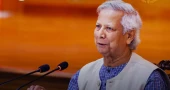
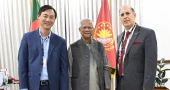
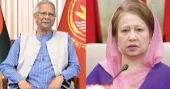
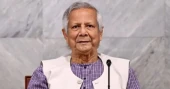
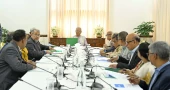
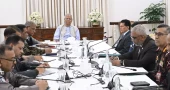
CA Prof Yunus
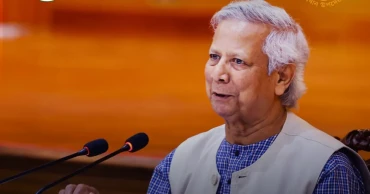
CA Prof Yunus to address nation at 9:15pm
Chief Adviser Prof Muhammad Yunus will address the nation at 9:15pm on Monday.
Bangladesh Television and Bangladesh Betar will broadcast his speech, said the Chief Adviser’s press wing.
Earlier, he delivered a farewell address to officers and staff at the Chief Adviser’s Office, marking the end of the interim administration’s tenure.
Following his speech, he joined officials and employees for a photo session at the office.
The interim government, which assumed office on August 8, 2024 under Prof Yunus, is set to conclude its term with the swearing-in of a new government on Tuesday (February 17).
The BNP-led alliance is poised to form the next government after securing a landslide victory in Thursday’s national election, winning 212 seats, while the Jamaat-e-Islami led alliance won 77 seats.
7 months ago
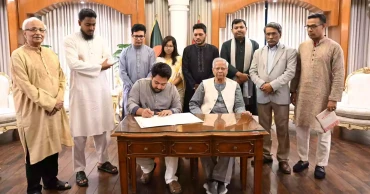
CA Prof Yunus thanks NCP for signing July Charter
Chief Adviser Prof Muhammad Yunus on Monday appreciated the National Citizen Party (NCP) for signing the July National Charter.
NCP Convener Nahid Islam and member secretary Akhtar Hossain signed the charter on behalf of the party in the presence of the Chief Adviser at the State Guest House Jamuna in the evening.
“The nation had the faith that the NCP would sign this charter, and today that faith has been fulfilled. Thank you for participating in this great work,” the CA said.
Prof Yunus delivers farewell speech as interim govt prepares to hand over power
Prof Yunus said the charter should guide actions at every level to build a new, humane Bangladesh, emphasising that all stakeholders must remain vigilant in implementing its principles.
The Chief Adviser also mentioned that the oath-taking ceremony for the members of the new parliament would be held on Tuesday and wished everyone success in the days ahead.
Nahid Islam said the MPs elected from his party would take their oaths tomorrow. “Although we were the last to sign the charter, we have been most active in implementing it. We will honor the trust the people have placed in us.”
Army Chief meets Chief Adviser Prof Yunus
National Consensus Commission Vice-Chairman Professor Ali Riaz, Commission member Badiul Alam Majumder and Special Assistant to the Chief Adviser Monir Haider, were present.
The NCP delegation included Monira Sharmin, Sarwar Tushar, Javed Rasin and Zahirul Islam.
7 months ago
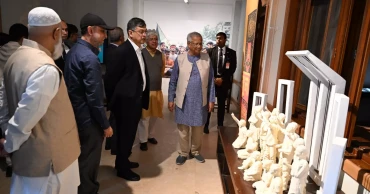
Visit July Uprising Museum at Gonobhaban to witness brutal history: CA
Chief Adviser Prof Muhammad Yunus on Tuesday (January 20, 2026) urged all to visit the July Uprising Memorial Museum at Gonobhaban to understand and realise the brutalities of the previous regime.
“Every citizen of the country should come here and spend a day. Students should visit the museum in groups. By spending time here, people will understand the hardships and brutalities this nation had to endure,” he said while inspecting the progress of the final phase of the museum’s construction.
Read more: BNP plans separate department for families of July martyrs, fighters: Tarique
Prof Yunus said anyone wishing to stay in the ‘Ayna Ghor’ built within the museum could do so for a few hours or even a day, to gain firsthand insight into the suffering detainees endured. “We must keep in mind how we can remain united to prevent such atrocities from happening again. We all share the belief that this nation must never return to those dark days,” he said.
Prof Yunus highlighted the courage of the youth and students who resisted oppression despite facing brutal acts. “They had no weapons, nothing. That ordinary people could stand fearlessly against armed forces is a lesson for all of us,” he said.
During the visit, Prof Yunus said the museum stands as a tribute to the blood of the July martyrs, calling it an unprecedented example globally.
Spain’s deadly train crash saddens Prof Yunus
“We hope that in the future, there will be no need to build such a museum anywhere else. If our nation ever loses its way, it can find guidance and inspiration in this museum,” he added.
The Chief Adviser arrived at the museum around 3pm and toured the museum's displays on the history behind the July Uprising and Sheikh Hasina's 16-year misrule, said the Chief Adviser’s press wing.
7 months ago
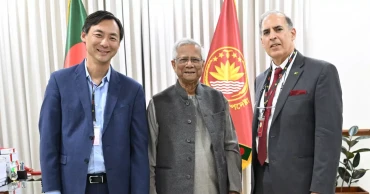
No possibility of reconciliation with previous regime at this moment: Prof Yunus
Chief Adviser Prof Muhammad Yunus has ruled out the possibility of reconciliation in Bangladesh at this moment due to the ‘continued denial’ by the former regime of its crimes.
He made the remarks when two former senior United States diplomats -- Albert Gombis and Morse Tan, both of whom served during the Donald Trump administration -- asked whether a truth and reconciliation initiative, similar to post-apartheid South Africa, was possible in Bangladesh.
They met the Chief Adviser at the State Guest House Jamuna in Dhaka late Tuesday night, said the Chief Adviser’s press wing on Wednesday (January 14, 2026).
Albert Gombis, a former Acting Under Secretary of State, and Morse Tan, a former Ambassador-at-Large, are visiting Bangladesh ahead of the crucial elections.
Read more: Ocean a major asset, yet it's increasingly polluted: Prof Yunus
Both diplomats praised the Chief Adviser for his crucial role in steering the country over the past one and a half years.
As a friend of late Nelson Mandela, Prof Yunus said, he closely followed South Africa’s truth and reconciliation process, but he saw no possibility of a similar move in Bangladesh right at this moment due to the continued denial by the former regime of its crimes.
“Time is not right. Where do you start? Truth and reconciliation come when you admit that you were wrong, when you repent and show remorse for your crimes, and when you create the right atmosphere,” the Chief Adviser said.
“But so far, there is no remorse, no repentance. Instead, they claim that the young people killed during the July uprising were killed by terrorists. There are stacks and stacks of evidence of their crimes, absolutely barbaric crimes, yet they remain in complete denial,” he said.
Prof Yunus reaffirmed his government’s commitment to hold the general elections and the referendum as scheduled on February 12.
He said there had been a flood of fake news and deliberately spread confusion surrounding the elections, but stressed that the Interim Government remained firm in its commitment to hold the polls on February 12 and to hand over power to a democratically elected government once the results are announced.
“No matter who says what, elections will be held on February 12, not a day before, not a day after,” the Chief Adviser said, adding that the vote would be free, fair and peaceful, and held in a festive atmosphere.
He said the interim government would remain completely neutral during the elections, ensuring an unbiased administration and a level playing field for all political parties.
During the hour-long meeting, the Chief Adviser and the visiting former diplomats discussed a wide range of issues, including the forthcoming elections, the July Revolution and its aftermath, the rise of young protesters, the July Charter and the referendum, fake news and misinformation targeting the vote, the Rohingya crisis, and the prospects for truth and reconciliation in a post-July Bangladesh.
The Chief Adviser said his government was campaigning for ‘Yes’ votes in the referendum, noting that the July Charter, set to be endorsed by the people, would usher in a new era of democratic governance and leave no room for future autocracy.
Election on Feb 12, no matter who says what: Prof Yunus tells former US diplomats
Prof Yunus said supporters of the former autocratic regime were spreading fake news and misinformation in an attempt to create confusion about the elections. “But people are alert. Increasingly, they can detect AI-generated misinformation videos,” he said.
Former Under Secretary Gombis agreed that fake news had emerged as ‘one of the main enemies’ of democracy worldwide and stressed the need for greater efforts to combat the threat.
SDGs Affairs Principal Coordinator and Senior Secretary Lamiya Morshed was also present at the meeting.
8 months ago
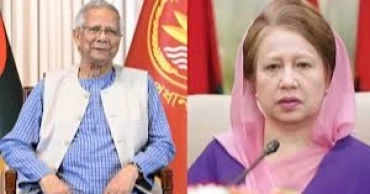
Prof Yunus mourns death of former Prime Minister Khaleda Zia
Chief Adviser Prof Muhammad Yunus on Tuesday (December 30, 2025) expressed profound sorrow at the death of three-time former Prime Minister and BNP Chairperson Begum Khaleda Zia, describing her a towering figure in the country’s democratic movement.
"With the sad demise of Begum Khaleda Zia, the nation has lost one of its most significant political guardians. I am deeply saddened and shocked by her death," said Prof Yunus in a condolence message.
He said Khaleda Zia was not merely a political leader, but an inseparable chapter in the history of Bangladesh. “In recognition of her long struggle, historic contributions, and the deep sentiment of the people toward her, the government declared her a person of great national importance earlier this month,” he added.
Chief Adviser calls Council of Advisers to discuss Khaleda Zia’s burial: Fakhrul
The Chief Adviser said that her role in establishing democracy, nurturing a multiparty political culture and safeguarding people’s rights would be remembered with respect.
He said through her firm and uncompromising leadership, the nation repeatedly found inspiration to overcome undemocratic conditions. "Her contributions to the country and its people will remain etched in national memory."
Despite political differences, her long political journey, people-oriented leadership, and unwavering resolve consistently guided the nation toward welfare and democratic values, Prof Yunus said.
"With her death, Bangladesh has lost an experienced, tested, and influential statesperson," he said.
Prof Yunus recalled that Khaleda Zia was the first female Prime Minister of Bangladesh and led the struggle to restore democracy during periods of authoritarian rule.
Entering politics in 1982 following the assassination of her husband, former President, Army Chief, and heroic freedom fighter Ziaur Rahman, she rose from a homemaker to a central figure in national politics.
Her decisive leadership played a pivotal role in ending the nine-year autocratic rule of General Hussain Muhammad Ershad, helping to restore democratic governance in the country.
The Chief Adviser highlighted several of her landmark initiatives, noting that many of her policies carried the nation forward. In particular, the introduction of free education and stipend programs for girls is widely regarded as a milestone in advancing women’s education in Bangladesh.
Read more: Former Prime Minister Khaleda Zia passes away
He said Begum Khaleda Zia’s political career was marked by notable electoral success, having been elected from multiple parliamentary constituencies between 1991 and 2001, and winning all seats she contested in the 2008 general election.
Following her assumption of office in 1991, she laid a strong foundation for the national economy through economic liberalization and reform-oriented policies, the Chief Adviser added.
Prof Yunus described Begum Khaleda Zia as a powerful symbol of struggle and resistance during what he termed the fascist regime of Sheikh Hasina. Her steadfast stance, he said, inspired the nation throughout a prolonged period of political adversity.
He also stated that she became a victim of severe political vendetta due to her success and influence. “She was sentenced to 17 years in prison in what were widely viewed as false and fabricated cases and spent a prolonged period in incarceration,” he said.
The Chief Adviser extended his heartfelt condolences to the bereaved family, as well as to BNP leaders, activists, and supporters across the country.
On this day of irreparable national loss, he called upon citizens to remain calm and patient, and urged everyone to offer prayers and supplications for the departed leader from their respective positions.
Read more: BNP announces 7-day mourning programme
8 months ago
Chief Adviser calls Council of Advisers to discuss Khaleda Zia’s burial: Fakhrul
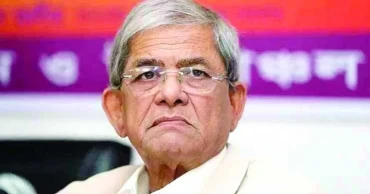
Chief Adviser Prof Muhammad Yunus has called BNP leaders to inform them that the Council of Advisers will discuss issues, including state honour and burial arrangements for former Prime Minister and BNP Chairperson Begum Khaleda Zia, BNP Secretary General Mirza Fakhrul Islam Alamgir said on Tuesday.
Speaking at a media briefing at Evercare Hospital, Fakhrul said the Chief Adviser would place the matter before a meeting of the Council of Advisers scheduled for 10:00am.
He said the decisions taken would later be coordinated with the government’s programmes.
Fakhrul also said a meeting of the BNP Standing Committee would be held.
Jamaat Ameer mourns Khaleda Zia’s death
“The mother of democracy and our national guardian left us at 6:00am. This loss is irreparable. The nation will not be able to make up for it,” he said.
He said Khaleda Zia devoted her entire life to the welfare of the people and that her death has created a political vacuum in the country.
Former Prime Minister Begum Khaleda Zia, 80, breathed her last at 6:00am on Tuesday (Dec 30) while undergoing treatment at Evercare Hospital in the capital.
8 months ago
Election to be held on time, Prof Yunus tells US Special Envoy
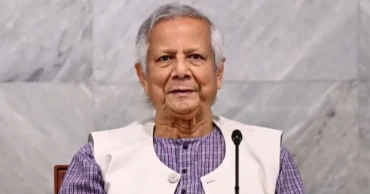
Chief Adviser Professor Muhammad Yunus on Monday (December 22, 2025) reiterated his commitment to holding the general election on February 12 next.
"The nation is eagerly waiting to exercise their voting rights which were stolen by the autocratic regime," he said.
Prof Yunus made the remarks during a telephone conversation with Sergio Gor, the US Special Envoy for South and Central Asia, at around 7:30 pm (Dhaka time).
The discussion, which lasted for about half an hour, focused on trade and tariff negotiations between Bangladesh and the United States, the upcoming general election, the country’s democratic transition, and the murder of young Bangladeshi political activist Sharif Osman Hadi.
Read more: EC’s briefing for DCs-SPs begins
Sergio Gor, who also serves as the US Ambassador to India, congratulated Prof Yunus for his leadership during recent tariff negotiations.
Bangladesh succeeded in reducing US reciprocal tariffs on Bangladeshi goods to 20 percent.
The US Special Envoy also discussed the massive funeral of Shaheed Osman Hadi, said Chief Adviser’s Press wing.
The Chief Adviser noted that supporters of the ousted autocratic regime were allegedly spending millions of dollars to disrupt the electoral process and that their fugitive leader was inciting violence.
He, however, said the interim government was “fully prepared” to deal with any challenges.
Read more: Tarique Rahman to become voter on Dec 27: Salahuddin
“We have roughly 50 days to go before the election. We want to hold a free, fair and peaceful election. We want to make it remarkable,” Prof Yunus said.
Commerce Adviser Sk Bashiruddin, National Security Adviser Dr Khalilur Rahman and SDG Coordinator and Senior Secretary Lamiya Morshed were present during the phone call.
8 months ago
Bangladesh’s inflation expected to fall below 7% by June: Govt
The government has expected that inflation in the country will fall below 7 percent by June 2026 ‘due to its contractionary monetary policy and austerity measures.
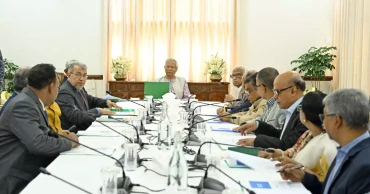
The expectation was expressed at a high-level meeting at the state guest house Jamuna on the country’s overall economic progress and budget expenditure on Monday under the leadership of Chief Adviser Prof Muhammad Yunus, according to a statement of the Chief Adviser’s press wing.
Finance Adviser Salehuddin Ahmed, Planning Adviser Wahiduddin Mahmud and Bangladesh Bank Governor Ahsan H Mansur attended the meeting.
The meeting reviewed key macroeconomic indicators, including inflation, wage growth, agricultural production, the financial and external sectors, remittance inflows, imports and the opening of letters of credit.
Read more: Bangladesh inflation rises to 8.29% in November
The 12-month average general inflation rate fell below 9 percent in November 2025 for the first time since June 2023 and on a point-to-point basis, inflation crossed 9 percent in March 2023, reaching 9.33 percent, it said.
The point-to-point inflation dropped below 9 percent in June 2025 and declined further to 8.29 percent in November 2025.
Regarding wage growth, the meeting observed that in recent years the gap between inflation and wage growth had been wide, resulting in a decline in real income.
In recent months of the current fiscal year, the gap has narrowed significantly.
In November 2025, point-to-point inflation and wage growth stood at 8.29 percent and 8.04 percent respectively, compared with average rates of 9.02 percent and 7.04 percent in fiscal year 2022-23.
On agriculture, the meeting noted that appropriate incentives and management led to a good Boro harvest in the last fiscal year, while favorable conditions so far indicate the possibility of a good Aman harvest this season.
Read more: Rice biggest driver of October’s food inflation in Bangladesh: GED
As a result, the government is expected to achieve its food grain procurement target in the current fiscal year.
As of December 15, 2025, Aman rice production reached 16.095 million metric tonnes, and officials expect the final output to exceed the target once harvesting is completed.
Although Aus rice production fell slightly short of the target, total production increased by 7.20 percent compared to fiscal year 2024-25, said the Press Wing.
Imbalances in various economic indicators have already moved towards a more stable position, said the statement.
On the financial and external sectors, the meeting was informed that gross foreign exchange reserves stood at 32.57 billion US dollars as of December 18, 2025, up from around 25 billion dollars in August 2024.
The reserve levels are expected to rise further due to a more stable exchange rate, increased remittance inflows and a significant rise in interest rates in the financial sector, it added.
Regarding the current account, it was noted that Bangladesh had recorded consecutive deficits from fiscal year 2016-17 to 2023-24, amounting to 18.7 billion dollars, 11.6 billion dollars and 6.6 billion dollars in fiscal years 2021-22, 2022-23 and 2023-24 respectively.
Due to improved financial management and measures to curb money laundering, the deficit narrowed to just 139 million dollars at the end of fiscal year 2024-25.
In the July to October period of the current fiscal year the deficit stood at 749 million dollars.
On remittances, the meeting noted that overseas employment for 500,000 workers was secured during July to November of the current fiscal year, compared with 397,000 during the same period last year.
During the same period, remittance inflows amounted to 13.04 billion dollars, marking a 17.14 percent increase year on year.
Import growth during July to November of fiscal year 2024-25 was negative at 1.2 percent but rose to 6.1 percent during the same period of fiscal year 2025-26, it said.
Read more: Bangladesh Bank keeps policy rate unchanged amid inflation fears ahead of election and Ramadan
On letters of credit, the meeting noted that the growth in opening LCs for capital machinery was negative 32.8 percent during July to October 2024 but increased to 27.7 percent in the same period of the current fiscal year.
Similarly, growth in opening LCs for industrial raw materials rose from 10.1 percent to 40.98 percent over the same period.
8 months ago
Law and order must be maintained before election: Prof Yunus
Chief Adviser Prof Muhammad Yunus has said the law and order situation must be maintained at any cost before the upcoming national election.
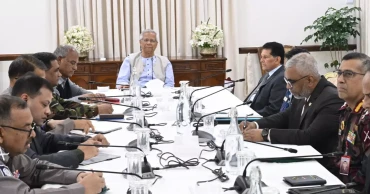
The meeting, held on Sunday afternoon (December 21, 2025), discussed in detail various issues, including the return of BNP acting Chairman Tarique Rahman to the country, security measures taken on the occasion of the upcoming Christmas and New Year celebrations.
Prof Yunus ordered the prompt arrest of those involved in the murder of youth leader Sharif Osman Hadi and other illegal activities.
The issues were discussed at a meeting held at state guest house Jamuna on Sunday afternoon with Prof Yunus in the chair.
The meeting reviewed the overall law and order situation in the country.
Home Affairs Adviser Md Jahangir Alam Chowdhury, National Security Advisor Dr Khalilur Rahman and top officials of various security and law enforcement agencies were present at the meeting, said Deputy Press Secretary Abul Kalam Azad Majumder on Monday.
Editors’ Council, NOAB condemn arson attacks on Prothom Alo, Daily Star.
Besides, the arrest of those involved in the murder of Inqilab Mancho spokesperson and July fighter Shaheed Sharif Osman Hadi and the progress of the investigation were discussed in detail.
The police informed the Chief Adviser that 31 people have already been identified through video footage on suspicion of being involved in the recent attacks on the offices of two national dailies and two cultural organizations.
At least six people have been arrested in various parts of the country, including Dhaka, in these incidents till Monday morning.
The arrestees are Md Kashem Farooqui, Md Saidur Rahman, Rakib Hossain, Md Naeem, Md Sohel Rana and Md Shafiqul Islam.
Mob incited by Elias Hossain sets fire to Daily Star office in Dhaka
The operation to arrest the remaining identified suspects is underway.
In addition, three of those who tried to create chaos near the residence of the Assistant High Commissioner of India in Chattogram have been identified through video footage.
8 months ago
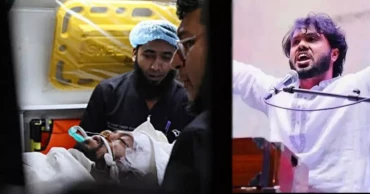
Hadi’s condition very critical, says Singapore’s Foreign Minister
Singapore’s Foreign Minister Dr Vivian Balakrishnan has said that the condition of Sharif Osman Hadi, spokesperson of Inquilab Moncho, is very critical.
At around 9:40 pm on Wednesday (December 17, 2025), Dr Balakrishnan called Chief Adviser Professor Muhammad Yunus and briefed him on Hadi’s medical condition and ongoing treatment.
Gun attack on Hadi: 2 suspects identified; shooter’s passport ‘blocked’
During the conversation, he said Hadi’s condition remains extremely critical, according to the CA’s Press Wing.
Earlier, Dr Balakrishnan visited Sharif Osman Hadi, a frontline fighter of the July Uprising who is currently receiving treatment in Singapore.
Motorbike, helmet and fake number plate used in attack on Hadi recovered
The Chief Adviser urged the people of the country to remain calm and requested everyone to pray and offer supplications for Hadi’s recovery.
Earlier on Monday, an air ambulance equipped with all emergency facilities for a critical patient, departed Hazrat Shahjalal International Airport carrying Hadi, who was shot in the head from close range in an assassination attempt last Friday, to Singapore for advanced treatment.
BGB unsure if Hadi attackers fled to India via Mymensingh border
9 months ago