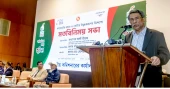
Prof Ali Riaz
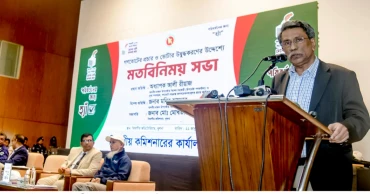
Key to nation’s success lies in people’s hands: Ali Riaz
Prof Ali Riaz, Special Assistant to the Chief Adviser, on Thursday said the key to the nation’s success rests with the country’s people.
Speaking at a consultation meeting organised by the Khulna Divisional Administration at the Divisional Commissioner’s Office auditorium, Prof Riaz emphasised the importance of public participation in the referendum and voter mobilisation.
Ali Riaz, also the chief coordinator of the public awareness campaign team on the upcoming referendum, urged people to vote ‘Yes’ in the referendum to reform the country and establish equality and dignity, marking their ballots with a tick.
BNP in favour of ‘Yes’ in referendum: Mahdi Amin
Ali Riaz highlighted that the July National Charter 2025 reflects the aspirations of people. “Although this charter is printed in black ink, its true meaning has been written in blood. While we may not have contributed with our blood, it is our responsibility to recognise the July National Charter 2025.”
He said the referendum is the best mechanism to determine the future system of government, and even though the interim government remains neutral in national elections, it supports the ‘Yes’ vote in the referendum.
According to the constitution, he said, public servants face no restrictions in campaigning for the ‘Yes’ vote.
Nation's future hinges on ‘Yes’ vote in referendum: Land Adviser
At the event, Special Guest Monir Haider, Special Assistant (Consensus) to the Chief Adviser, said the main aim of the 2024 mass uprising was to create a fascism-free and inequality-free society.
“This referendum serves to gauge public support for a new Bangladesh and a new settlement. Voting in favour of the July National Charter will constitutionally block the path of fascism,” he added.
Presided over by Khulna Divisional Commissioner Md Mokhtar Ahmed, the meeting was addressed, among others, by Prof Dr Md Maksud Helali, Vice-Chancellor of Khulna University of Engineering & Technology, Range DIG Md Rezaul Haque, and Metropolitan Police Commissioner Md Zahidul Hasan.
Officials from all 10 districts of Khulna Division, including district, divisional, and upazila-level officers, election officials, representatives from the Chamber of Commerce, teachers and students from schools and colleges, civil society members, NGO representatives and media personnel, attended the consultation meeting.
8 months ago
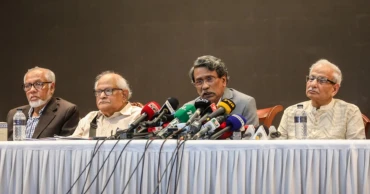
NCC recommends referendum, constitution reform assembly to implement July Charter
The National Consensus Commission (NCC) on Tuesday recommended the interim government to arrange a referendum following immediate promulgation of the July National Charter (Constitutional Reform) Implementation Order 2025.
“We’ve recommended the government to arrange a referendum any day till the national-election day from the promulgation of an order,” said NCC Vice-Chair Prof Ali Riaz.
He said this replying to a question at a press briefing at the Foreign Service Academy after the submission of the recommendation report over the ways to implement the national charter before Chief Adviser of the interim government and also NCC chair Prof Muhammad Yunus at the latter’s residence, State Guest House Jamuna.
Prof Ali Riaz said they placed two alternative recommendations before the interim government over how to implement the July National Charter 2025, particularly 48 reform recommendations that are related to the Constitution.
“We requested and recommended the government to promulgate an order immediately. It will be the July National Charter (Constitution Reform) Implementation Order 2025. Under this order, the government will arrange a referendum. In that referendum, we have recommended the government to place one question before the people—whether they agree to implement the order and its schedule containing 48 constitutional reform issues,” he said.
Explaining the recommendation further, Ali Riaz said a Constitution Reform Assembly will be effective simultaneously with the 13th parliament to implement the July National Charter.
But the tenure of the constitution reform assembly will be 270 days to implement the charter by bringing changes to the Constitution, he said.
“During this period, members of the Constitution Reform Assembly will carry out all necessary amendments, additions, deletions, and modifications to incorporate into the Constitution the reform recommendations contained in the July National Charter and endorsed in the referendum,” he said.
He said the elected representatives in the next general election will take oaths twice—once as members of the Constitution Reform Assembly and again as members of Parliament.
An upper house (Senate) will be formed under the proportional representation (PR) system within 45 days after the 270-day tenure of the Constitution Reform Assembly. However, political parties will not be required to disclose their candidate lists for the upper house before the upcoming general election, he added.
Talking about the alternative recommendation, Ali Riaz said the government shall promulgate an order framing a Constitution Amendment Bill on the 48 issues (incorporated in the schedule of the order) and then arrange a referendum on the order.
If the referendum secures people’s approval, the bill will assist the work of the Constitution Reform Assembly. It will not be given merely for adoption, but to serve as a guide and support in their task, he said.
“If the Constitution Reform Assembly fails to complete its tasks within 270 days, the bill approved in the vote (referendum) will automatically replace the relevant constitutional provisions,” said the NCC vice chair.
He said they firmly believe that the Constitution Reform Assembly will successfully accomplish its responsibility, and no such situation will arise where automatic implementation becomes necessary.
Prof Riaz said they strongly believe that Bangladesh’s political parties and the elected representatives of the people would play their due role in performing this historic responsibility and lead the nation toward a new democratic journey.
The referendum question will be: “Do you give your consent to the July National Charter (Constitution Reform) Implementation Order, 2025, and to the constitutional reform proposals contained in its Schedule-1?”
The 48 reform recommendations are mostly related to the presidential election, the President’s powers and clemency, the tenure of the Prime Minister, holding more than one office by the Prime Minister, the caretaker government system, formation of a 100-seat upper house (Senate) under PR election, women’s representation in Parliament, selecting the Deputy Speaker and four key parliamentary committee chairmen from opposition MPs, allowing MPs to vote freely beyond their party stance except on two occasions—financial bills and votes of confidence in Parliament—appointment of the most senior Appellate Division justice as the Chief Justice, formation of a judicial appointment commission, decentralisation of the Supreme Court to divisional levels, and specific appointment processes for the Chief Election Commissioner, election commissioners, Ombudsmen, heads and members of public service commissions, the Comptroller and Auditor General, and the Anti-Corruption Commission chairman and commissioners, declaration of emergency, expansion of basic rights of the citizen, the fundamental principles of the state.
The National July Charter 2025, however, contains a total of 84 reform recommendations, including the 48 related to the Constitution.
Recommendations on July Charter implementation submitted to CA
Prof Riaz said the NCC initially sought opinions of political parties on 166 reform proposals and held dialogues with them since March 2025. The second-phase dialogues, held since June 2025, focused on 20 fundamental constitutional reform questions.
Later, the Commission conducted the third round of talks with 30 political parties to determine the best mechanism for implementing the July National Charter.
On October 17, political parties, including BNP and Jamaat, as well as Chief Adviser and NCC Chair Prof Muhammad Yunus signed the July Charter at a festive ceremony at the South Plaza of Jatiya Sangsad, pledging to implement the reform document.
So far, 25 political parties have signed the charter, while five parties—National Citizen Party (NCP), Communist Party of Bangladesh (CPB), Bangladesh Samajtantrik Dal (Basod), Basod (Marxist), and Bangladesh Jasod—have yet to do so.
NCC members Dr Badiul Alam Majumdar, Dr Iftekharuzzaman, Justice Emdadul Haque, Safar Raj Hossain, Md Ayub Miah, Chief Adviser’s Special Assistant Monir Haider, and Chief Adviser’s Press Secretary Shafiqul Alam were present at the briefing.
10 months ago

Multiple proposals in pipeline if July Charter not agreed: Prof Riaz
NCC Vice-Chair Prof Ali Riaz said on Sunday that the Commission will submit several proposals to the government on implementing the July National Charter 2025 if political parties fail to reach a consensus.
“If the political parties cannot come to an agreement on how to implement the July Charter, the Commission will make more than one proposal before the interim government,” he said while chairing the dialogue between the NCC and political parties in the capital.
The discussion, held at 11:45am at the Foreign Service Academy, aimed to determine the process for implementing the July National Charter 2025, particularly the Constitution-related reform recommendations.
Prof Ali Riaz said the decision to implement the July National Charter ultimately rests with the interim government and the political parties. “If a consensus or a sort of agreement can be reached among you, the implementation will be easier and faster,” he said.
Mentioning that the Chief Adviser of the interim government and also the head of the Commission held a meeting with the NCC members on Sunday morning, Prof Riaz said the Chief Adviser asked them to move forward swiftly and make the Charter acceptable to all by transforming it into a political document endorsed by every party.
He said the Commission held the discussion with political parties for a specific reason — to discuss more concrete, well-defined and concise proposals regarding the implementation of the July Charter, if the political parties place.
Prof Yunus happy over National Consensus Commission’s progress
“If the political parties can present clear and concise proposals on the implementation process, we will consolidate and incorporate them in our submission to the interim government,” he said.
“Our goal is to complete this process by October 15 next as the national election is approaching,” said the NCC Vice Chair, adding that they do not want to disrupt the electoral process or the electoral preparation of the political parties.
“The Commission’s tenure ends on October 15, so we must complete the task before that,” Prof Riaz said, adding, “We know that you (political parties) have already held talks among yourselves. Based on that, if you can give a collective proposal beyond partisan considerations, we will discuss it further…..This is our sincere request to you.”
Some 30 political parties and alliances, including BNP, Jamaat-e-Islami, and NCP, joined Sunday’s dialogue.
Consensus Commission reviews final phase preparations for July Charter
Earlier, the NCC sat with political parties on September 17 to explore ways to implement the July Charter.
In the last discussion, the Commission presented before the political parties the final advice of its legal experts on the implementation of the July National Charter 2025, but the parties failed to reach a consensus over the enactment of a constitution order which may be endorsed by a referendum to be held simultaneously with the upcoming national election.
The panel of legal experts advised that the interim government may enact a Constitution Order (CO) with immediate effect, incorporating the core reforms envisaged by the July Charter 2025.
The CO may thereafter be put to a referendum to be held on the same date as the next general election. The CO may include the provision for referendum.
If the CO receives the assent of the people through a referendum, it will be validated with effect from the date of its enactment, said the legal expert panel.
Then, no dialogue was held with the political parties as NCC Vice Chair Prof Ali Riaz went to the USA on September 20 and returned on Tuesday last.
The NCC has so far held three rounds of dialogue with political parties — from March 20 to May 19, from June 2 to July 30, and now the third round on the implementation of the charter since September 14 last.
National Consensus Commission tenure extended till October 15
The Consensus Commission, formed on February 15 last under the Chief Adviser of the Interim Government Prof Muhammad Yunus, to prepare a reform charter by July 15, 2025.
Later, its tenure was extended on several occasions. Now the NCC will need to find a mechanism over the implementation of the July Charter within the next 10 days as its extended tenure will expire on October 15.
11 months ago

Reform dialogue: 19 basic issues decided in 2nd-round talks
A total of 19 fundamental reform issues were decided amid political consensus and notes of dissent in some cases during the second-round dialogues between the National Consensus Commission and political parties.
The second-round reform dialogue, opened by Chief Adviser Prof Muhammad Yunus on June 02 last, concluded on Thursday night.
The 19 important agreed issues include the caretaker government, Prime Minister’s tenure, holding more than one office by the Prime Minister, fundamental principles of the State, a bicameral parliament (Upper House and Lower House), women representation in Parliament, expansion of fundamental rights, Article 70 of the Constitution, chairmanship of parliamentary standing committees, delimitation of constituencies, provision regarding presidential clemency, decentralisation of the judiciary, declaration of a state of emergency, appointment of the Chief Justice and amendment of the Constitution.
The decided issues are the presidential election, the president’s authority and responsibility, the establishment of an independent police commission and the appointment process to the key posts of five important institutions –Election Commission, Public Service Commission, Anti-Corruption Commission, the Comptroller and Auditor General and Ombudsman.
“In the second-round dialogues with the political parties, decisions were taken on a total of 19 issues based on discussion and consensus. Among them, some issues, including notes of dissent from some parties, were accepted,” said NCC vice chair Prof Ali Riaz on Thursday night.
“All the agreed issues will be incorporated in the July National Charter,” he told reporters during a briefing at the Foreign Service Academy following the 23rd day of the second-round dialogue.
Reform dialogue: Consensus on presidential election
Prof Riaz said the issues adopted some with note(s) of dissent including proposals for amending Article 70 of the Constitution, enhancing women’s representation, decentralising the judiciary and Supreme Court, barring the Prime Minister from holding multiple offices, and enshrining constitutional provisions regarding appointments to the Public Service Commission, Anti-Corruption Commission, Comptroller and Auditor General and Ombudsman.
Other agreed matters included the formation of an Upper House, the presidential election system, enhancing the presidential powers and responsibility, the caretaker government system and the fundamental principles of state.
He said the highest number of dissenting notes came regarding the proposal to increase women’s representation.
Prof Riaz said Bangladesh JASAD, BSD (Marxist), and Communist Party of Bangladesh (CPB) submitted notes of dissent and walked out of the session over the state’s fundamental principles.
Ganoforum, however, submitted a dissenting opinion on the matter but did not walk out.
The NCC Vice Chair urged the parties to first engage in intra-party discussions to implement the agreed issues, and assured them that it would continue to play a catalytic role.
Political consensus on women’s representation; presidency empowerment idea floated: Ali Riaz
“The Commission will sit again with the parties at an appropriate time,” he added.
More than 30 political parties and alliances, including Bangladesh Nationalist Party-BNP, Bangladesh Jamaat-e-Islami and National Citizen Party-NCP took part in the second-round dialogue that was wrapped up on Thursday.
1 year ago

Reform dialogue resumes with focus on President’s authority
The National Consensus Commission (NCC) on Wednesday started its 22nd session of second-round dialogues with political parties to reach decisions on several important reform issues, including the President's authority and responsibilities.
The session began at 2:55pm at the Foreign Service Academy with NCC vice chair Prof Ali Riaz in the chair.
Thirty political parties are taking part in the talks to present their respective positions on the proposed reforms.
Several important reform issues, including the President’s responsibility and authority, women’s representation in parliament, and expansion of basic rights of the nationals, are being discussed in the 22nd session of the second-round dialogue.
Political parties agree on forming independent police commission: Ali Riaz
The Consensus Commission aims to finalise a unified stance on key reform proposals by Thursday (July 31) after completing discussions on 20 major reform issues during the ongoing second-round dialogue.
The commission will finalise the July National Charter 2025 with the agreed proposals with a timeline for implementation of the state reform initiatives within the next two years reflecting the public aspirations demonstrated during the 2024 July-August Uprising.
Formed on February 15, 2025, under the leadership of Chief Adviser Prof Yunus, the Commission was tasked with forging a unified national stance on crucial state reforms.
The commission held its first-round talks with the political parties and alliances between March 20 and May 19.
1 year ago

Reform talks resume with focus on appointment of caretaker chief
The National Consensus Commission (NCC) on Tuesday started its 21st session of second-round dialogues with political parties to reach decisions on several important reform issues.
“We will be able to send the agreed points - from the first round dialogue—to the parties by Wednesday. Combining the points of consensus from both rounds, we will reach a charter-ready position within the day after tomorrow,” Prof Riaz hoped.
The session began at 11:30am at the Foreign Service Academy in the capital with NCC vice chair Prof Ali Riaz presiding.
In his introductory speech, Prof Ali Riaz said, “We must give a final shape to the National Charter by July 31 at any cost. At least, we must clearly incorporate in the Charter those issues on which consensus is achieved.”
He said the NCC has already sent a draft of the Charter to the political parties and is now waiting for their feedback.
Political parties must commit to implement Charter in two years: NCC
“We will be able to send the agreed points—both from the first round and up to this stage of the second round—to the parties by Thursday. Combining the points of consensus from both rounds, we will reach a charter-ready position within the day after tomorrow,” Prof Riaz hoped.
Some 30 political parties, including Bangladesh Nationalist Party (BNP), Bangladesh Jamaat-e-Islami and National Citizen Party-NCP, are taking part in the talks to present their respective positions on the proposed reforms.
Several important reform issues, including the appointment process of the caretaker government chief, are being discussed in the 21st session of the second-round dialogue.
The Consensus Commission aims to finalise a unified stance on key reform proposals by July 31 after completing discussions on some 20 major reform issues during the ongoing second-round dialogue.
The Commission will finalise the July National Charter 2025 with the agreed proposals with a timeline for implementation of the state reform initiatives within the next two years reflecting the public aspirations demonstrated during the 2024 July-August Mass Uprising.
Bangladesh's NCC struggles to reach consensus on key reform issues
Formed on February 15, 2025, under the leadership of Chief Adviser Prof Yunus, the Commission was tasked with forging a unified national stance on crucial state reforms.
The Commission held its first-round talks with the political parties and alliances between March 20 and May 19.
1 year ago
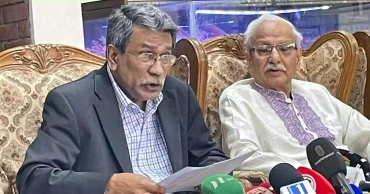
Political parties agree on forming independent police commission: Ali Riaz
Political parties have reached a consensus on the formation of an independent police commission, Vice Chair of National Consensus Commission Prof Ali Riaz said on Sunday.
"So far, there has been a consensus on 12 major issues as part of the ongoing political dialogue and reform discussions," he said.
Speaking at the 19th session of the second round of reform talks, held at the Foreign Service Academy in Dhaka, Prof Riaz also mentioned that progress has been made on seven additional issues, though final agreement on those has yet to be achieved.
Outlining the proposed structure of the Bangladesh Police Commission, he said it will comprise nine members.
The commission will be chaired by a retired judge of the Appellate Division who is not older than 75 years and a retired police officer, under the age of 62 and below the rank of Additional Inspector General, will serve as the member secretary, he added.
Other members will include representatives of the Leader of the House, the Leader of the Opposition, the Speaker and the Deputy Speaker.
The commission will also include a retired government official of at least Secretary rank with experience as a District Magistrate, a judicial officer not below the rank of District Judge or a High Court lawyer with at least 15 years of experience, and a human rights activist with a minimum of 10 years’ practical experience in a registered human rights organisation.
Try to reach decisions over unsettled reform issues soon: Ali Riaz
At least two of the commission members will be women.
Meanwhile, political parties reached a consensus over two reform proposals – one for not allowing anyone to serve as the Prime Minister for more than 10 years in life and another is for forming an independent police commission to ensure professionalism and accountability in the police force.
“We had reached a consensus on one matter but didn’t announce it before. It’s that the Prime Minister will not be allowed to serve more than 10 years in total,” said Prof Ali Riaz.
The NCC Vice Chair expressed the hope that discussions with political parties will be concluded by July 31 and the draft of the national charter will be sent to the parties by the commission on Monday.
Some 30 political parties, including Bangladesh Nationalist Party (BNP), Bangladesh Jamaat-e-Islami and the National Citizen Party (NCP), participated in the second-round dialogue.
1 year ago

Political parties in Bangladesh agree on PM’s term limit, independent police commission
Political parties on Sunday reached a consensus over two reform proposals – one for not allowing anyone to serve as the Prime Minister for more than 10 years in life and another is for forming an independent police commission to ensure professionalism and accountability in the police force.
“We had reached a consensus on one matter but didn’t announce it before. It’s that the Prime Minister will not be allowed to serve more than 10 years in total,” said Prof Ali Riaz, Vice Chair of the National Consensus Commission (NCC), during the 19th session of the second-round reform dialogue with the political parties at the Foreign Service Academy in the capital.
He said the Commission will include this – maximum tenure of a Prime Minister is 10 years – in the National Charter.
Prof Riaz then asked, “Are we all agreed on this? Earlier, Mr Salahuddin Ahmed had placed a condition on this—does that still remain?”
In response, BNP Standing Committee Member Salahuddin Ahmed clarified his party’s position, saying, “We earlier proposed that no one shall remain in the post of Prime Minister for more than 10 years. I had mentioned that if there is no provision for appointments to the constitutional and statutory bodies through a committee, we won’t agree to this.”
Unresolved reform issues must be decided within 10 days: Ali Riaz
"The forum has now agreed to include such a provision in the Constitution for the Election Commission. If similar committees are discussed for appointing other bodies, the same conditions will apply,” he said, adding, “We hope you can consider it. You may announce the 10-year limit. In fact, this was our proposal.”
Earlier in the day, the NCC proposed the formation of an independent police commission aimed at ensuring professionalism and accountability in the Bangladesh Police.
Following discussion, the participating political parties agreed in principle to the formation of such a commission, though they will continue to deliberate on its structure.
Speaking about the matter, Prof Ali Riaz said, “We are in consensus on the formation of a police commission. We’ll continue discussions on its formation process. Bangladesh’s political parties have agreed in talks to establish an independent police commission that will ensure accountability, responsibility, and a people-friendly police service.”
During the placement of the proposal, Prof Riaz said the issue of forming a police commission was not among the original 166 reform proposals sent to political parties for opinion.
“We are not including this issue to waste time,” he said, adding that both political parties and citizens have consistently questioned why the formation of a police commission is not being discussed during the dialogues.
In light of the police’s role during the 2024 July–August uprising and over the past 16 years, this demand for a police commission is legitimate. That’s why, following both formal and informal consultations, the proposal has been brought to the table, he said.
Referendum needed for future changes to caretaker system in constitution: Ali Riaz
This commission will be mandated to address complaints raised by both police personnel and citizens.
A retired police official who served at least as additional IGP will be its member secretary.
The seven other members will be one representative each of the Leader of the House, the Leader of Opposition, the Speaker and the Deputy Speaker, a listed lawyer of the High Court, a human rights activist and a retired police official who served at least as additional IGP.
Of them, only the chairman and the member secretary will be permanent members, while the rest seven members will not receive any salary.
Some 30 political parties, including Bangladesh Nationalist Party (BNP), Bangladesh Jamaat-e-Islami and the National Citizen Party (NCP), are participating in the second-round dialogue.
The NCC aims to finalise a unified position on approximately 20 core reform proposals by July 31 through consensus-building with political parties.
The second round of talks began on June 2, inaugurated by Chief Adviser and Commission Chairman Prof Muhammad Yunus.
The Commission, formed on February 15, 2025 under Prof Yunus’ leadership, was entrusted with building national consensus on key state reforms. It previously held first-round talks with political parties and alliances between March 20 and May 19.
1 year ago

Part of draft National Charter to be sent to political parties Monday: Ali Riaz
The National Consensus Commission is set to send the draft preamble and commitment section of the National Reform Charter to political parties on Monday.
“The Commission has prepared a draft of the National Charter excluding only the agreed reform proposals rather focusing on its other parts like preamble and commitments. This draft will be sent to all political parties tomorrow (Monday) for consideration,” said NCC Vice Chair Prof Ali Riaz on Sunday.
He said this while presiding over the 19th session of the second-round dialogue between the NCC and the political parties at the Foreign Service Academy in the capital.
Ali Riaz said the draft parts of the National Charter will be finalised reflecting the opinions of the political parties.
If there is any major or fundamental objection raised by you (political parties) over any word of the draft text, then it will be discussed here in the forum (dialogue) otherwise it will not, he said, adding that the ongoing dialogue on state reforms must conclude by July 31 under any circumstances.
“We must finish this process (of reform discussion) by July 31 by any means. There is no alternative,” he added.
Three issues — formation of a police commission, fundamental principles of the State and expansion of basic rights of the citizens — are being discussed on Sunday.
State reform dialogue must conclude by July 31: Prof Ali Riaz
The NCC Vice Chair said there has been a consensus on 10 of the eighteen key agenda items discussed so far, although notes of dissent were also recorded in some cases. “Seven other issues have been extensively discussed but not yet resolved. We are close to making decisions on those,” he said.
Mentioning that one of them has been referred to the Commission for a final decision, he said adding that the Commission will announce its decision on that as soon as possible. “Besides, three other reform issues have not been placed for discussion yet.”
Talking about Sunday's agenda, Ali Riaz said three issues have been placed for discussion. Among them, the formation of a police commission is quite a new issue.
Prof Riaz said the issue of forming a police commission was not among the original 166 reform proposals sent to political parties for opinion.
“We are not including this issue to waste time,” he said, adding that both political parties and citizens have consistently questioned why the formation of a police commission is not being discussed during the dialogues.
In light of the police’s role during the 2024 July–August uprising and over the past 16 years, this demand for a police commission is legitimate. That’s why, following both formal and informal consultations, the proposal has been brought to the table, he said.
Prof Riaz said this police commission will ensure the professionalism and competence of police members.
Noting that Sunday's discussion may need to continue till 10pm, he said, “We must wrap up the entire dialogue process by July 31. Only then may we allocate a separate day for signing the national charter.”
According to the NCC proposal, an independent nine-member commission titled Bangladesh Police Commission will be formed under the chairmanship of a retired justice of the Appellate Division of the Supreme Court in a bid to ensure the performance of police members to discharge the lawful duties with competence.
This commission will be mandated to address complaints raised by both police personnel and citizens.
A retired police official who served at least as additional IGP will be its member secretary.
The seven other members will be one representative each of the Leader of the House, the Leader of Opposition, the Speaker and the Deputy Speaker, a listed lawyer of the High Court, a human rights activist and a retired police official who served at least as additional IGP.
Of them, only the chairman and the member secretary will be permanent members, while the rest seven members will not receive any salary.
Some 30 political parties, including Bangladesh Nationalist Party (BNP), Bangladesh Jamaat-e-Islami and the National Citizen Party (NCP), are participating in the second-round dialogue.
The NCC aims to finalise a unified position on approximately 20 core reform proposals by July 31 through consensus-building with political parties.
The second round of talks began on June 2, inaugurated by Chief Adviser and Commission Chairman Prof Muhammad Yunus.
The Commission, formed on February 15, 2025 under Prof Yunus’ leadership, was entrusted with building national consensus on key state reforms. It previously held first-round talks with political parties and alliances between March 20 and May 19.
1 year ago

State reform dialogue must conclude by July 31: Prof Ali Riaz
Vice Chair of the National Consensus Commission Prof Ali Riaz on Sunday said the ongoing dialogue on state reforms must conclude by July 31 under any circumstances.
“We must finish this process (of reform discussion) by July 31 by any means. There is no alternative,” he said while presiding over the 19th-day session of the second-round dialogue between the NCC and political parties at the Foreign Service Academy in the capital.
Three issues — formation of a police commission, fundamental principles of the State and expansion of basic rights of the citizens — are being discussed on Sunday.
The NCC Vice Chair said there has been a consensus on 10 of the eighteen key agenda items discussed so far, although notes of dissent were also recorded in some cases. “Seven other issues have been extensively discussed but not yet resolved. We are close to making decisions on those,” he said.
Mentioning that one of them has been referred to the Commission for a final decision, he said adding that the Commission will announce its decision on that as soon as possible.
Besides, three other reform issues have not been placed for discussion yet, said Prof Riaz.
Talking about Sunday's agenda, he said three issues have been placed for discussion. Among them, the formation of a police commission is quite a new issue.
Reform dialogue resumes; formation of police commission among agenda
Prof Riaz said the issue of forming a police commission was not among the original 166 reform proposals sent to political parties for opinion.
“We are not including this issue to waste time,” he said, adding that both political parties and citizens have consistently questioned why the formation of a police commission is not being discussed during the dialogues.
In light of the police’s role during the 2024 July–August uprising and over the past 16 years, this demand for a police commission is legitimate. That’s why, following both formal and informal consultations, the proposal has been brought to the table, he said.
Noting that Sunday's discussion may need to continue till 10pm, he said, “We must wrap up the entire dialogue process by July 31. Only then may we allocate a separate day for signing the national charter.”
Some 30 political parties, including Bangladesh Nationalist Party (BNP), Bangladesh Jamaat-e-Islami and the National Citizen Party (NCP), are participating in the second-round dialogue.
The NCC aims to finalise a unified position on approximately 20 core reform proposals by July 31 through consensus-building with political parties.
The second round of talks began on June 2, inaugurated by Chief Adviser and Commission Chairman Prof Muhammad Yunus.
Bangladesh's NCC struggles to reach consensus on key reform issues
The Commission, formed on February 15, 2025 under Prof Yunus’ leadership, was entrusted with building national consensus on key state reforms. It previously held first-round talks with political parties and alliances between March 20 and May 19.
1 year ago