LA fire
Delayed emergency alerts failed Los Angeles residents during wildfires
Government emergency alert systems are designed with a simple purpose: to provide residents with critical information about nearby hazards and safety instructions, reports AP.
However, as seen in the devastating Los Angeles wildfires and other emergencies, these alerts depend on a complex communication chain involving first responders, government officials, third-party companies, and the public.
At times, this system fails.
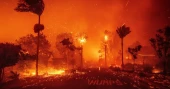
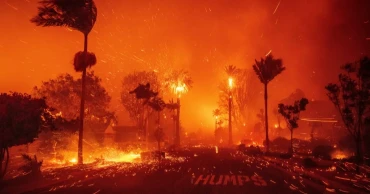
When powerful winds ignited wildfires in Southern California on Jan. 7, evacuation orders for certain neighbourhoods—particularly the part of Altadena where most fatalities occurred—were issued long after houses had already caught fire. On Tuesday, Los Angeles County officials authorised an external review of the alert system’s performance during the Eaton Fire and Palisades Fire in response to residents’ concerns. City authorities refused to answer AP’s inquiries about delays in some Palisades Fire alerts, though Fire Captain Branden Silverman noted that assessing a fire and determining evacuation protocols can take time.
Progress made on huge fire north of Los Angeles while new fires erupt in Southern California
This problem is increasingly common. After-action reports and investigations have identified failures in alert systems in other major fires: the 2017 Tubbs Fire, which claimed 22 lives in Santa Rosa; the 2018 Camp Fire, which resulted in 85 deaths in Paradise; the Woolsey Fire, which broke out the same day and killed three in Malibu; Colorado’s 2021 Marshall Fire, which destroyed over 1,000 homes near Denver; and Hawaii’s 2023 Lahaina Fire, which devastated the historic town and killed 102 people.
It may take months to determine why some evacuation orders were delayed during the Los Angeles wildfires.
Several residents who lost their homes in the Eaton Fire told The Associated Press they never received any notifications about their area. For others, the first warning came as a frantic text message in the middle of the night.
Susan Lee Streets, who had registered for the Nixle alert app, did not receive any alerts specific to her West Altadena neighbourhood before she and her family evacuated on their own around 10 p.m. after losing power and mobile service.
“If we had been informed that houses and other structures were burning, we would have understood the gravity of the situation,” she said. “We almost went to bed that night with two kids, a dog, and two cats in the house.”
Her phone finally received an alert after 3 a.m. By then, her home—and irreplaceable family heirlooms, including her children’s Christmas ornaments—had been reduced to ashes.
“We lost everything. Absolutely everything,” Streets said, her voice breaking.
Tricia Wachtendorf, director of the Disaster Research Center at the University of Delaware, emphasised that alerts must be clear and specific. Research has shown that for alerts to be effective, people must hear, understand, believe, personalise, and confirm them before taking action.
“Sending a message at 3 a.m. doesn’t guarantee that someone will hear it,” Wachtendorf said.
The period between midnight and 3:30 a.m. was particularly difficult for first responders in Los Angeles County, according to an AP review of scanner traffic recordings and data from CalFire, FEMA, and the Watch Duty app.
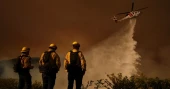
Resources were stretched thin, and hurricane-force winds had grounded aerial firefighting support, making it harder for authorities to assess the fire’s spread from above.
Emergency calls reporting burning homes flooded in as embers ignited rooftops and gardens. During a 30-minute window, firefighters were dispatched to 17 new addresses while some crews ran dangerously low on fuel.
By 12:07 a.m., CalFire records showed that dozens of neighbourhoods east of Altadena’s North Lake Avenue had been ordered to evacuate due to the Eaton Fire. However, no warnings had been issued for the western areas—where all 17 confirmed fatalities occurred—even though house fires had been reported there more than an hour earlier, as first reported by the Los Angeles Times.
Over the next three hours, firefighters shifted from requesting reinforcements for the eastern edge of the fire to urgently notifying command that the flames were spreading west along the foothills near Sunset Ridge.
At 3:30 a.m., evacuation orders were significantly expanded, with residents in 12 Altadena neighbourhoods and beyond told to “leave now.”
Jodi and Jeff Moreno first learned about the fire from a neighbourhood app. The first official warning they received came around 2:30 a.m., when authorities shouted through a bullhorn instructing them to evacuate. They quickly gathered their three daughters, their dog, and essential documents before fleeing.
They received no text alerts until after they had left.
“On the neighbourhood apps, some people were leaving, while others were staying. There was a wide range of responses. We had to figure things out on our own,” Jodi Moreno said. “It was hard to determine exactly where the fire was and where embers were landing… That’s the kind of information we expect from authorities.”
Desperate for updates, both the Morenos and Streets downloaded the Watch Duty app, which consolidates evacuation maps and real-time information from multiple sources. Since launching in 2021, the app has expanded to cover 22 states and became an essential tool for many residents.
“The best warning system is one that actually informs people,” said Nick Russell, vice president of operations at Watch Duty.
Over 50,000 under evacuation orders or warnings as wildfire imperils homes north of Los Angeles
“There is a necessary process in issuing official evacuation warnings, orders, or shelter-in-place instructions,” he added. “But transparency is key—people need to understand why those discussions are happening between law enforcement and fire officials. That’s what we provide.”
The process of issuing evacuation orders begins when firefighters or other personnel on the ground recommend action, Russell explained. The decision then moves up the chain of command until the sheriff’s office officially issues an order.
During major emergencies, communication can be hindered by factors like poor radio signals, wind noise, or technical issues. Incident command centres may struggle to process vast amounts of data from different agencies, making it difficult to grasp the full scope of a disaster like a wildfire.
In Los Angeles County, residents who sign up for emergency alerts through the AlertLACounty website are directed to a list of 57 links to local or city-specific alert systems, along with a general one covering 19 cities. The city of Los Angeles and the Sheriff's Department also operate their own alert services.
It remains unclear how these overlapping systems, which use different software, integrate with each other—or whether officials coordinate their alerts effectively.
A 2024 Hazard Mitigation Plan instructed the city’s Emergency Management Department to identify gaps in alert systems in areas with poor mobile coverage and implement a solution. However, this objective was assigned only a “medium” priority and a long-term timeline, with completion expected within the next decade.
Meanwhile, the county’s Hazard Mitigation Plan—last updated in 2020—did not prioritise emergency alerts or public notifications. Instead, its primary objectives focused on educating residents about how wind increases wildfire risk and improving community wildfire protection efforts.
Officials at the County’s Coordinated Joint Information Center declined to comment, stating only that an independent review of evacuations and emergency notifications is planned. The Office of Emergency Management, County Fire Department, and Sheriff’s Department have committed to fully participating in the review.
1 year ago
Trump criticises California water policy before touring LA
As President Donald Trump prepares to visit areas affected by wildfires in California, he is once again focusing on one of his regular targets for criticism: the state’s water policy.
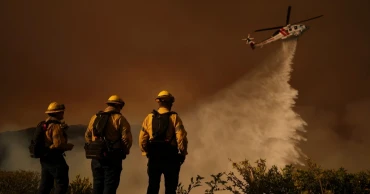
Since the fires began on January 7, Trump has used social media and interviews to accuse the state of sending excessive amounts of water to the Pacific Ocean, rather than directing it south toward Los Angeles. He also pointed out that some hydrants ran dry during the early hours of the firefighting efforts in Pacific Palisades, reports AP.
Progress made on huge fire north of Los Angeles while new fires erupt in Southern California
Early in his second term, Trump urged federal officials to create plans to redirect more water to California’s Central Valley, an area with abundant crops, as well as to southern cities. A few days later, he threatened to withhold federal disaster assistance unless state leaders changed their water management strategy.
This article looks at the facts behind Trump’s comments and the extent of presidential influence over California’s water policies:
Where does Southern California’s water come from?
California's water is largely sourced from the north, while its population is mainly located in the drier southern region. Los Angeles, the nation’s second-largest city, relies on water from external sources. The Central Valley, which is relatively dry, contains fertile land where much of the country's fruits and vegetables are grown.
Two systems of dams and canals transport water from northern rain and snowmelt to the south. The federal government operates the Central Valley Project, while the state manages the State Water Project. Both systems channel water through the Sacramento-San Joaquin River Delta, an estuary crucial for fish and wildlife such as salmon and the endangered delta smelt, a species Trump has shown interest in.
Southern California’s water supply is split between local sources like groundwater, and state and federally managed systems, including the Colorado River. The Los Angeles Department of Water and Power also manages aqueducts that draw water from the Sierra Nevada.
What power does Washington have over California’s water?
Federal officials manage how much water is allocated to the delta to protect endangered species and to users of the Central Valley Project, mostly farms. This project does not supply water to Los Angeles. Both state and federal officials typically coordinate on water distribution, with the goal of maintaining water flow through the delta to support the ecosystem.
However, Trump and others argue that the state allows too much water to flow into the ocean, rather than redirecting it to cities and farms.
What actions has Trump taken regarding California’s water policy in the past?
During his previous administration, Trump allowed more water to be redirected from the delta to the Central Valley, a move opposed by environmental groups who claimed it would harm endangered species. California Governor Gavin Newsom filed a lawsuit, arguing that the policy would drive endangered fish species to extinction, including the delta smelt, chinook salmon, and steelhead trout.
Under President Joe Biden, new regulations were introduced in December, which environmental groups claimed offered some improvements over Trump’s first set of rules.
What is Trump’s stance now?
Trump continues to criticize California’s water management. On his Truth Social platform, he recently attacked the state for diverting millions of gallons of water to the Pacific Ocean, instead of using it for towns, cities, and farms across California.
Such comments have been welcomed by farmers and water managers in the Central Valley, who feel federal water allocations have been too limited over the past two years, despite a period of heavy rainfall in 2023 that helped the state recover from drought. However, dry conditions are returning to central and southern California.
Trump has now instructed the federal government to again redirect more water to farmers and cities.
How does this relate to the Los Angeles fires?
Not much. The ongoing debate about farms versus fish is a well-established issue in California’s water politics and does not always follow partisan lines. Some environmentalists argue that Newsom is too accommodating to farming interests, but this debate is not related to the water issues faced during the Los Angeles wildfires.
Over 50,000 under evacuation orders or warnings as wildfire imperils homes north of Los Angeles
Trump has suggested that state officials should “turn the valve” to provide more water to the city, but the state’s water supplies are not responsible for the hydrant shortages or the near-empty Santa Ynez Reservoir during the fire fight.
The hydrants failed because they were overstressed, and the reservoir was empty due to maintenance. Newsom has called for an investigation into how the Los Angeles Department of Water and Power handled these issues.
According to the Metropolitan Water District of Southern California, the region has enough water in storage to meet around three years of demand. Interim General Manager Deven Upadhyay affirmed, "We can deliver what our agencies need."
If the federal government decides to allocate more water, it may not benefit Los Angeles. Without coordination between state and federal systems, increasing federal water draw could lead California to reduce its own water allocations to protect the delta, Upadhyay added.
1 year ago